


roadmap.sh vs Other Developer Learning Platforms: Which One Actually Gets You Hired?

Praveen Kumar
The Real Problem With Learning to Code in 2026
Here is a scenario every developer has lived through: you enroll in a course, finish 80% of it, build the instructor's todo app, and then sit down to get a job — and realize you have no idea what to actually learn next.
The course taught you React. But the job posting also wants TypeScript, REST APIs, Git, testing, Docker, and system design. Nobody told you in what order to learn these things, or even that they all existed.
This is the gap that roadmap.sh was built to fix. But is it better than the alternatives? Let's break it down.
What Is roadmap.sh?
roadmap.sh is a community effort to create roadmaps, guides, and other educational content to help guide developers in picking up a path and guide their learnings.
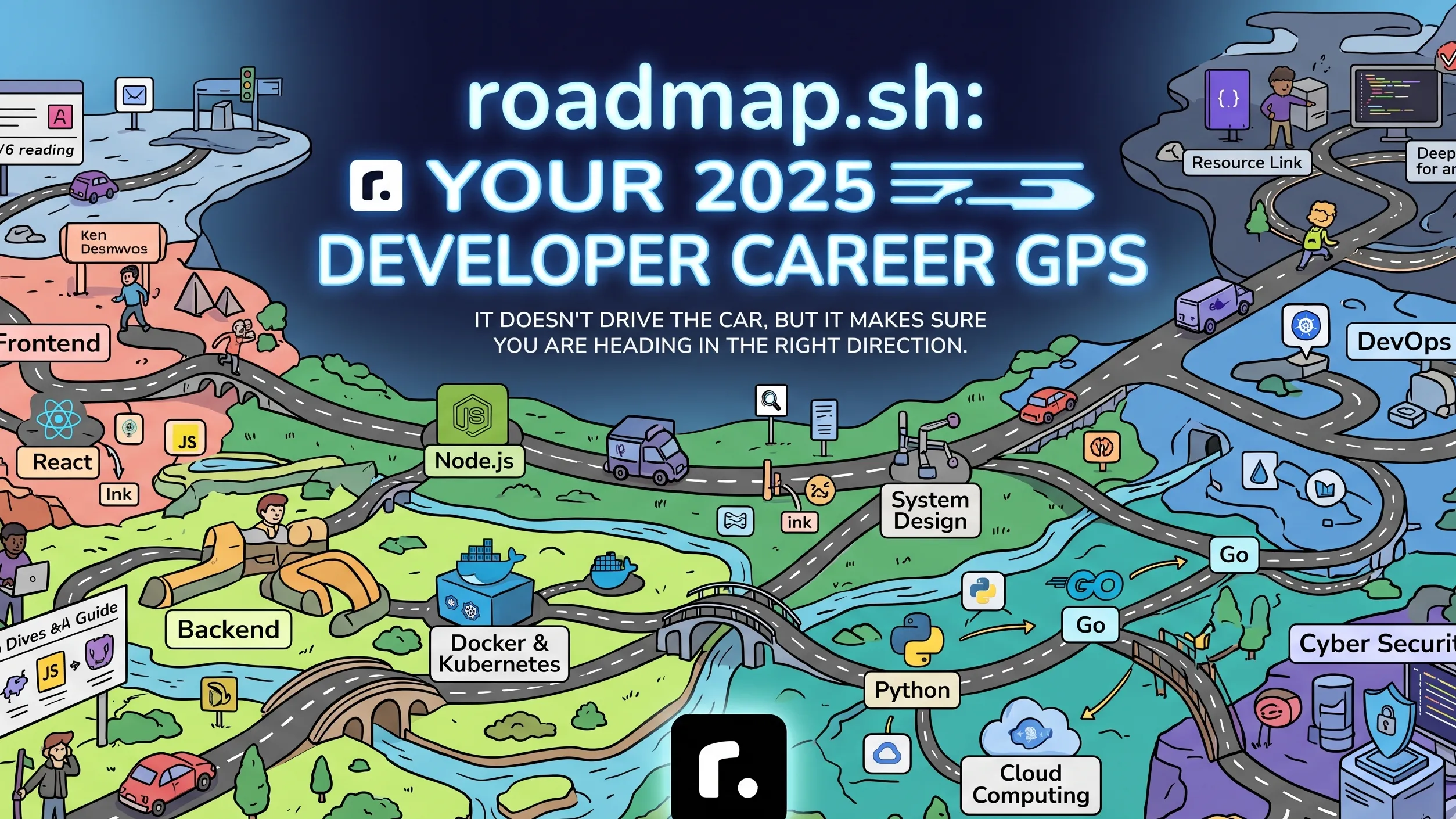
It does not teach you directly. It tells you what to learn, in what order, and links you to the best resources for each topic. Think of it as a GPS for your developer career — it doesn't drive the car, but it makes sure you are heading in the right direction.
As of 2026, it covers role-based paths like Frontend, Backend, Full Stack, DevOps, AI Engineer, and Cyber Security, plus skill-based deep dives into React, Node.js, Docker, Kubernetes, System Design, and dozens more.
Platform-by-Platform Breakdown
1. roadmap.sh — The Career GPS
Best for: Developers who know how to self-direct and want to avoid wasted learning.
roadmap.sh does one thing exceptionally well: it shows you the complete picture before you start. Instead of following a course's arbitrary curriculum, you see the entire skill tree for your chosen role — all the technologies, in dependency order, with clear markers for what is essential vs. optional.
Recent additions like an AI Tutor, interactive project ideas, and best-practice guides have made it far more than a static diagram. The roadmaps are maintained by the community and updated regularly, which means they reflect what the industry actually hires for — not what was relevant five years ago when a course was recorded.
Limitations: It does not teach you. If you lack the discipline to find and follow external resources on your own, you will feel lost. It is a map without a vehicle.
Verdict: Irreplaceable as a planning tool. Zero substitutes for this specific purpose.
2. Udemy — The Largest Course Marketplace
Best for: Beginners who need hand-holding and structured video instruction.
Udemy has thousands of developer courses, often purchasable for under ₹500 during sales. Instructors like Maximilian Schwarzmüller and Colt Steele have built genuinely excellent content for beginners.
The core problem is curriculum drift. A course you buy today may have been recorded in 2021 and only partially updated. You have no way of knowing, mid-course, whether what you are learning reflects current industry practice or legacy patterns. There is also no structured learning path — one course ends and then you have to figure out what to buy next, often leading to course-hopping without real depth.
Another issue: Udemy courses optimize for completion and ratings, not for job readiness. Finishing a 40-hour course feels productive but does not mean you can build production software.
Verdict: Good entry point for beginners. Weak at helping you build a coherent, job-ready skill set without external guidance.
3. freeCodeCamp — The Free Full Curriculum
Best for: Self-starters who want a free, structured path through the fundamentals.
freeCodeCamp offers a completely free, browser-based curriculum that takes you from HTML basics through responsive design, JavaScript algorithms, frontend libraries, APIs, databases, and Python. You earn certifications along the way, and the projects are genuinely portfolio-worthy.
What freeCodeCamp does brilliantly is remove all friction. No setup, no cost, no decision fatigue. You just start and follow the path.
The limitation is scope. freeCodeCamp's curriculum is thorough for web fundamentals but does not cover DevOps, cloud infrastructure, system design, testing practices, or the deeper backend patterns that senior engineering roles require. You can get your first job from freeCodeCamp. You cannot use it alone to become a strong mid-level or senior engineer.
Verdict: Excellent for the first 6–12 months of learning. Pairs very well with roadmap.sh to know where to go after you finish.
4. Coursera / edX — University-Backed Credentials
Best for: Professionals who need formal credentials for corporate environments or career changers who want structured pacing.
Coursera and edX bring university and big-tech brand credibility. Google, IBM, Meta, and Stanford offer certificates that carry genuine weight in some hiring contexts — particularly in enterprise, government, or roles where a credential is part of a checklist.
The content quality is high for theoretical foundations — algorithms, machine learning math, system design principles. The pacing, however, is designed for academic semesters, not career pivots. Courses move slowly, often get abstract without practical application, and are expensive if you are pursuing a full specialization without financial aid.
For pure web development, Coursera is overkill. For data science, ML, or roles requiring academic-style knowledge, it can be worth it.
Verdict: Justified for specific career paths. Overkill for most web developers.
5. The Odin Project — The Hidden Gem
Best for: Developers who want a rigorous, project-first full-stack curriculum at zero cost.
The Odin Project is the most underrated resource in this list. It is a free, open-source curriculum that takes you from complete beginner to a solid junior full-stack developer, covering HTML/CSS, JavaScript, Git, Node.js, databases, and React — all through project-based learning where you build real things from scratch.
Unlike Udemy courses, it does not hand you code to type along with. You are given a goal, given context, pointed to documentation, and expected to figure it out. This is uncomfortable. It is also exactly how professional development works.
The limitation is that it ends. After The Odin Project, you have a strong foundation, but no clear path to specialize in DevOps, system design, or a specific stack. This is precisely where roadmap.sh picks up.
Verdict: Best free curriculum for getting to junior level. Pairs perfectly with roadmap.sh for what comes next.
Head-to-Head Comparison
| Feature | roadmap.sh | Udemy | freeCodeCamp | Coursera | The Odin Project |
|---|---|---|---|---|---|
| Cost | Free | ₹499–₹3,000/course | Free | Free–₹3,000/month | Free |
| Teaches directly? | No (guides only) | Yes | Yes | Yes | Yes |
| Career path clarity | Excellent | Poor | Moderate | Moderate | Good |
| Content freshness | Community-updated | Varies by instructor | Regularly updated | Varies | Actively maintained |
| Practical projects | Project ideas included | Instructor projects | Portfolio projects | Assignments | Build-from-scratch |
| Depth for seniors | Full career coverage | Limited | Limited | Strong for ML/CS | Junior-focused |
| Self-discipline required | Very high | Low-Medium | Medium | Low-Medium | High |
| Best stage | All stages | Beginner | Beginner–Intermediate | Intermediate–Advanced | Beginner–Intermediate |
The Honest Recommendation: Use All of Them Together
The mistake developers make is treating these as competitors. They are not. They are complementary layers of a learning system.
Here is the approach that actually works:
Step 1 — Orientation (Day 1): Open roadmap.sh and read the full Backend or Frontend roadmap for your target role. Do not start learning yet. Just understand the complete landscape. Know what exists.
Step 2 — Foundation (Months 1–6): Use freeCodeCamp or The Odin Project for structured, free learning. Build the fundamentals properly without spending money.
Step 3 — Depth (Months 6–12): When you hit a specific technology you need to go deep on — say, React, Node.js, or Docker — pick a targeted Udemy course from a verified instructor. Use roadmap.sh to confirm which technology to study next.
Step 4 — Credentials (Optional): If your target role or employer values them, add a Google or IBM Coursera certificate in your specific domain.
Step 5 — Career Growth (Ongoing): Keep roadmap.sh open as your ongoing career reference. Every 6 months, revisit where you are on the map and identify your next skill gap.
Why roadmap.sh Deserves Its Own Category
Most educational platforms sell you a product. roadmap.sh solves a meta-problem: knowing what to learn.
This distinction matters far more than it sounds. The developers who stagnate are not the ones who stop coding. They are the ones who keep learning the wrong things in the wrong order. They spend six months going deep on a technology that is either unnecessary for their goals or something they should have learned two steps later.
roadmap.sh is the only resource that puts the full career map in front of you before you take a step. Nothing else does this. For that reason alone, it belongs in every developer's toolkit regardless of what else they use.
Final Verdict
If you could only bookmark one resource for your developer career, bookmark roadmap.sh. Not because it teaches the most, but because it ensures that everything else you learn is in service of a coherent destination.
Start with the roadmap. Fill in the gaps with freeCodeCamp, The Odin Project, and targeted Udemy courses. Add Coursera if your career path requires credentials. Return to roadmap.sh every time you wonder what to learn next.
The developers who grow fastest are not the ones who consume the most content. They are the ones who always know exactly what they need to learn next — and why.
Published by APXTECK — IT Solutions & Digital Growth Partner for Indian Businesses.
We help SMBs build web platforms, rank on search, and automate operations. Explore our services → https://www.apxteck.com/services
Article Comments
You must be signed in to post comments.
Sign In to Join the Discussion →No comments approved yet. Be the first to share your thoughts!
About the Author

Praveen Kumar
Software Developer
Professional engineers crafting clean code architectures and visual portfolios for SMBs.
Related Insights

UPI MDR Is Back — Ashneer Grover Is Half Right | APXTECK

Amodei Wants to Slow AI. Indian SMBs, Read This First | APXTECK

How Blinkit's Free Ambulance Became Its Best Marketing Move

GPT-6 Astra: OpenAI’s New AI Model Could Change Software Development and Business Work

AI-Powered Cyberattacks Are Rising: Why Every Business Needs Stronger Cybersecurity Now

How Next.js and Generative Search Help Builders Win Leads

Build Your Own Food Delivery App: Stop Giving Your Profits to Swiggy & Zomato