


GPT-5.6 vs Grok 4.5 vs Claude Fable 5 — I Built the Same GTA Game With All Three. Here Is the Honest Result.

Praveen Kumar
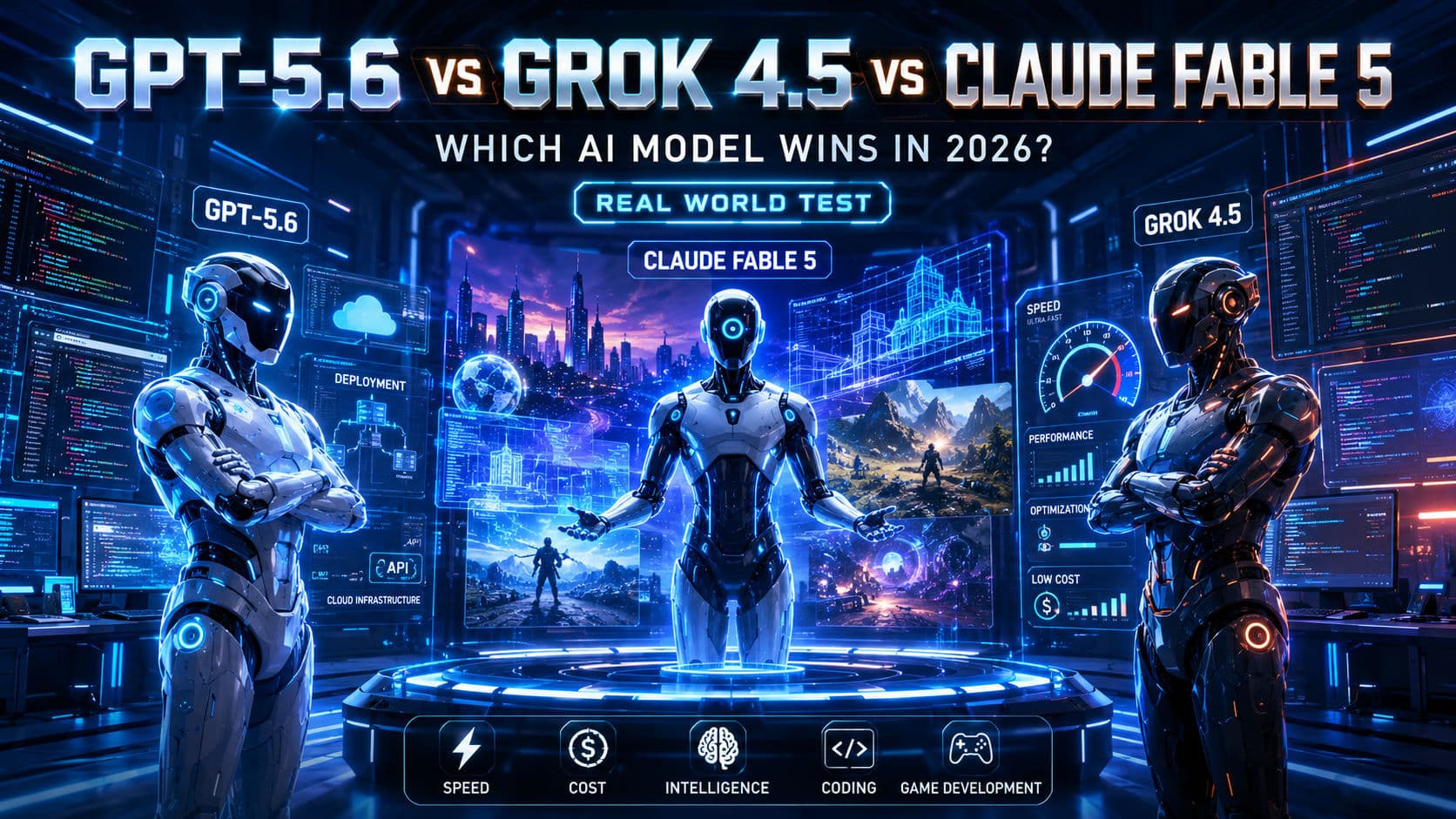
One Week Changed Everything
In nine days between late June and early July 2026, three of the world's most powerful AI labs each launched a major new model. OpenAI previewed the GPT-5.6 family on June 26 and pushed it to general availability on July 9. xAI launched Grok 4.5 on July 8. Anthropic had already released Claude Fable 5 on June 9 — though it was briefly suspended on June 12 under US government export controls and restored globally on July 1.
Three flagship models from three of the most well-funded AI labs in the world, all within nine days. The question every developer immediately asked was the same: which one do I actually use?
The honest answer is that it depends entirely on what you are building and what you are willing to spend. And the gap between the right answer and the wrong answer is large enough to matter significantly to your monthly API bill.
What Each Model Actually Is
Before any comparison, the basics.
Claude Fable 5 is Anthropic's most capable widely released model as of July 2026. It sits above Claude Opus 4.8 and targets long-horizon, complex, open-ended projects where quality is the primary constraint and cost is secondary. It costs $10 per million input tokens and $50 per million output tokens — the most expensive of the three by a significant margin.
GPT-5.6 is a three-tier family from OpenAI. Sol is the flagship at $5 input and $30 output per million tokens, designed for the hardest reasoning, coding, and professional agent workloads. Terra sits in the middle at $2.50 and $15. Luna is the budget tier at $1 and $6 — fast, efficient, and designed for high-volume tasks where the plan is already clear. The Codex environment inside ChatGPT ties these models together with agentic building, live deployment, and tool integration across the full OpenAI ecosystem.
Grok 4.5 is xAI's most capable model, launched July 8 and trained in close collaboration with Cursor — the AI coding editor. It costs $2 per million input tokens and $6 per million output, making it the cheapest frontier model in the current market. It runs at approximately 80 tokens per second — faster than both Fable and Sol — and uses significantly fewer tokens per task than the competition.
The Game Test — Same Prompt, Three Builds
The clearest way to understand what separates these models is not benchmarks — it is watching them build something from a single sentence.
The prompt was identical for all three: build a GTA-style game, get it to feature parity, test it yourself, and fix your own bugs.
Grok 4.5 produced a game called Metro Rush. Cars, police, a wanted level system — the foundational elements were present. But the execution showed the model's current limitations: slow frame rates, laggy movement, and significant back-and-forth required before the core loop worked reliably. It was a starting point more than a finished product.
GPT-5.6 built Neon Burrow using Three.js. This was a genuine step up — a proper open world where the player could walk around, enter and exit vehicles, and trigger a five-star wanted system that responded dynamically to player behavior. The world held together coherently and the game logic was sound. GPT-5.6 also pushed its version to a live shareable link directly from ChatGPT — a meaningful practical advantage for anyone who wants to share a build with a client or colleague without managing hosting.
Claude Fable 5 produced Apex City. The technical implementation was comparable to GPT's Neon Burrow — open world, vehicles, police response. But the detail that separated it was environmental: the lighting shifted dynamically into a sunset as you drove through the city, changing the entire mood of the scene. The vehicle physics felt more grounded. The world felt more real in a way that is difficult to specify technically but immediately noticeable experientially.
Round one on visual and environmental quality went to Fable — though GPT's live deployment advantage made it a meaningful trade-off rather than a clear win.
The Minecraft Test — Where Sound Changed Everything
The second test was a Minecraft clone, same single-prompt approach across all three.
Grok produced something called Vaultcraft — visually recognizable as Minecraft, with correct block aesthetics and world structure. But critical gameplay elements were missing: mobs could not be killed, sheep did not spawn, water was absent. The visual impression was right; the gameplay experience was not.
GPT-5.6's Minecraft felt genuinely close to the original. Trees could be chopped and dropped blocks correctly. The physics behaved properly. A live weather system ran rain and clear sky cycles while you played. It was a working game, not just a visual approximation.
Fable's version added something neither of the others had: sound. When a mob was hit, you heard it. The mob turned and fled. Water flowed audibly. Sand had texture. The gap between non-invasive methods and surgical implants in this domain continues to narrow — and in this case, the gap between "working game" and "game that feels like a game" came down to audio. It was the first AI-built interactive environment with spatial sound that felt like the game it was referencing rather than a technical approximation of it.
Round two again went to Fable on experience, with GPT competitive on gameplay mechanics. Grok was the starting point both others had already moved past.
The Apple Ad Test — Where the Gap Was Widest
The third test was the most revealing. The prompt was not a game — it was a 30-second iPhone 18 launch film in the style of a real Apple advertisement, built as a single HTML file using Three.js. The same mood board reference images were provided to all three.
Grok attempted it — reshaped the phone body and port design, animated the sequence — but the result did not read as an Apple advertisement. The attempt was evident; the execution did not land.
GPT-5.6 studied the reference images carefully, matched the lens and body details precisely, and held the Apple aesthetic through the animation. It was genuinely close. A polished technical execution that communicated the right brand language.
Fable's version showed all four phones simultaneously with precise material reflections — the way glass and aluminum catch light, the specific quality of the illumination that Apple's own motion team obsesses over. This was one HTML file, no video editor, no After Effects, no render farm. An AI wrote a thirty-second brand film as a web page, and it looked like something Apple would actually publish.
On this test, the gap was the widest of the three rounds — and it was the most commercially significant result, because it demonstrated that Fable's quality advantage is not abstract benchmark performance. It shows up in the kind of creative and visual work that clients actually pay for.
The Real Numbers: What Each Model Costs at Scale
The game tests reveal quality differences. The pricing table reveals when those differences actually justify the cost.
| Model | Input per 1M tokens | Output per 1M tokens | Per agentic task |
|---|---|---|---|
| Claude Fable 5 | $10 | $50 | $11.80 |
| GPT-5.6 Sol | $5 | $30 | $5.07 |
| Grok 4.5 | $2 | $6 | $2.49 |
Per task, Grok 4.5 in Grok Build costs $2.49, compared to $5.07 for GPT-5.5 in Codex and $11.80 for Fable 5 in Claude Code. That is a nearly five-to-one cost difference between the cheapest and most expensive option for the same category of task.
Grok 4.5 also averages just 1.9 million tokens per task, far less than GPT-5.5 (6.2M) and Fable 5 (7.2M) — meaning it is not just cheaper per token, it uses fewer tokens to complete the same work. This matters for Indian developers and startups where monthly API costs compound directly against tight budgets.
For an Indian startup running 1,000 agentic coding tasks per month: Grok costs approximately ₹2.09 lakh. GPT-5.6 Sol costs approximately ₹4.26 lakh. Fable 5 costs approximately ₹9.91 lakh. The quality difference is real. Whether it is worth a 4.7x cost premium depends entirely on what you are building.
The Benchmarks Behind the Builds
The game tests are illustrative. The benchmarks give the structural picture.
Vendor figures show Fable 5 ahead on the hardest coding tests, scoring 80.4% on SWE-Bench Pro against 64.7% for Grok 4.5. That fifteen-point gap on the hardest public software engineering benchmark is the largest lead any model has held on that test since the original SWE-Bench saturated. On long-horizon, multi-file, complex repository work — the kind of problem that takes a senior engineer hours — Fable's advantage is measurable and consistent.
Flip to DeepSWE 1.1 and the order inverts: Sol takes it at 72.7% with Fable at 69.7% and Grok back at 53%. On tight tool loops, shell fluency, and terminal-based agentic tasks, GPT-5.6 Sol leads. On independent intelligence ranking, the top three pack inside six points: Fable at 59.9, Sol at 58.9, Grok at 54. The intelligence gap between the best and the best value has never been narrower at the frontier.
There is one important caveat on Grok. Accuracy on the AA-Omniscience Index rose from 35 to 52 percent, but the hallucination rate jumped from 25 to 54 percent too. Grok 4.5 knows more and is more confident — but it is also more confidently wrong more often. For production applications where factual accuracy matters, this is a real constraint that the benchmark headline numbers do not capture.
The New ChatGPT App — What Actually Changed
Beyond the model itself, OpenAI rebuilt the ChatGPT application around two modes: Work and Codex.
Work is for getting things done — presentations, files, research, planning, and automating routine tasks. Codex is the builder — apps, tools, features, and bug fixing. The distinction is designed to make the model's capabilities accessible to non-developers. You do not need to understand code to use Codex mode; you need to describe what you want built.
The effort dial — Light, Medium, High, Extra, Ultra — controls how much compute and reasoning the model applies to each task. Ultra is the most expensive and most capable; Light is fast and cheap. The approval setting controls how much autonomy the agent gets: check with me at every step, or approve for me and handle everything except genuinely risky operations.
The live deployment feature — /sites — is the most practically useful addition for developers building client-facing work. You build something in Codex, type /sites, and it deploys to a live URL that can be shared immediately. No local server, no hosting configuration, no domain management. A client can see a working prototype within seconds of it being built.
Claude has rebuilt its app too — with Chat, Cowork, and Code sitting side by side. Cowork is the equivalent of Work mode — agentic task execution without requiring code knowledge. Claude Code is the equivalent of Codex — the building environment for developers.
The Honest Verdict for Indian Developers
July 2026 is a triangle. One corner is peak quality: Fable 5, priced like the premium product it is. One corner is platform depth: GPT-5.6 Sol, with Codex, multi-agent tooling, and the deepest integration surface in the industry. One corner is efficiency: Grok 4.5, where frontier-adjacent quality costs pocket change and runs fast.
No vendor is trying to win all three corners. Picking the right model means knowing which corner your work actually lives in.
Use Claude Fable 5 when quality is the primary output — visual work, brand-level creative, complex multi-file engineering problems, or long-horizon research where a wrong answer costs more than the token premium. The GTA sunset, the Apple ad lighting, the Minecraft sound — these were not accidents. Fable consistently produces the output that requires the least post-processing to be client-ready.
Use GPT-5.6 Sol when you need platform depth and live deployment. The /sites feature alone is worth significant time saved for any developer presenting work to clients. Sol's terminal and shell performance makes it the right choice for agentic coding tasks that require tight tool loops. The OpenAI ecosystem integration — Google Calendar, GitHub, Notion, Figma, Canva — is the widest of any model in this comparison.
Use Grok 4.5 when cost is a real constraint and the task does not require Fable-level polish. For high-volume coding assistance, documentation generation, structured data work, and anything where you are running thousands of tasks per month, Grok's 4.7x cost advantage over Fable compounds into genuinely significant monthly savings. The hallucination risk means it is not the right choice for factual, customer-facing, or compliance-sensitive applications — but for developer-facing technical work, it is the most efficient frontier model available.
The practical stack for Indian developers: Grok 4.5 for volume. GPT-5.6 Terra for everyday production work. Fable 5 for the problems nothing else solves.
This is not a choice you make once. It is a routing decision you make per task — and the developers who build that routing logic into their workflows will spend dramatically less on AI infrastructure than those who pick one model and apply it to everything.
Published by APXTECK — AI Integration and Full-Stack Development for Indian Developers and SMBs. We help Indian businesses integrate the right AI models, build production-ready platforms, and ship faster without overpaying. Talk to us about your AI stack →
Article Comments
You must be signed in to post comments.
Sign In to Join the Discussion →No comments approved yet. Be the first to share your thoughts!
About the Author

Praveen Kumar
Co-Founder & DirectorFull-Stack Developer, APXTECK
Praveen Kumar is the Founder and Full-Stack Developer at APXTECK, an AI-powered IT agency helping Indian SMBs grow through web development, automation, and AI integration. He builds production-grade systems using Node.js, Next.js, PostgreSQL, and modern AI APIs. When he is not shipping code, he is writing about practical technology that actually works for Indian businesses.
Related Insights

The 3 Careers That Will Pay the Most in 2026–2030 — AI, Quantum, and the End of Engineering Silos

OmniRoute: The Free Open-Source Tool That Connects Claude Code, Cursor, and Codex to 1.6 Billion Free Tokens Every Month

How to Grow Your Business: The 4 Powerful Growth Strategies Explained

Microsoft's Record 570 Security Fixes: What Every Business and IT Team Should Learn About Modern Cybersecurity

Sonam Wangchuk Hunger Strike LIVE: CJP Announces Mass Hunger Strike on July 16, Peaceful Parliament March Planned for July 20

What Developers Can Learn from Recent Grok AI Repository Upload Reports

Mandatory Certificates and Registrations Every Indian Startup Needs in 2026