


What Developers Can Learn from Recent Grok AI Repository Upload Reports

APX Teck
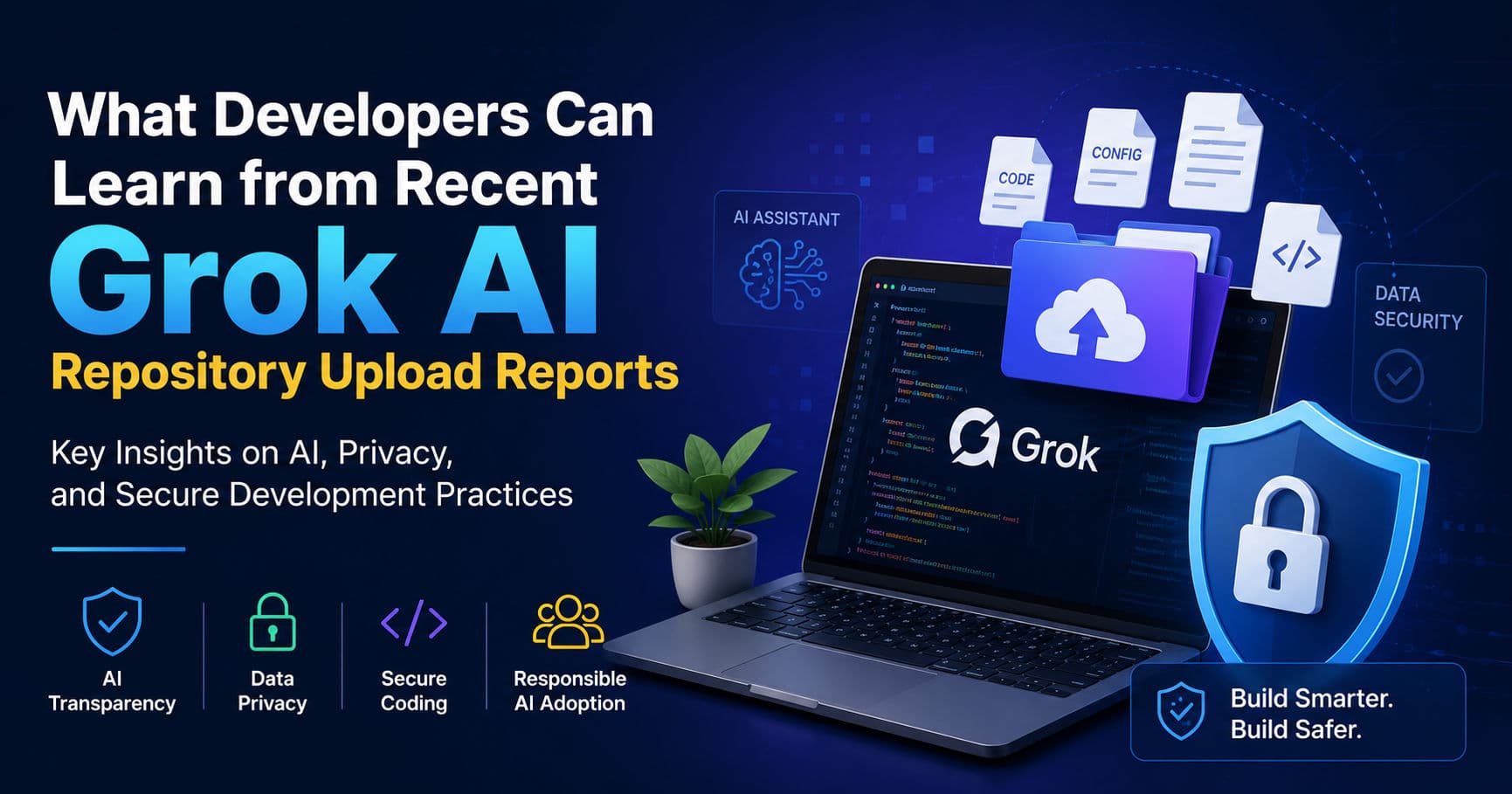
What Developers Can Learn from Recent Grok AI Repository Upload Reports
Artificial Intelligence is changing software development faster than ever before. From writing code and fixing bugs to generating documentation and reviewing pull requests, AI-powered coding assistants have become valuable tools for developers across the world. They help teams save time, improve productivity, and focus on solving real business problems instead of repetitive programming tasks.
As these tools become more capable, developers are also becoming more conscious about one important question: What happens to the data we share with AI?
That question recently gained significant attention after reports suggested that Grok Build, an AI coding assistant developed by xAI, may have transmitted more repository data than some users expected during certain coding tasks. Although the company responded quickly and Elon Musk announced that previously uploaded data would be deleted, the discussion highlighted an important issue that extends beyond a single AI platform.
Whether you are an independent developer, a startup founder, or part of a large enterprise engineering team, the real takeaway isn't just about one tool—it's about understanding how AI coding assistants interact with your development environment and how you can protect sensitive information while benefiting from AI-driven productivity.
Why This Matters to Every Developer
Modern software repositories contain much more than application code. A typical Git repository often includes deployment scripts, environment configurations, infrastructure files, internal documentation, API integrations, and business logic that represent months or even years of development effort.
For many organizations, these repositories are among their most valuable digital assets.
Imagine spending months building an innovative product only to realize that your development tools may be accessing more project data than you initially understood. Even if there is no malicious intent, developers naturally want complete transparency about what information is being processed and why.
This is exactly why discussions around AI privacy have become increasingly important.
The recent Grok reports have reminded the software community that while AI can dramatically improve productivity, security and transparency should always remain top priorities.
Understanding the Reported Issue
According to publicly available reports, researchers observed that certain interactions with Grok Build appeared to transmit larger portions of tracked project repositories than expected during testing. The reports quickly gained attention because software repositories frequently contain confidential business information beyond source code.
These repositories may include:
- Internal technical documentation
- Configuration files
- Infrastructure automation scripts
- Database connection settings
- Testing environments
- API integrations
- Application architecture
- Business workflows
Although the available reports focused on testing observations and the exact impact on users has not been fully detailed publicly, the discussion encouraged developers to think more carefully about how AI development tools process information.
The conversation quickly shifted from one specific platform to a broader industry question:
How can developers safely use AI without compromising project security?
Elon Musk's Response
Following the reports, Elon Musk publicly stated that previously uploaded data would be deleted. The response aimed to reassure developers and organizations that concerns were being taken seriously.
While this announcement addressed immediate questions, it also encouraged a broader conversation about transparency in AI systems.
Developers increasingly expect AI platforms to clearly explain:
- What information is collected
- When data is transmitted
- How long data is stored
- Whether organizations can control data retention
- How users can verify privacy settings
These expectations are becoming standard across the software industry as AI tools continue evolving.
AI Productivity Should Never Replace Security
There is no doubt that AI has become an incredible productivity booster.
Developers can now:
- Generate code snippets within seconds
- Debug complex functions faster
- Create documentation automatically
- Understand unfamiliar codebases
- Build prototypes rapidly
- Improve testing efficiency
However, increased productivity should always be balanced with responsible security practices.
Organizations should treat AI coding assistants just like any other development tool—carefully evaluating permissions, privacy settings, and organizational policies before integrating them into production workflows.
The Bigger Picture
Rather than focusing only on one incident, businesses should view these discussions as an opportunity to improve their own development processes.
Every company using AI-assisted coding should ask important questions:
- Do developers understand what data AI tools access?
- Are sensitive credentials excluded from repositories?
- Are security policies documented?
- Is source code protected using proper access controls?
- Are privacy settings regularly reviewed?
Answering these questions helps organizations build stronger and more secure development environments.
Best Practices for Using AI Coding Tools
Whether you're using Grok, GitHub Copilot, ChatGPT, or any other AI-powered development assistant, following a few simple practices can significantly reduce security risks.
1. Keep Sensitive Credentials Out of Repositories
Never store passwords, API keys, database credentials, or private certificates directly inside your project repository.
Instead, use secure environment management solutions and secret management tools.
2. Review Privacy Settings
Before using any AI coding platform, take time to review its privacy controls, data retention policies, and available security options.
Understanding how your data is handled helps you make informed decisions.
3. Limit Repository Access
Only provide AI assistants with the minimum amount of information required to complete a task.
Avoid sharing unnecessary files or unrelated project directories whenever possible.
Expert Insight
"AI can significantly improve developer productivity, but it should never replace secure development practices. The most successful engineering teams combine AI-powered efficiency with strong privacy controls, secure coding standards, and transparent workflows."
Key Takeaways
✔ AI coding assistants are transforming modern software development.
✔ Developers should understand exactly what project data AI tools can access.
✔ Store secrets securely instead of committing them to repositories.
✔ Review AI platform privacy settings before using them on production projects.
✔ Follow secure coding practices throughout the software development lifecycle.
✔ Transparency and security are just as important as productivity.
Why This Matters for Businesses
Every organization adopting AI should remember one simple principle:
"The goal isn't just to build software faster—it's to build software that remains secure, reliable, and trusted."
Businesses that establish clear AI governance policies today will be better prepared as AI becomes a standard part of software development.
Final Thoughts
The recent discussions around Grok AI serve as a valuable reminder that every new technology brings both opportunities and responsibilities. AI coding assistants are becoming increasingly powerful, helping developers write cleaner code, automate repetitive tasks, and accelerate innovation.
At the same time, organizations should understand how these tools process project data and ensure that security remains a core part of every development workflow. Responsible AI adoption is not about avoiding new technology—it's about using it wisely.
Whether you're building your first application or managing enterprise software at scale, combining AI with secure development practices will help create reliable, future-ready solutions.
Ready to Build Secure AI-Powered Software?
At Apxteck, we help startups, SMEs, and enterprises design and develop modern, secure, and scalable digital solutions.
Whether you need:
- Custom Web Applications
- AI-Powered Software
- Enterprise Solutions
- UI/UX Design
- Full-Stack Development
- Cloud-Based Applications
our experienced team is ready to help transform your ideas into reliable, high-performance products.
Get in touch with our experts today:
https://www.apxteck.com/contact
Trusted Resources
To learn more about AI security and development best practices, explore these official resources:
- xAI Official Website – https://x.ai
- Git Documentation – https://git-scm.com/docs
- GitHub Security Documentation – https://docs.github.com/en/code-security
- OWASP Secure Coding Practices – https://owasp.org
- Google AI Principles – https://ai.google/responsibility/principles/
Article Comments
You must be signed in to post comments.
Sign In to Join the Discussion →No comments approved yet. Be the first to share your thoughts!
About the Author

APX Teck
Technology Consultant
Professional engineers crafting clean code architectures and visual portfolios for SMBs.
Related Insights

GPT-6 Astra: OpenAI’s New AI Model Could Change Software Development and Business Work

AI-Powered Cyberattacks Are Rising: Why Every Business Needs Stronger Cybersecurity Now

How AI Is Helping Small Businesses Save Time, Reduce Costs, and Grow Faster in 2026

How AI Is Transforming the Entertainment Industry in 2026: Movies, Music, Gaming & Streaming

Meta Glass AI Explained: Features, Benefits, Use Cases & Everything You Need to Know in 2026

UPI MDR Is Back — Ashneer Grover Is Half Right | APXTECK

Amodei Wants to Slow AI. Indian SMBs, Read This First | APXTECK