

How AI Is Helping Small Businesses Save Time, Reduce Costs, and Grow Faster in 2026

Pratik Mali
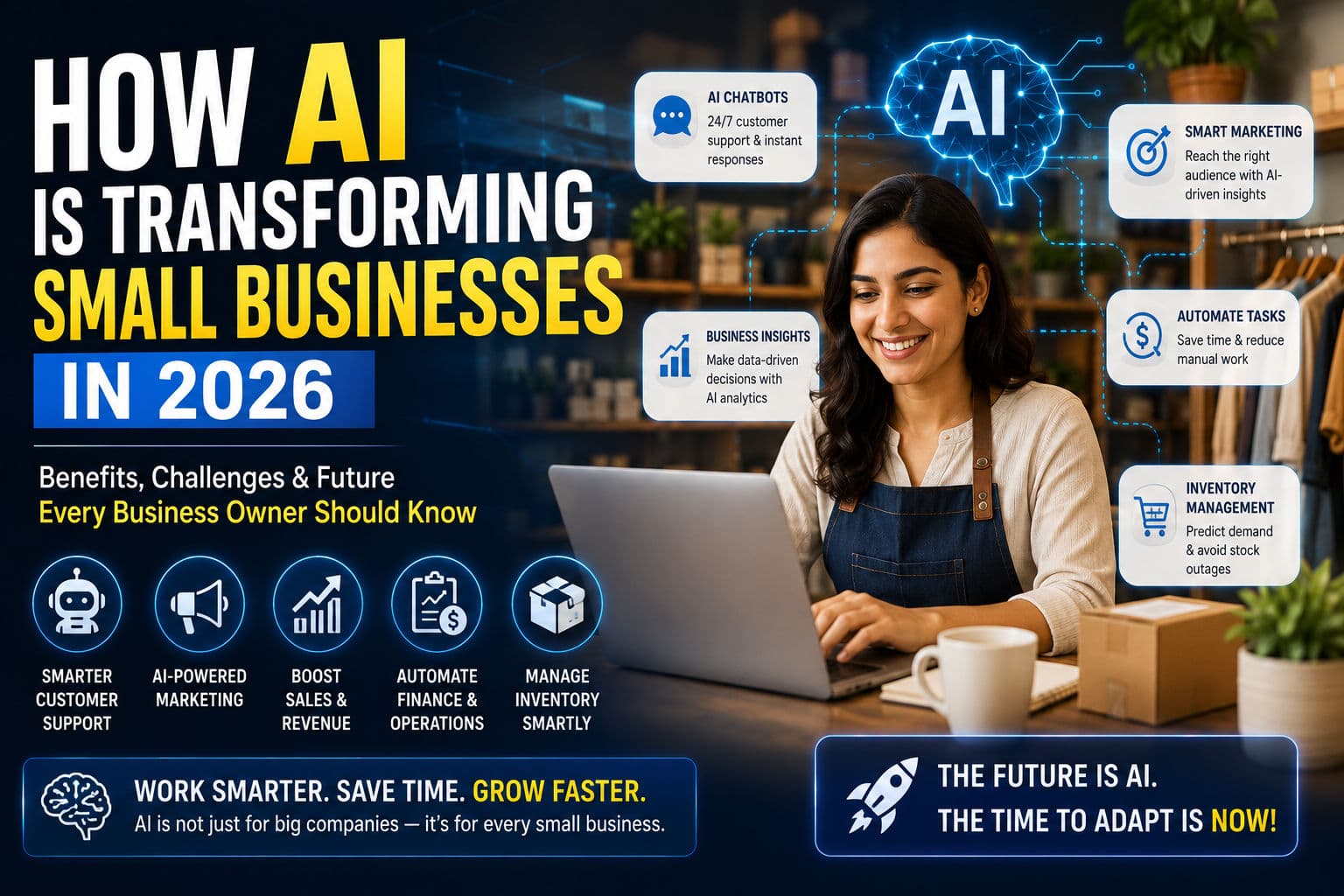
Running a small business has never been easy. Business owners often juggle multiple responsibilities—from managing customer inquiries and marketing campaigns to handling inventory, finances, and daily operations. While large enterprises have dedicated teams for every department, small businesses usually operate with limited budgets and fewer employees.
This is where Artificial Intelligence (AI) is making a real difference.
A few years ago, AI was considered a technology reserved for large corporations with significant financial resources. Today, that's no longer the case. Affordable AI-powered tools are helping small businesses automate repetitive tasks, improve customer service, increase sales, and make smarter business decisions without requiring a large workforce.
Whether you own a local retail store, an online business, a restaurant, a digital agency, or a startup, AI can help you work more efficiently and stay competitive in an increasingly digital world.
In this guide, we'll explore how AI is transforming small businesses in 2026, its practical applications, benefits, challenges, and why adopting AI is becoming essential for long-term success.
What Is Artificial Intelligence?
Artificial Intelligence refers to computer systems that can perform tasks that normally require human intelligence.
These systems can:
- Analyze large amounts of data
- Learn from user behavior
- Recognize patterns
- Answer customer questions
- Generate content
- Predict trends
- Automate repetitive work
- Make intelligent recommendations
Unlike traditional software that follows fixed instructions, AI continuously improves by learning from data and user interactions.
This ability makes AI one of the most valuable technologies available to businesses today.
Why Small Businesses Need AI
Small businesses often face common challenges:
- Limited staff
- Tight budgets
- Growing competition
- Time-consuming manual work
- Difficulty managing customers
- Marketing challenges
Instead of hiring additional employees for every task, businesses can now use AI-powered tools to automate many routine activities.
This allows business owners and employees to spend more time focusing on strategy, customer relationships, and business growth.
AI isn't replacing entrepreneurs—it is helping them become more productive.
1) AI in Customer Support
Customer service plays a major role in business success.
Today's customers expect quick responses, even outside business hours.
AI-powered chatbots and virtual assistants help businesses answer common customer questions instantly.
These tools can:
- Respond to FAQs
- Track orders
- Book appointments
- Handle basic support requests
- Guide customers through products and services
- Collect customer information
Instead of waiting for business hours, customers receive immediate assistance, improving satisfaction and trust.
For small businesses, this means providing professional customer support without hiring a large support team.
2) AI in Marketing
Marketing is one of the biggest areas where AI is creating value.
Instead of spending hours planning campaigns manually, AI tools help businesses create better marketing strategies based on customer behavior and market trends.
AI can assist with:
- Writing social media posts
- Creating blog content
- Generating email campaigns
- Keyword research
- SEO optimization
- Audience targeting
- Ad performance analysis
- Customer segmentation
This allows businesses to reach the right audience while reducing marketing costs.
3) AI in Sales
Every business wants to increase sales.
AI helps identify potential customers by analyzing purchasing behavior, browsing history, and customer preferences.
Sales teams can use AI to:
- Score leads
- Predict buying behavior
- Recommend products
- Personalize offers
- Automate follow-up emails
Instead of contacting every lead manually, businesses can focus on customers who are most likely to make a purchase.
This improves conversion rates while saving valuable time.
4) AI in Accounting and Finance
Managing finances is often one of the most stressful parts of running a small business.
AI-powered accounting software simplifies financial management by automating repetitive tasks.
Businesses can use AI to:
- Generate invoices
- Track expenses
- Categorize transactions
- Detect unusual spending
- Prepare financial reports
- Forecast cash flow
This reduces manual errors while giving business owners a clearer understanding of their financial health.
5) AI for Inventory Management
Businesses that sell physical products often struggle with inventory management.
Running out of stock can lead to lost sales, while ordering too much inventory increases storage costs.
AI helps businesses analyze historical sales data and predict future demand.
It can automatically:
- Monitor stock levels
- Forecast inventory requirements
- Suggest reorder quantities
- Identify slow-moving products
This improves inventory accuracy while reducing waste.
6) AI in Business Analytics
Modern businesses generate enormous amounts of data every day.
AI helps convert that data into meaningful insights.
Instead of manually analyzing spreadsheets, AI dashboards provide real-time reports showing:
- Sales performance
- Customer trends
- Revenue growth
- Marketing effectiveness
- Product demand
- Business opportunities
This allows business owners to make faster and more informed decisions.
7) AI Improves Customer Experience
Customers today expect businesses to understand their needs.
AI makes personalization possible.
Businesses can recommend products, send personalized offers, remember customer preferences, and provide customized experiences.
This creates stronger customer relationships and increases brand loyalty.
People are more likely to return to businesses that understand their preferences and deliver relevant experiences.
Benefits of AI for Small Businesses
Artificial Intelligence is no longer just a futuristic concept—it has become a practical business tool that delivers measurable results. Small businesses adopting AI are finding new ways to improve efficiency, reduce costs, and provide better customer experiences without significantly increasing their workforce.
Here are some of the biggest benefits AI offers.
1) Increased Productivity
One of the greatest advantages of AI is automation. Instead of spending hours on repetitive tasks like data entry, scheduling appointments, or responding to common customer questions, AI handles these activities automatically.
This gives employees more time to focus on strategic work, customer relationships, and business growth.
2) Better Customer Service
Customers expect fast and reliable support, regardless of the time of day.
AI-powered chatbots and virtual assistants provide instant responses, answer frequently asked questions, track orders, and even recommend products based on customer preferences.
This improves customer satisfaction while reducing the workload on support teams.
3) Lower Operating Costs
Hiring additional staff for every department isn't always possible for small businesses.
AI helps reduce costs by automating routine processes such as:
- Customer support
- Marketing
- Accounting
- Inventory management
- Report generation
- Appointment scheduling
Businesses can achieve more with fewer resources.
4) Smarter Decision-Making
Every business generates valuable data, but understanding that data can be challenging.
AI analyzes customer behavior, sales trends, inventory levels, and marketing performance to generate actionable insights.
Instead of relying on guesswork, business owners can make decisions based on real-time information.
5) Personalized Customer Experiences
Modern customers expect businesses to understand their needs.
AI helps deliver personalized experiences by recommending products, sending customized offers, and remembering customer preferences.
This creates stronger customer relationships and encourages repeat purchases.
Real-World Examples of AI in Small Businesses
Artificial Intelligence is already helping thousands of businesses across different industries.
1) Retail Stores
Retail businesses use AI to forecast inventory, recommend products, analyze customer buying behavior, and automate customer support.
2) Restaurants
Restaurants use AI for:
- Online ordering
- Table reservations
- Customer feedback analysis
- Delivery optimization
- Demand forecasting
3) Healthcare Clinics
Small healthcare practices use AI to schedule appointments, manage patient records, send reminders, and improve administrative efficiency.
4) Digital Marketing Agencies
Marketing agencies rely on AI for:
- Content generation
- SEO optimization
- Keyword research
- Email marketing
- Campaign analytics
- Social media management
5) E-commerce Businesses
Online stores use AI to recommend products, recover abandoned carts, personalize shopping experiences, and predict customer demand.
Popular AI Tools for Small Businesses
Today's market offers numerous AI-powered tools designed specifically for small businesses.
Some popular categories include:
Customer Support
- AI Chatbots
- Virtual Assistants
- Help Desk Automation
Marketing
- AI Content Writing
- Social Media Scheduling
- Email Marketing Automation
Sales
- CRM Automation
- Lead Scoring
- Customer Analytics
Accounting
- Invoice Automation
- Expense Tracking
- Financial Forecasting
Design
- AI Image Generation
- Logo Design
- Presentation Creation
The good news is that many of these tools offer affordable plans suitable for startups and small businesses.
Challenges of Using AI
Although AI offers many benefits, it's important to understand its limitations.
Initial Learning Curve
Adopting new technology requires training and adjustment.
Business owners and employees need time to learn how to use AI tools effectively.
Data Privacy
AI systems often process customer information.
Businesses must ensure they comply with privacy regulations and protect sensitive customer data.
Human Oversight
AI should support human decision-making rather than replace it.
Important financial, legal, or customer-related decisions should always involve human review.
Cost of Advanced Solutions
While many AI tools are affordable, advanced enterprise solutions may require a larger investment.
Businesses should choose solutions that match their size and budget.
Will AI Replace Small Business Owners?
This is one of the most common questions.
The answer is No.
AI can automate repetitive tasks, analyze information, and generate recommendations, but it cannot replace human creativity, leadership, emotional intelligence, or strategic thinking.
Successful businesses will use AI as a productivity partner—not as a replacement for people.
The combination of human expertise and AI-powered automation will deliver the best results.
The Future of AI in Small Businesses
Over the next few years, AI is expected to become even more accessible and powerful.
Future developments may include:
- Fully automated customer support
- AI-powered business assistants
- Predictive inventory management
- Smart financial planning
- Personalized shopping experiences
- Voice-controlled business dashboards
- AI-driven cybersecurity
- Advanced business analytics
As technology becomes more affordable, AI will no longer be a competitive advantage—it will become a standard business tool.
Businesses that begin adopting AI today will be better prepared for tomorrow's digital economy.
Article Comments
You must be signed in to post comments.
Sign In to Join the Discussion →No comments approved yet. Be the first to share your thoughts!
About the Author

Pratik Mali
Technology Consultant
Professional engineers crafting clean code architectures and visual portfolios for SMBs.
Related Insights

UPI MDR Is Back — Ashneer Grover Is Half Right | APXTECK

Amodei Wants to Slow AI. Indian SMBs, Read This First | APXTECK

How Blinkit's Free Ambulance Became Its Best Marketing Move

GPT-6 Astra: OpenAI’s New AI Model Could Change Software Development and Business Work

AI-Powered Cyberattacks Are Rising: Why Every Business Needs Stronger Cybersecurity Now

How Next.js and Generative Search Help Builders Win Leads

Build Your Own Food Delivery App: Stop Giving Your Profits to Swiggy & Zomato