


How to Hire the Right Business Automation Without Burning Your Seed Capital

Praveen Kumar
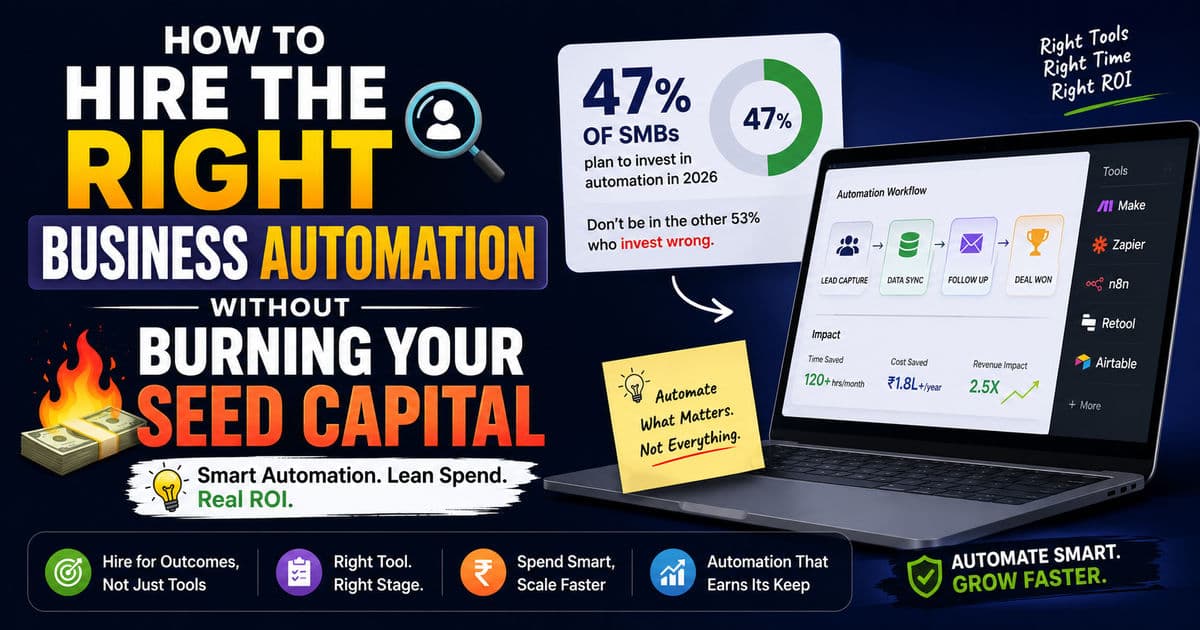
How to Hire the Right Business Automation Without Burning Your Seed Capital
Nearly half of all SMBs globally plan to invest in AI or automation tools in 2026, up from just 22 percent two years ago. That is the fastest-rising priority in the entire SMB technology budget. But here is the part nobody talks about at startup meetups in Bengaluru or Pune — only 18 percent of SMBs have actually deployed automation in production environments. The rest are stuck in evaluation mode, pilot phases, or worse, paying monthly subscriptions for tools they set up once and never touched again. For a seed-stage founder in India working with ₹20-50 lakh of capital and an 8-12 month runway, every wasted subscription is runway you will never get back.
The problem is not that business automation does not work. It works spectacularly well when scoped correctly. The problem is that most founders treat automation like a shopping spree instead of a hiring decision. You would never hire an employee without defining the role, estimating the ROI, and setting a probation period. Your automation tools deserve the same scrutiny.
The Automation Spending Trap That Kills Indian Seed-Stage Startups
Indian micro and small businesses spend an average of just ₹50,000 annually on digital tools. That sounds low, but the real issue is allocation — most of that spend is scattered across standalone tools with no integration strategy. A CRM here, a WhatsApp API there, a Zapier subscription nobody remembers setting up. The result is fragmented workflows, duplicate data entry, and an operations stack that costs money without saving time.
Seed-stage founders fall into this trap for three reasons. First, FOMO — every Y Combinator blog post tells you to "automate early," so you sign up for tools before you have repeatable processes to automate. Second, vendor marketing — platforms like Zapier, HubSpot, and Intercom are brilliant at making you feel like you need their premium tiers from day one. Third, the "just ₹1,500 a month" fallacy — four tools at ₹1,500 each is ₹6,000 a month, ₹72,000 a year, and roughly 1.5 percent of a ₹50 lakh seed round spent on tools that might not be generating measurable returns.
Automation Is an Investment, Not an Expense
The right framing changes everything. When you "hire" a business automation tool, you should expect it to do one of three things: save a measurable number of hours per week, reduce a specific error rate, or directly increase revenue through faster response times or better conversion. If the tool you are considering cannot demonstrably do at least one of these within 30 days, it is not ready for your stage.
How to Evaluate Business Automation Like You Would Evaluate a Hire
Before you sign up for any tool, run it through the same filter you would use for your first hire.
Define the Job Description
What specific, repeatable task are you automating? "Automate our sales process" is not a job description. "Send a WhatsApp follow-up message within 5 minutes of a new lead submitting the contact form" is a job description. The more specific you are, the cheaper and faster the solution becomes.
Map out every manual step in the process you want to automate. Count how many times per day or week each step happens. Calculate the time each step takes. Multiply by your hourly cost (even if you are the one doing it — your time as a founder has an opportunity cost of ₹1,000-3,000 per hour at minimum). That is your automation budget ceiling for this workflow.
Check the Salary Range
Automation tools price themselves wildly differently, and the sticker price is almost never the full cost. Zapier charges per individual task step — a 5-step workflow running 1,000 times per month consumes 5,000 tasks, which can push you into their ₹4,000-8,000 per month tiers fast. Make (formerly Integromat) charges per operation but offers roughly 60 percent lower costs for comparable workflows. n8n, the open-source option, can run on a ₹800 per month VPS with unlimited executions — but only if your team can manage a Docker container.
| Platform | Starting Price | Pricing Model | Best For | Gotcha for Indian Startups |
|---|---|---|---|---|
| Zapier | ~₹1,700/month | Per task (each step counts) | Non-technical teams, simple workflows | Costs explode with multi-step, high-volume flows |
| Make | ~₹750/month | Per operation (cheaper per step) | Mid-complexity workflows with branching logic | Steeper learning curve than Zapier |
| n8n (Cloud) | ~₹1,700/month | Per execution (entire workflow = 1 unit) | Technical teams, high-volume automation | Requires understanding of data flows |
| n8n (Self-hosted) | ~₹800/month (VPS cost) | Unlimited executions | Dev-led teams with compliance needs | You manage infrastructure and updates |
| Zoho Flow | ~₹600/month | Per task | Teams already on Zoho CRM/Books | Limited integrations outside Zoho ecosystem |
For a 10-step workflow running 10,000 times per month, the cost difference between Zapier and self-hosted n8n can be 80-90 percent. That is not a rounding error — that is months of additional runway.
Run a Probation Period
Never commit to an annual plan for an automation tool until you have run it for at least 60 days on a monthly plan and measured the actual impact. The "20 percent discount for annual billing" is not worth it if you discover in month two that the tool does not handle your edge cases or that your process changed.
Set clear success metrics before you start the trial: hours saved per week, error rate reduction, lead response time improvement, or conversion rate change. If the tool does not move at least one of these metrics meaningfully within 60 days, fire it.
What to Automate First — The Seed-Stage Priority Stack
Not every process deserves automation at the seed stage. The temptation to automate everything is real, especially for technical founders who enjoy building systems. But automation that does not connect to revenue, retention, or critical operations is a distraction.
Tier 1 — Automate Immediately (Week 1-2)
These are processes where delay directly costs you money or customers.
Lead response automation sits at the top. If a potential customer fills out your contact form and does not hear back within 30 minutes, your conversion probability drops by over 50 percent. A simple automation that sends a WhatsApp message or email acknowledgment within minutes costs virtually nothing to set up — even the free WhatsApp Business app handles this for operations with fewer than five team members.
Invoice and payment follow-ups come next. If you are using Razorpay or any payment gateway, automate payment link generation and send reminders for pending invoices. Tally's AI features now handle GST-compliant invoice generation, and integrating Tally with WhatsApp for payment reminders can be done for under ₹2,000 per month.
Tier 2 — Automate After Product-Market Fit (Month 2-4)
CRM automation makes sense only after you have a repeatable sales process. Signing up for Zoho CRM or HubSpot when you have 15 leads per month is overkill. A Google Sheet with a simple Zapier trigger to send follow-up reminders works fine until you cross 50-100 active leads per month.
Social media scheduling and content distribution belong here. Tools like Buffer or Zoho Social at ₹500-1,500 per month make sense when you are publishing regularly, but not when your content strategy is still evolving week to week.
Tier 3 — Automate After Revenue Validation (Month 4-8)
Customer support automation — chatbots, ticket routing, knowledge base systems — should wait until you have enough customer volume to justify the investment. A rule-based WhatsApp chatbot costs ₹1,000-3,000 per month. An AI-powered chatbot with CRM integration starts at ₹4,000-8,000 per month. If you are handling fewer than 20 support conversations per day, a human (you) responding personally builds more trust and generates better product feedback than any bot.
Marketing automation — drip campaigns, lead scoring, behavioural triggers — is a post-revenue play. These tools cost ₹5,000-20,000 per month for meaningful capabilities, and they only produce ROI when you have enough traffic and leads to feed the funnel.
The WhatsApp Business API Cost Trap
WhatsApp automation deserves its own section because it is the single most over-purchased tool among Indian seed-stage startups. Every founder in India wants WhatsApp automation because every customer in India uses WhatsApp. The logic is sound. The execution, however, often burns cash unnecessarily.
The WhatsApp Business App is free and handles basic automation — quick replies, greeting messages, product catalogues — for small teams. It is perfectly adequate for most seed-stage businesses handling under 50 conversations per day.
The WhatsApp Business API, which enables bulk messaging, multi-agent inboxes, and chatbot integration, has a layered cost structure that catches founders off guard. Meta charges per delivered template message — roughly ₹0.86 for marketing messages and ₹0.12 for utility messages, plus 18 percent GST on top. Then your Business Solution Provider (BSP) adds a platform fee, typically ₹2,400-5,600 per month for entry-level plans with providers like Wati or AiSensy. Add chatbot automation and you are looking at another ₹1,000-8,000 per month depending on complexity.
A seed-stage founder sending 500 marketing messages per month through the API is spending ₹3,500-6,500 per month minimum. Compare that to the free WhatsApp Business App handling the same volume manually at zero cost. The API becomes essential at scale — 500-plus daily conversations, multi-agent teams, CRM integration — but buying it at seed stage is like hiring a VP of Sales when you have three customers.
Red Flags That You Are Overspending on Automation
If any of these sound familiar, you are burning seed capital on the wrong tools at the wrong time.
You are paying for a CRM with fewer than 50 active contacts. Use a spreadsheet. You are paying for a team inbox when only one person answers customer messages. Use the free WhatsApp Business App. You are paying for a workflow automation platform but have fewer than three active workflows. Consolidate or cancel. You are paying for a marketing automation tool but do not have a consistent content or email strategy. The tool is not the bottleneck — the strategy is. You are paying for a premium plan but only use features available on the free or starter tier. Downgrade immediately.
The best-run seed-stage startups in India operate their entire automation stack for under ₹5,000 per month. They are aggressive about cancelling tools that do not deliver measurable ROI within 60 days, and they upgrade only when the free tier genuinely constrains growth.
The Build-vs-Buy Decision for Technical Founders
Technical founders face an additional temptation — building custom automation instead of buying tools. This is sometimes the right call, but far less often than engineers believe.
Building a custom WhatsApp integration using Meta's Cloud API, for instance, costs ₹0 in platform fees. But it costs 40-80 hours of developer time to build, test, and maintain. At even ₹500 per hour of founder time, that is ₹20,000-40,000 in opportunity cost — roughly equivalent to 6-10 months of a BSP subscription. The build option only wins when your automation needs are genuinely custom or when you are processing volumes that make per-message fees unsustainable.
Self-hosted n8n is the sweet spot for technical founders who want flexibility without full custom development. You get unlimited executions, 1,000-plus native integrations, full JavaScript and Python support inside workflows, and complete data sovereignty — all running on a ₹800-1,500 per month VPS. The tradeoff is maintenance overhead and a steeper learning curve. If your team can manage Docker containers and handle occasional debugging, self-hosted n8n is the most capital-efficient automation platform available for Indian startups in 2026.
A Sample Seed-Stage Automation Budget
Here is what a disciplined ₹5,000 per month automation stack looks like for a typical Indian seed-stage startup:
| Tool | Monthly Cost | What It Does |
|---|---|---|
| WhatsApp Business App | ₹0 | Lead communication, quick replies, catalogue |
| Google Workspace (Starter) | ₹125/user (~₹375 for 3) | Email, Sheets as lightweight CRM, Drive |
| Zoho CRM (Free tier) | ₹0 | Up to 3 users, basic pipeline tracking |
| Make (Free tier) | ₹0 | 1,000 operations/month for basic workflows |
| Razorpay (transaction-based) | ~₹0 fixed | Payment links, automated invoicing |
| Tally (existing licence) | ~₹1,500 | GST billing, accounting, AI features |
| Buffer (Free tier) | ₹0 | Social media scheduling, 3 channels |
| n8n Self-hosted (if technical) | ~₹800 | Unlimited workflow executions |
| Total | ₹2,675-₹4,675 | Full operations automation stack |
Compare this to the ₹15,000-25,000 per month that many seed-stage founders accidentally spend by subscribing to premium tiers of Zapier, HubSpot, Intercom, and a WhatsApp API provider before they need them.
The Three Questions Before Every Automation Purchase
Before you commit to any automation tool — free or paid — ask three questions. First: what specific manual process does this replace, and how many hours per week does that process currently consume? If the answer is less than two hours per week, the process is probably not worth automating yet. Second: what happens if this automation breaks at 2 AM? If the answer is "nothing until Monday," the automation is not mission-critical enough for a paid tool — a free-tier solution or a manual backup is fine. Third: will this tool still be the right choice when we have 10x our current volume? If the answer is no, do not invest in learning and integrating a tool you will outgrow in six months. Pick the tool that serves you at both current scale and 10x scale, even if it requires slightly more setup effort today.
Seed capital is finite. Every rupee you save on tools you do not need is a rupee that funds another week of product development, another round of customer interviews, or another month of runway before your next raise. Treat your automation stack like a team — hire deliberately, evaluate ruthlessly, and fire fast when something is not delivering.
Published by APXTECK — building automation systems and AI integrations that Indian SMBs actually need. Let's talk →
Article Comments
You must be signed in to post comments.
Sign In to Join the Discussion →No comments approved yet. Be the first to share your thoughts!
About the Author

Praveen Kumar
Co-Founder & DirectorFull-Stack Developer, APXTECK, chatgpt, google
Praveen Kumar is the Co-Founder and Full-Stack Developer at APXTECK, an AI-powered IT agency helping Indian SMBs grow through web development, automation, and AI integration. He builds production-grade systems using Node.js, Next.js, PostgreSQL, and modern AI APIs. When he is not shipping code, he is writing about practical technology that actually works for Indian businesses.
Related Insights

UPI MDR Is Back — Ashneer Grover Is Half Right | APXTECK

Amodei Wants to Slow AI. Indian SMBs, Read This First | APXTECK

How Blinkit's Free Ambulance Became Its Best Marketing Move

GPT-6 Astra: OpenAI’s New AI Model Could Change Software Development and Business Work

AI-Powered Cyberattacks Are Rising: Why Every Business Needs Stronger Cybersecurity Now

How Next.js and Generative Search Help Builders Win Leads

Build Your Own Food Delivery App: Stop Giving Your Profits to Swiggy & Zomato