


UPI MDR Is Back — Ashneer Grover Is Half Right | APXTECK

Praveen Kumar
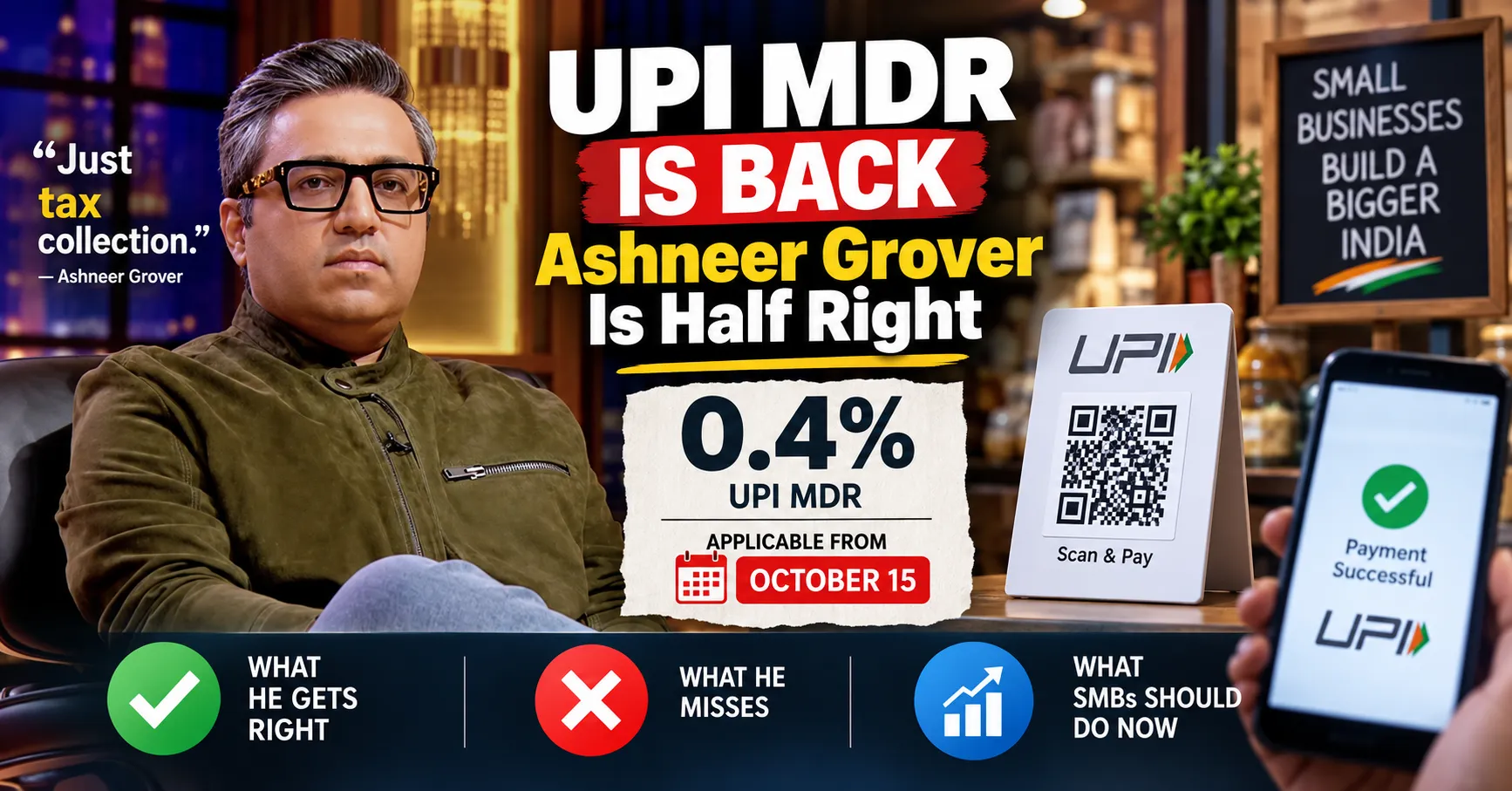
UPI MDR Is Back — Ashneer Grover Is Half Right
On September 15, 2026, NPCI confirmed what Indian merchants had feared for months: a 0.4% Merchant Discount Rate on person-to-merchant UPI transactions above ₹2,000, effective October 15. The six-year free ride that began in January 2020 is officially ending for a slice of Indian commerce.
Within hours, former BharatPe co-founder Ashneer Grover was on CNN-News18 and X calling the move "just tax collection," warning India could become a "cash economy again," and asking a pointed question: whose losses is this charge supposed to offset?
His argument is emotionally compelling. It is also incomplete. Here is the honest breakdown — what Grover gets right, where his argument breaks down, and what Indian SMBs should actually do before October 15.
What NPCI Actually Announced
Before dissecting Grover's critique, the facts need to be clear because most coverage has been imprecise.
NPCI's new framework works like this: merchants — not consumers — pay 0.4% MDR on eligible person-to-merchant UPI transactions above ₹2,000. The fee is capped at ₹300 for transactions of ₹75,000 or more. Person-to-person transfers remain completely free. All UPI transactions up to ₹2,000 remain free for everyone. Consumers cannot be surcharged — merchants are legally barred from passing the MDR to buyers.
Three exemptions matter for small businesses. First, micro merchants classified under the P2PM (Person-to-Person-Merchant) framework — those receiving up to ₹1 lakh per month through UPI QR directly into personal accounts — pay zero MDR regardless of individual transaction size. A kirana store owner accepting a ₹5,000 payment stays exempt as long as total monthly UPI receipts stay under ₹1 lakh. Second, select utility and essential-service categories get concessional rates. Third, a merchant's classification — not a single transaction — determines liability. One payment above ₹2,000 does not automatically trigger MDR.
The MDR revenue stays within the UPI ecosystem, split between the issuing bank, acquiring bank, payment service provider, and UPI app. NPCI says the money funds infrastructure, cybersecurity, innovation, and customer service.
What Ashneer Grover Gets Right
Grover's core argument has three legs, and two of them are solid.
The cash-infrastructure comparison is valid
Grover cited ₹30,500 crore as the annual cost of running India's ATM network and cash logistics. That number comes from industry estimates and RBI data, and the comparison is fair. Every rupee transacted digitally instead of physically saves banks real money — armoured vans, cash loading, ATM maintenance, reconciliation, currency management. If UPI has helped India avoid even a fraction of incremental cash-handling costs, the argument that banks owe UPI infrastructure investment — not the other way around — has genuine weight.
The profitability challenge is legitimate
Grover posted specific numbers on X: RBI surplus transfer to the government at ₹2.87 lakh crore, total listed bank profits at ₹4.11 lakh crore, and NPCI's own pre-tax surplus at ₹1,888 crore. His question — "Whose losses are being offset?" — is pointed because nobody in the UPI chain is actually losing money. The banks are profitable. NPCI is profitable. The payment apps are scaling. If nobody is bleeding, the charge starts to look less like a sustainability measure and more like a revenue line.
The political framing resonates
When Grover says "Free UPI is the only UPI — if you start charging, you can say tata bye-bye," he is articulating what millions of small merchants feel. UPI adoption in India was not an accident of technology. It was an accident of zero cost. Ninety-four per cent of small merchants surveyed in a government-commissioned study have adopted UPI. The fear that any charge, however small, could create a psychological barrier to digital adoption is not irrational.
Where Grover's Argument Breaks Down
Here is where the numbers tell a different story than the rhetoric.
The ₹2,000 threshold is not arbitrary
Grover called the threshold a convenient round number designed to extract maximum revenue. The data tells a more precise story. Only about 4% of person-to-merchant UPI transactions by volume exceed ₹2,000 — but those 4% account for roughly 66% of P2M transaction value. The threshold is set precisely where it exempts the overwhelming majority of transactions by count while applying only to high-value merchant payments where 0.4% is operationally absorbable.
A ₹3,000 transaction attracts ₹12 in MDR. A ₹50,000 transaction attracts ₹200. A ₹1,00,000 transaction attracts ₹300 — the cap. Compare these to credit card MDR at 1.5–2.5% and debit card MDR at up to 0.90%. The UPI MDR is less than half the cheapest card alternative.
| Transaction Value | UPI MDR (0.4%) | Debit Card MDR (0.9%) | Credit Card MDR (2%) |
|---|---|---|---|
| ₹3,000 | ₹12 | ₹27 | ₹60 |
| ₹10,000 | ₹40 | ₹90 | ₹200 |
| ₹50,000 | ₹200 | ₹450 | ₹1,000 |
| ₹75,000 | ₹300 (cap) | ₹675 | ₹1,500 |
| ₹1,00,000 | ₹300 (cap) | ₹900 | ₹2,000 |
At every price point, UPI remains the cheapest digital payment acceptance channel by a significant margin. Grover is comparing UPI-with-MDR to UPI-at-zero. The more honest comparison is UPI-with-MDR versus every other payment method his former company BharatPe helped merchants accept.
UPI's operational cost is real
Industry estimates put the annual cost of running UPI operations — servers, fraud prevention, technical support, dispute resolution — at roughly ₹20,000 crore. UPI processed 2,451 crore transactions worth ₹29.9 lakh crore in August 2026 alone. At that scale, the infrastructure is not free to maintain. The government has been subsidising low-value UPI transactions through incentive schemes — ₹3,631 crore in FY24 alone — to keep the system free. The question is not whether UPI costs money to run. It does. The question is whether the funding model should come from government subsidies indefinitely or from a thin fee on the highest-value commercial transactions.
Grover frames this as the government collecting a tax. A more accurate framing is that the government is shifting part of the infrastructure cost from taxpayers to the merchants who derive the most commercial value from the platform. Those are different things.
The "cash economy" warning is overstated
Grover's most dramatic claim — that MDR could push India back to cash — does not survive contact with the actual numbers. The MDR applies to large merchants on transactions above ₹2,000. The kirana store, the vegetable vendor, the chai stall — the merchants who drove UPI's mass adoption — are explicitly exempt under the P2PM framework. The 86% of P2M transactions that fall below ₹500 are not affected at all.
A retail chain processing ₹1 crore monthly in eligible UPI transactions faces roughly ₹40,000 per month in MDR charges. That is a real cost, but it is not the kind of cost that sends Reliance Retail or DMart back to cash counters. For a mid-sized restaurant doing ₹5 lakh in monthly UPI above ₹2,000, the monthly MDR is ₹2,000. That is less than one delivery order's commission on Zomato.
The merchants most likely to feel the pinch are mid-market SMBs — jewellery stores, electronics retailers, furniture shops, medical equipment suppliers — processing high-value transactions regularly. These are exactly the merchants who would pay significantly more in card MDR if UPI did not exist.
The Real Question Nobody Is Asking
Both Grover and the government are debating the wrong question. The debate is framed as "should UPI be free or should merchants pay?" The question Indian SMBs should be asking is: "What does my total payment-acceptance cost look like after October 15, and is my checkout stack optimised for it?"
Here is where the operational impact lands.
Route transactions intelligently
If your e-commerce or POS system treats all payment methods identically, you are leaving money on the table from October 15. Transactions under ₹2,000 should default to UPI — zero cost. Transactions above ₹2,000 where UPI MDR at 0.4% is still cheaper than card MDR should also stay on UPI. The only transactions worth considering alternative routing for are those where EMI, card offers, or bank-funded promotions give you a net-lower acceptance cost than 0.4%.
Audit your merchant classification
If you are a small merchant receiving under ₹1 lakh monthly through UPI QR into a personal account, you are exempt. But the exemption is not permanent — NPCI's FAQ says a P2PM merchant receiving more than ₹1 lakh for three consecutive months can be reclassified into the standard P2M category. If you are near that threshold, you need to know it before October, not after your first MDR deduction.
Renegotiate your acquiring contracts
The 0.4% is the headline rate. How much of that your payment aggregator or acquiring bank passes through to you — and on what terms — depends on your contract. If you are using Razorpay, PayU, Cashfree, or any other payment aggregator, read the updated terms before October 15. Bulk-volume merchants should be negotiating now, not in November when the first statements arrive.
Do not split transactions
The worst possible response to MDR is to ask customers to make two payments of ₹1,500 instead of one payment of ₹3,000. Apart from being a terrible customer experience, it is exactly the kind of behaviour that will attract regulatory scrutiny and potentially get your merchant account flagged.
Budget it and move on
For most SMBs doing real commercial volume, the MDR is a line item, not a crisis. A business processing ₹10 lakh monthly in eligible UPI transactions above ₹2,000 pays ₹4,000 per month — less than most businesses spend on their internet connection. Treat it as a cost of digital infrastructure, because that is what it is.
Grover Is Fighting Yesterday's Battle
Ashneer Grover built BharatPe on the promise of zero-cost payment acceptance for Indian merchants. That promise was powerful, and it helped bring millions of merchants into the digital economy. His instinct to protect that ecosystem is genuine.
But the UPI of 2026 is not the UPI of 2020. It processes ₹29.9 lakh crore in a single month. It handles 85% of India's digital payment volume. It is critical national infrastructure on the scale of the railway network. Critical infrastructure at this scale needs a funding model that does not depend on annual government subsidies.
The 0.4% MDR on high-value merchant transactions is not a betrayal of UPI's promise. It is the cost of UPI growing up. The merchants who pay it are the ones who benefit the most from it — and they are still paying less than half of what any competing digital payment method would charge them.
Grover is right that the government should not interfere with something that works. He is wrong that 0.4% on transactions above ₹2,000, with small merchants fully exempt, constitutes interference. It constitutes plumbing.
Indian SMBs have 29 days before October 15. Use them to audit your payment stack, renegotiate your aggregator terms, and confirm your merchant classification. That is more useful than debating whether the fee should exist.
If your business needs help optimising checkout flows, payment routing, or understanding how the new MDR framework affects your specific setup, reach out to us at apxteck.com/contact. We build payment-integrated systems for Indian SMBs and we will tell you straight if the MDR actually matters for your numbers — or if it does not.
Published by APXTECK — an AI-powered IT agency helping Indian SMBs build payment-integrated, production-grade digital systems. Learn more at apxteck.com/services.
Article Comments
You must be signed in to post comments.
Sign In to Join the Discussion →No comments approved yet. Be the first to share your thoughts!
About the Author

Praveen Kumar
Co-Founder & DirectorFull-Stack Developer, APXTECK, chatgpt, google
Praveen Kumar is the Co-Founder and Full-Stack Developer at APXTECK, an AI-powered IT agency helping Indian SMBs grow through web development, automation, and AI integration. He builds production-grade systems using Node.js, Next.js, PostgreSQL, and modern AI APIs. When he is not shipping code, he is writing about practical technology that actually works for Indian businesses.
Related Insights

Amodei Wants to Slow AI. Indian SMBs, Read This First | APXTECK

How Blinkit's Free Ambulance Became Its Best Marketing Move

GPT-6 Astra: OpenAI’s New AI Model Could Change Software Development and Business Work

AI-Powered Cyberattacks Are Rising: Why Every Business Needs Stronger Cybersecurity Now

How Next.js and Generative Search Help Builders Win Leads

Build Your Own Food Delivery App: Stop Giving Your Profits to Swiggy & Zomato

How to Hire the Right Business Automation Without Burning Your Seed Capital