

Build Your Own Food Delivery App: Stop Giving Your Profits to Swiggy & Zomato

Praveen Kumar
Build Your Own Food Delivery App: Stop Giving Your Profits to Swiggy & Zomato
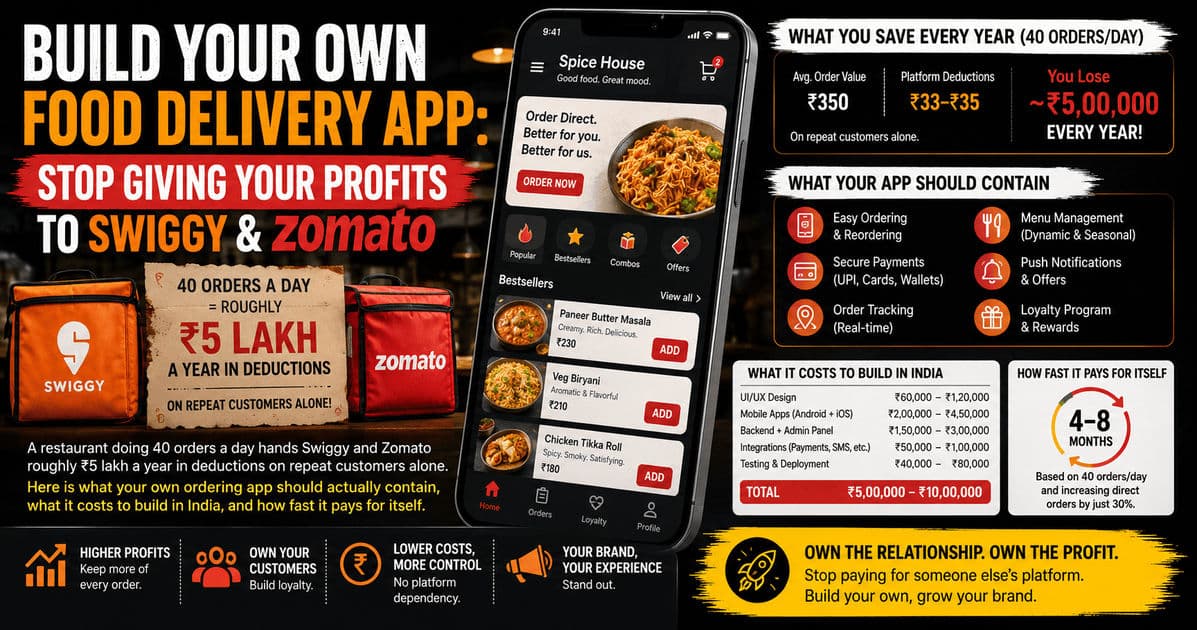
Take a restaurant doing 40 orders a day at an average of ₹450. That is ₹5.4 lakh a month through the aggregators. At an effective deduction of 30% — commission, GST on commission, payment gateway, delivery share — the platforms keep about ₹1.6 lakh of it every month.
Now the part that should bother you. Somewhere between 40% and 60% of those orders come from people who have ordered from you before. They know your name, they know what they want, and many of them live within two kilometres. You are paying a full customer acquisition fee, every single month, on customers you already acquired.
That recurring leak is what your own ordering app exists to close. Not to replace Swiggy and Zomato — to stop renting your regulars back from them.
What "Your Own App" Should Actually Mean in 2026
Most restaurant owners picture a Play Store download with their logo on it. That is usually the wrong first build, and the reason is install friction.
Asking a hungry customer to visit the Play Store, download 40MB, create an account, and add a delivery address is asking for five steps of effort in exchange for a discount they have not yet learned to expect. Most will not do it. Restaurant apps that fail almost never fail on features — they fail because nobody installed them.
Start with a progressive web app
A PWA opens from a link. No store, no download, no waiting. It runs on effectively every Android phone in India, works on iOS, and can be saved to the home screen with an icon that looks identical to a native app. Build cost is a fraction of native, and you can put the link inside a WhatsApp message, a QR code on the table, or a sticker on the packaging.
Once you have a few thousand people ordering through the PWA regularly, a native app becomes worth building — because now you have an audience to install it, and push notification access genuinely improves reorder rates. Build the native app for the customers you already have, not to find new ones.
The Feature Set That Actually Matters
Every agency quote you receive will be padded with features that sound impressive and change nothing. Here is what earns its place.
Non-negotiable:
- Menu with clear photography, item-level customisation, and real-time availability toggles so your kitchen can switch off a sold-out item in two taps
- UPI and card checkout through Razorpay, with UPI as the visible default since it dominates Indian food ordering
- Live order status, even if it is just four states — accepted, preparing, out for delivery, delivered
- Repeat order in one tap from order history, which is the single highest-value screen in the entire product
- A kitchen-facing dashboard with an audible alert that works on a cheap Android tablet
- Customer database export, because the whole point is that this data is yours
Worth adding by month three:
- Loyalty balance visible on the home screen
- Scheduled ordering for offices and regular lunch customers
- WhatsApp order confirmations, which get read far more reliably than SMS or email
Skip at launch:
- Live rider GPS tracking on a map — expensive to build, and a status update plus an ETA satisfies almost everyone
- In-app chat support, when a WhatsApp number does the job
- Ratings and reviews, which need volume to mean anything
- A rider app, unless you are running your own delivery fleet on day one
That skip list is where budgets die. Live map tracking alone can add lakhs to a quote and rarely moves reorder rate.
What It Costs to Build in India
| Build | Realistic cost | Timeline | Best fit |
|---|---|---|---|
| WhatsApp catalogue ordering | ₹15,000-40,000 setup, plus per-conversation API cost | 1-2 weeks | Any restaurant, day one |
| QR ordering for tables and packaging | ₹25,000-60,000 | 2-3 weeks | Anyone with dine-in or delivery packaging |
| Branded PWA with Razorpay checkout | ₹1-3 lakh | 4-8 weeks | The default recommendation for most outlets |
| Native Android and iOS app | ₹6-15 lakh | 3-5 months | Multi-outlet, or ₹10 lakh+ monthly online volume |
| Full platform with rider app and dispatch | ₹15-35 lakh | 5-8 months | Chains running their own fleet |
Add 15-20% of the build cost per year for maintenance, hosting, API usage and OS compatibility updates. Anyone who quotes you a build price without mentioning ongoing costs is quoting you half the truth.
The payback maths, honestly
Take the restaurant above — ₹1.6 lakh a month going to platforms. Suppose a PWA plus WhatsApp costs ₹2.5 lakh to build and migrates 25% of repeat orders in the first year. That is roughly ₹40,000 a month recovered, against a ₹2.5 lakh build. Payback lands around seven months, and everything after that is margin.
Run the same exercise on a ₹12 lakh native app at the same 25% migration and payback stretches past two years. Same business, same customers — the difference is entirely in what you chose to build first.
This is why I push almost every independent restaurant toward phase one to three and treat the native app as a later decision funded by the savings from the earlier ones.
The Hard Part: Getting People to Use It
Building the app is the easy half. Migration is where restaurants quietly give up, so plan it as deliberately as the build.
Put the link everywhere physical. A QR sticker on every delivery bag, on every table, on the bill, at the counter. Aggregator orders are your cheapest possible source of direct-channel signups, because the customer is already holding your food.
Give a specific, visible reason to switch. Not "order direct and support us." A defined benefit: ten percent off your next direct order, or a free beverage on the third one. Vague appeals to loyalty do not change behaviour; a number does.
Keep prices identical across channels. Do not punish the aggregator customer — they will notice and simply stop ordering from you. Compete on the incentive, not on menu manipulation.
Use WhatsApp as the retention engine. A broadcast list of past customers costs almost nothing per message and reaches people who never installed anything. Collect phone numbers from day one, even in a paper register. A kitchen in Ahmedabad that started doing this in October 2025 had 1,800 numbers by January 2026 — a channel that cost nothing and outperforms most paid advertising.
Track one number: percentage of monthly orders arriving direct. If it is not climbing month over month, the problem is your migration mechanism, not your app.
Where This Doesn't Work
Straight answer, because you should hear it before you spend anything.
If you opened in the last three months and have no repeat base, you have a discovery problem, and the aggregators are solving it more cheaply than you can. Build the WhatsApp list now, build the app later.
If your aggregator listing is underperforming because of a 3.6 rating, slow kitchen prep time, or bad photos, a direct channel will underperform for exactly the same reasons — and those fixes cost far less.
And if you are a pure cloud kitchen with no dine-in footfall and no packaging touchpoint outside the aggregator bag, migration is genuinely harder, because you have fewer places to put the QR code. Possible, but budget more time and expect a slower ramp.
What To Do Next
Pull your last three months of settlement statements and work out your true effective deduction — every line, as a percentage of gross order value. Then estimate what share of your orders come from repeat customers. Multiply those two together and you have your annual leak, which is also your build budget.
For most independent restaurants that number lands somewhere between ₹4 lakh and ₹12 lakh a year, which comfortably funds phases one through three with room left over.
At APXTECK we build these systems for Indian restaurants and cloud kitchens — WhatsApp Business API ordering, QR systems, branded PWA checkouts with Razorpay and UPI, kitchen dashboards, and native apps when your volume justifies one. We start with your settlement statements and tell you which phase your numbers actually support.
Send us your numbers and we will build the plan with you.
Published by APXTECK — restaurant technology built on real unit economics, without the fluff. apxteck.com/services
Article Comments
You must be signed in to post comments.
Sign In to Join the Discussion →No comments approved yet. Be the first to share your thoughts!
About the Author

Praveen Kumar
Co-Founder & DirectorFull-Stack Developer, APXTECK, chatgpt, google
Praveen Kumar is the Co-Founder and Full-Stack Developer at APXTECK, an AI-powered IT agency helping Indian SMBs grow through web development, automation, and AI integration. He builds production-grade systems using Node.js, Next.js, PostgreSQL, and modern AI APIs. When he is not shipping code, he is writing about practical technology that actually works for Indian businesses.
Related Insights

UPI MDR Is Back — Ashneer Grover Is Half Right | APXTECK

Amodei Wants to Slow AI. Indian SMBs, Read This First | APXTECK

How Blinkit's Free Ambulance Became Its Best Marketing Move

GPT-6 Astra: OpenAI’s New AI Model Could Change Software Development and Business Work

AI-Powered Cyberattacks Are Rising: Why Every Business Needs Stronger Cybersecurity Now

How Next.js and Generative Search Help Builders Win Leads

How to Hire the Right Business Automation Without Burning Your Seed Capital