

How Blinkit's Free Ambulance Became Its Best Marketing Move

Praveen Kumar
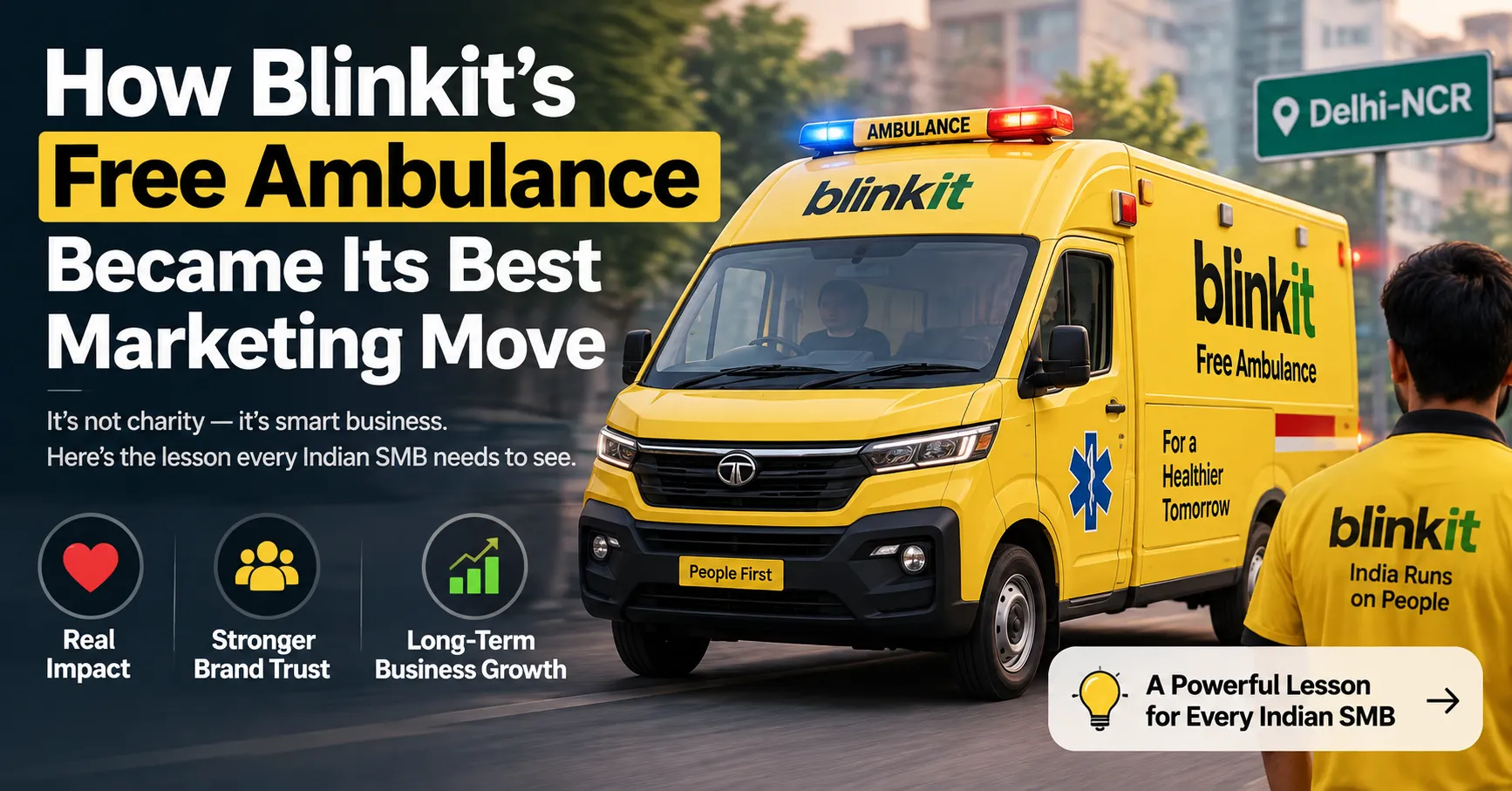
How Blinkit's Free Ambulance Became Its Best Marketing Move
On September 6, 2026, a five-storey PG building called Hostel Daze collapsed in Satya Niketan, South-West Delhi — less than a kilometre from Delhi University's South Campus. Students were trapped. Panic set in. And in that chaos, the first medical responder to reach the site wasn't police, wasn't NDRF, wasn't a government ambulance. It was Blinkit.
Paramedics arrived by 1:45 PM — within 11 minutes of the police receiving the first PCR call. Nine more Blinkit ambulances followed over the next 90 minutes. Around 27 Blinkit staff ended up on the ground, moving concrete slabs with their bare hands alongside locals. Every ambulance, every paramedic, every oxygen cylinder — free.
That moment didn't just save lives. It rewrote what an entire generation of Delhi residents thinks when they hear the name Blinkit. And it happened without a single rupee spent on advertising.
What Blinkit Actually Built — And Why It Worked
Let's set the record straight: this isn't a CSR initiative cooked up by a PR agency. When Blinkit CEO Albinder Dhindsa launched the ambulance service on January 2, 2025, he was explicit: "Profit is not a goal here. We will operate this service at an affordable cost and invest in really solving this critical problem for the long term."
He started with five ambulances in Gurugram. No fanfare. No press release blitz. Just five vehicles, a paramedic on each, and a question worth answering: can a quick commerce platform's logistics infrastructure deliver emergency medical response faster than the existing system?
By March 2026 — just over a year into operation — the answer was an unambiguous yes. The service had handled over 4,200 emergency calls. In 87% of those cases, the ambulance reached the patient within 10 minutes. Over 1,800 of those calls were classified as time-critical medical emergencies.
The fleet had grown from 5 to 25 ambulances, covering Gurugram, Manesar, and select Delhi neighbourhoods including Lajpat Nagar, Malviya Nagar, Patel Nagar, Dwarka, and Greater Kailash. Paramedics are trained at the Blinkit Academy specifically for high-pressure, time-critical situations. Each ambulance carries oxygen cylinders, AEDs, stretchers, monitors, and emergency medications.
This is not a PR stunt. It is infrastructure — built methodically, scaled responsibly, and now proving itself in real crises.
The Word-of-Mouth Engine No Ad Budget Can Buy
Here's what makes the ambulance service so strategically brilliant from a brand perspective: every person it helps becomes an involuntary evangelist.
A viral Reddit post from February 2026 captures this perfectly. A Gurugram resident's 90-year-old grandmother had a medical emergency late at night. He opened the Blinkit app. A paramedic called him within minutes to assess the situation. The ambulance arrived in under 10 minutes. The service was completely free. He posted about it — and the post spread across Delhi, Gurugram, and Indian tech and startup communities within hours.
When the Satya Niketan collapse happened on September 6, students trapped under rubble didn't dial 112 first — they called ambulances through Blinkit. That behavioural shift — from government emergency line to a grocery app — is the product of 20 months of earned trust, one genuine intervention at a time.
An AIIMS professor, Dr. Deepak Agrawal, publicly shared on LinkedIn that the AIIMS Trauma Centre had received a patient brought in by a Blinkit ambulance. He described how the paramedic team had correctly stabilised the patient's cervical spine before transport — textbook emergency protocol. That post, coming from a senior doctor at India's most respected medical institution, carried more brand weight than a ₹10 crore campaign ever could.
Why Indian Consumers Respond to This Differently
Indian urban consumers — particularly in Delhi-NCR — carry a deep, earned cynicism about emergency services. The ambulance system is chronically underfunded and unreliable. In that context, a company actually delivering what the government promised decades ago is not just impressive. It is emotionally resonant.
When someone from your family is saved by a Blinkit ambulance, you don't just use Blinkit more. You tell people about it. You defend the brand in arguments. You become a walking advertisement with 100x more credibility than any influencer campaign.
This is word-of-mouth marketing at its most powerful — not manufactured, not incentivised, not gamified. Genuinely earned.
The Business Logic Behind "Non-Profit" Positioning
You might ask: how does spending crores on ambulances and paramedics without a revenue model make business sense?
The answer lies in what Blinkit is actually competing for.
Quick commerce in India is a brutal market. Blinkit, Swiggy Instamart, Zepto, and BigBasket are all fighting for the same urban Indian consumer in the same top 15-20 cities. Delivery times have converged. App experience is similar. Grocery selection is broadly comparable. On pure product terms, differentiation is getting harder.
Brand trust, on the other hand, is extraordinarily difficult to replicate. It takes time, consistency, and moments of genuine proof. Blinkit has manufactured — or rather, earned — those moments at scale.
Consider the economics. Quick commerce companies typically spend 15–25% of GMV on customer acquisition. A customer who has had a family member helped by a Blinkit ambulance has an effectively infinite lifetime value from a retention standpoint. They are not going to delete the app to save ₹20 on onions.
The ambulance service doesn't need to break even. It is the retention strategy.
The Satya Niketan Moment as a Case Study
The September 6 building collapse crystallised exactly why this strategy works. Here is what happened in sequence:
| Timeline | Event |
|---|---|
| 1:33 PM | Delhi Fire Department receives alert |
| 1:34 PM | PCR call received at South Campus police station |
| 1:40 PM | Blinkit ambulance receives alert via app |
| 1:45 PM | Blinkit paramedics are first to arrive at site |
| 1:50 PM | Paramedics with oxygen and medical equipment operational |
| ~3:15 PM | 10 Blinkit ambulances, 27 staff on site |
The Blinkit team arrived before NDRF. Before police could establish perimeter. They then stayed, pulled debris, and coordinated with firefighters and locals until relief operations were fully established.
This was not a scripted moment. It was the natural outcome of having invested in a functioning rapid-response system with real geographic coverage across Delhi-NCR.
Every news report from The Print, Tribune, Newslaundry, and PTI named Blinkit prominently. The brand appeared in national headlines not in the context of a promotion — but in the context of saving lives. That is coverage money cannot buy, because audiences are trained to dismiss promotional coverage. They do not dismiss survival stories.
What Indian SMBs and Startups Should Actually Take From This
Before you conclude "this only works at Blinkit's scale," let me push back on that.
The underlying principle is not about ambulances. It is about investing in something genuinely useful to your community that also happens to demonstrate your core competence.
Blinkit's core competence is rapid logistics — getting things to places fast. The ambulance service is literally just that competency applied to a different, higher-stakes domain. It required no new technology. No new product team. Just the operational playbook already powering 10-minute grocery delivery, applied to emergency response.
For an Indian SMB or founder, the question is: what does your business do exceptionally well, and how could that capability be deployed for your community in a way that creates genuine goodwill?
A few realistic examples:
A coaching institute that prepares students for JEE or NEET could offer a free crisis counselling session for students who fail their exams — not as marketing, but as genuine support for a population under enormous mental health pressure. Done consistently and authentically, that spreads through parent networks faster than any pamphlet campaign.
A restaurant using Swiggy or Zomato could offer free meals to delivery workers on extreme heat days. The goodwill generated among that community — which talks constantly about which restaurants treat them well — is disproportionately valuable in a market where rider experience influences ratings.
A small SaaS product targeting Indian businesses could offer its core reporting tool free to NGOs registered under the FCRA. The NGO founder community is dense, tightly networked, and vocal. A single genuine testimonial from a respected NGO goes further than a sponsored LinkedIn post.
The Pattern Underlying All of This
| What Blinkit Did | The Principle |
|---|---|
| Used existing logistics for ambulances | Repurpose your core competency for community good |
| Started small (5 ambulances), scaled proof | Prove it works before you announce it |
| Kept it free, not subsidised | Authenticity requires no expectation of return |
| Let users generate the content | Earned media beats paid media at driving trust |
| Showed up in a crisis (Satya Niketan) | Real moments crystallise brand memory |
The companies that win long-term brand loyalty in India — in a market that is deeply sceptical of corporate claims — are the ones that act before they speak. Blinkit launched ambulances and then waited for the results to do the talking. The results obliged.
The Honest Caveat
I want to be clear about something: not every SMB has the capital to replicate what Blinkit has done. A 25-ambulance fleet, trained paramedics, and Blinkit Academy infrastructure requires serious money and an organisational commitment that most small businesses genuinely cannot make.
But the strategic logic scales down. The ambulance service works because it is specific, operational, and genuinely useful — not because it is expensive. A ₹0 initiative that is truly helpful to your community will outperform a ₹50,000 social media campaign every time, if it is built on a real use case and executed consistently.
The mistake most Indian SMBs make is spending on visibility before earning trust. Blinkit did it the other way around. Trust first. Visibility followed — and it came free, through every user who shared a story that actually mattered.
What's Next for Blinkit
The service is currently operational in Gurugram, Manesar, and select Delhi-NCR areas. Albinder Dhindsa has stated the goal is to expand to all major Indian cities within two years of the 2025 launch. If the Satya Niketan response demonstrated anything, it's that the model holds under real-world stress — not just routine medical calls, but multi-ambulance mass casualty responses in congested urban terrain.
For the Indian quick commerce market, this changes the game. Swiggy Instamart and Zepto compete on price and speed. Blinkit is now competing on something neither of them can copy quickly: trust built through two years of genuine service, one saved life at a time.
That is a moat. And it didn't cost a single rupee of advertising spend to build.
If you're building a business or a brand in India and thinking about how to earn genuine word-of-mouth rather than buy it, the APXTECK team can help you identify where your core capability creates real community value. Talk to us at apxteck.com/contact.
Published by APXTECK — AI-powered web development and automation for Indian SMBs. Explore our services at apxteck.com/services.
Article Comments
You must be signed in to post comments.
Sign In to Join the Discussion →No comments approved yet. Be the first to share your thoughts!
About the Author

Praveen Kumar
Co-Founder & DirectorFull-Stack Developer, APXTECK, chatgpt, google
Praveen Kumar is the Co-Founder and Full-Stack Developer at APXTECK, an AI-powered IT agency helping Indian SMBs grow through web development, automation, and AI integration. He builds production-grade systems using Node.js, Next.js, PostgreSQL, and modern AI APIs. When he is not shipping code, he is writing about practical technology that actually works for Indian businesses.
Related Insights

UPI MDR Is Back — Ashneer Grover Is Half Right | APXTECK

Amodei Wants to Slow AI. Indian SMBs, Read This First | APXTECK

GPT-6 Astra: OpenAI’s New AI Model Could Change Software Development and Business Work

AI-Powered Cyberattacks Are Rising: Why Every Business Needs Stronger Cybersecurity Now

How Next.js and Generative Search Help Builders Win Leads

Build Your Own Food Delivery App: Stop Giving Your Profits to Swiggy & Zomato

How to Hire the Right Business Automation Without Burning Your Seed Capital