


How AI Is Transforming the Entertainment Industry in 2026: Movies, Music, Gaming & Streaming

Pratik Mali
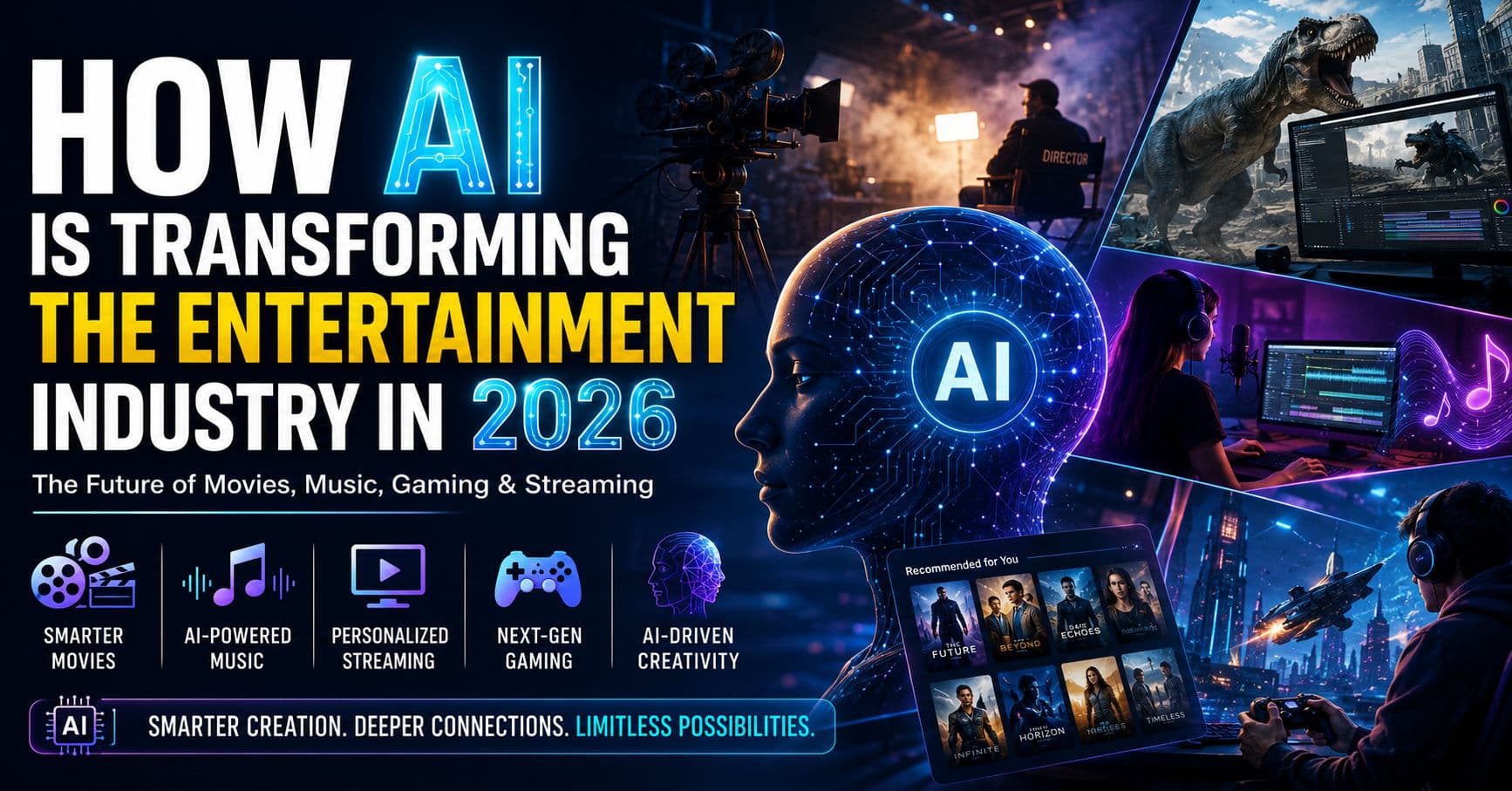
Entertainment has always evolved alongside technology. From black-and-white films to color television, from DVDs to streaming platforms, every technological advancement has changed the way people consume content. Today, another major transformation is taking place—and it's being driven by Artificial Intelligence (AI).
In 2026, AI is no longer just a tool used behind the scenes. It's becoming an essential part of the entertainment industry, helping filmmakers create realistic visual effects, enabling musicians to compose songs, improving recommendations on streaming platforms, and even changing how video games respond to players.
Whether you're watching a blockbuster movie, binge-watching your favorite web series, listening to music on Spotify, or playing the latest video game, there's a good chance AI is already shaping your experience.
For businesses, creators, and audiences alike, AI is opening up exciting possibilities while also raising important questions about creativity, ethics, and the future of entertainment.
In this guide, we'll explore how AI is transforming movies, music, streaming platforms, gaming, animation, and content creation—and what it means for the future of digital entertainment.
What Is AI in Entertainment?
Artificial Intelligence in entertainment refers to the use of smart algorithms and machine learning technologies to create, improve, distribute, and personalize digital content.
Unlike traditional software that follows fixed instructions, AI can analyze large amounts of data, identify patterns, and make intelligent decisions. This allows entertainment platforms to understand audience preferences, automate creative tasks, and deliver more personalized experiences.
Today, AI is used across nearly every part of the entertainment industry, including:
- Movie production
- Music creation
- Video editing
- Streaming recommendations
- Gaming
- Animation
- Visual effects (VFX)
- Voice generation
- Content moderation
- Personalized advertising
As AI technology continues to improve, its role in entertainment is becoming even more significant.
AI in the Film Industry
Filmmaking has always required creativity, time, and significant investment. AI is helping studios simplify many complex tasks while giving creators new ways to bring their ideas to life.
1) Script Analysis
Before production begins, AI can analyze movie scripts to identify pacing issues, predict audience preferences, and even suggest improvements based on successful storytelling patterns.
While AI doesn't replace screenwriters, it serves as a valuable tool for refining ideas and identifying potential weaknesses in a script.
2) Visual Effects (VFX)
Modern movies rely heavily on visual effects, and AI is making the process faster and more efficient.
AI-powered tools can:
- Remove unwanted objects from scenes
- Enhance visual quality
- Generate realistic backgrounds
- Improve facial animations
- Speed up rendering processes
This reduces production time while maintaining high-quality visuals.
3) Editing and Post-Production
Video editing is another area where AI is making a major impact.
Editors can use AI to:
- Automatically organize footage
- Detect the best scenes
- Improve color correction
- Remove background noise
- Generate subtitles
- Upscale video quality
These features allow creative teams to focus more on storytelling rather than repetitive technical tasks.
AI in Music
Artificial Intelligence is also changing the way music is created and experienced.
Rather than replacing musicians, AI acts as a creative assistant that helps artists experiment with melodies, lyrics, and production techniques.
Some AI tools can:
- Compose original melodies
- Suggest chord progressions
- Generate background music
- Improve audio quality
- Remove unwanted noise
- Master songs automatically
Independent artists especially benefit from these tools because they reduce production costs while speeding up the creative process.
Streaming services also use AI to recommend songs based on listening habits, making music discovery easier than ever before.
Personalized Streaming Experiences
Streaming platforms such as Netflix, Disney+, Amazon Prime Video, and Spotify rely heavily on AI to keep users engaged.
Every time you watch a movie, skip a song, or search for content, AI learns more about your preferences.
It then uses this information to recommend content that matches your interests.
Instead of showing the same homepage to every user, AI creates a personalized entertainment experience.
This improves customer satisfaction while increasing viewing time and platform engagement.
AI in Gaming
Gaming has become one of the fastest-growing entertainment industries, and AI is playing a vital role in its evolution.
Modern games use AI to create smarter opponents, realistic environments, and dynamic gameplay experiences.
For example:
- Enemies adapt to player behavior.
- Non-player characters (NPCs) respond more naturally.
- Game difficulty adjusts automatically.
- Virtual worlds become more interactive.
- AI helps detect cheating and improve online security.
These advancements make games more immersive and enjoyable for players of all skill levels.
AI and Content Recommendations
Have you ever wondered why YouTube always seems to suggest another interesting video?
Or why Netflix recommends shows that match your taste?
The answer is Artificial Intelligence.
Recommendation systems analyze factors such as:
- Viewing history
- Search behavior
- Watch time
- Ratings
- User interests
- Similar audience behavior
Based on this information, AI predicts what users are most likely to enjoy next.
This personalization benefits both audiences and streaming companies by improving user satisfaction and increasing content consumption.
AI in Animation and Visual Effects (VFX)
Animation has always been one of the most time-consuming aspects of filmmaking. Creating realistic characters, environments, and special effects often takes months—or even years—of work by large creative teams.
Today, AI is helping animation studios speed up many of these processes without compromising quality.
Instead of manually creating every movement frame by frame, AI can assist with:
- Character animation
- Facial expressions
- Lip synchronization
- Motion tracking
- Background generation
- Scene enhancement
- Lighting adjustments
This doesn't replace artists. Instead, it allows designers and animators to spend more time on creativity while AI handles repetitive tasks.
Hollywood studios, animation companies, and game developers are increasingly using AI-powered tools to produce more realistic visual experiences in less time.
AI for Content Creators
The rise of YouTube, Instagram, TikTok, and other social media platforms has transformed millions of people into content creators.
AI has become an essential assistant for creators by simplifying everyday tasks.
Today, AI can help with:
- Video editing
- Thumbnail generation
- Caption writing
- Subtitle creation
- Voice enhancement
- Background removal
- Image generation
- Script suggestions
- Social media scheduling
For small creators with limited budgets, AI tools reduce production costs while helping maintain professional-quality content.
This allows creators to focus more on storytelling and connecting with their audience.
AI in Live Sports and Broadcasting
Artificial Intelligence is also improving live sports coverage.
Broadcasters now use AI to:
- Generate instant match highlights
- Analyze player performance
- Display real-time statistics
- Improve camera tracking
- Predict game trends
- Personalize sports content
Fans can enjoy smarter match analysis and customized viewing experiences based on their favorite teams or players.
As AI technology improves, sports broadcasting is expected to become even more interactive.
Benefits of AI in Entertainment
Artificial Intelligence offers numerous advantages for both creators and audiences.
1) Faster Content Production
AI automates repetitive tasks, allowing studios and creators to produce high-quality content more quickly.
2) Better User Experience
Streaming services use AI to recommend personalized content, helping users discover movies, music, and shows they genuinely enjoy.
3) Lower Production Costs
AI-powered editing, animation, and design tools reduce the time and resources required to create professional-quality content.
4) Improved Accessibility
AI-generated subtitles, language translation, speech recognition, and voice synthesis make entertainment more accessible to audiences worldwide.
5) Enhanced Creativity
Rather than replacing creative professionals, AI helps them experiment with new ideas, explore different styles, and improve workflows.
Challenges and Ethical Concerns
While AI offers many exciting opportunities, it also introduces several important challenges.
Copyright Issues
One of the biggest debates is whether AI-generated content should be protected under copyright laws.
Questions remain about ownership, originality, and fair use.
Deepfake Technology
AI can create highly realistic fake videos and voices.
Although this technology has legitimate uses in filmmaking and visual effects, it can also be misused for misinformation or identity manipulation.
Responsible use and stronger regulations will be essential.
Impact on Creative Jobs
Some people worry that AI may replace editors, designers, writers, or musicians.
However, industry experts generally believe AI will act as a collaborative tool rather than replacing human creativity.
Creative thinking, storytelling, and emotional expression remain uniquely human strengths.
Privacy Concerns
Streaming platforms collect large amounts of user data to personalize recommendations.
Companies must ensure transparent data practices while protecting user privacy.
The Future of AI in Entertainment
Artificial Intelligence is still evolving, and its influence on entertainment will continue to grow over the coming years.
Future developments may include:
1) AI-generated interactive movies
2) Personalized movie endings
3) Fully virtual actors
4) Real-time multilingual dubbing
5) Hyper-personalized music playlists
6) AI-assisted filmmaking
7) Immersive virtual reality experiences
8) Smarter gaming environments
As technology advances, audiences can expect entertainment experiences that are more interactive, engaging, and tailored to individual preferences.
Will AI Replace Human Creativity?
This is one of the most frequently asked questions.
The simple answer is No.
AI is incredibly powerful when it comes to automation, analysis, and generating ideas, but it lacks genuine human emotions, imagination, cultural understanding, and life experiences.
A compelling movie, an emotional song, or a memorable story still depends on human creativity.
The most successful entertainment in the future will likely be created through collaboration between talented creators and intelligent AI tools.
Article Comments
You must be signed in to post comments.
Sign In to Join the Discussion →No comments approved yet. Be the first to share your thoughts!
About the Author

Pratik Mali
Technology Consultant
Professional engineers crafting clean code architectures and visual portfolios for SMBs.
Related Insights

UPI MDR Is Back — Ashneer Grover Is Half Right | APXTECK

Amodei Wants to Slow AI. Indian SMBs, Read This First | APXTECK

How Blinkit's Free Ambulance Became Its Best Marketing Move

GPT-6 Astra: OpenAI’s New AI Model Could Change Software Development and Business Work

AI-Powered Cyberattacks Are Rising: Why Every Business Needs Stronger Cybersecurity Now

How Next.js and Generative Search Help Builders Win Leads

Build Your Own Food Delivery App: Stop Giving Your Profits to Swiggy & Zomato