

China Just Put a Data Center on the Ocean Floor. No Humans Allowed. Here Is Why This Changes Everything.

Praveen Kumar
The Biggest Cost in AI Is Not the Model. It Is the Cooling.
Every time you ask an AI model a question, somewhere in the world a rack of servers generates heat. Not a little heat — enormous quantities of sustained, relentless heat that must be removed continuously or the hardware fails. A modern GPU cluster running AI inference generates roughly the same heat as a small commercial kitchen, running twenty-four hours a day, seven days a week, forever.
The industry's solution to this problem for the past fifty years has been air conditioning. Industrial-scale air conditioning, consuming enormous quantities of electricity, in climate-controlled buildings that themselves require significant land, water, and infrastructure. The average data center spends roughly 40% of its total energy just on keeping servers cold. In hot climates, that number is worse. As AI workloads grow and GPU clusters become denser and hotter, the cooling problem only intensifies.
China looked at this problem and asked a different question. Instead of building better air conditioning, what if you put the servers somewhere that is already cold?
On May 20, 2026, the answer went live.
What China Just Built
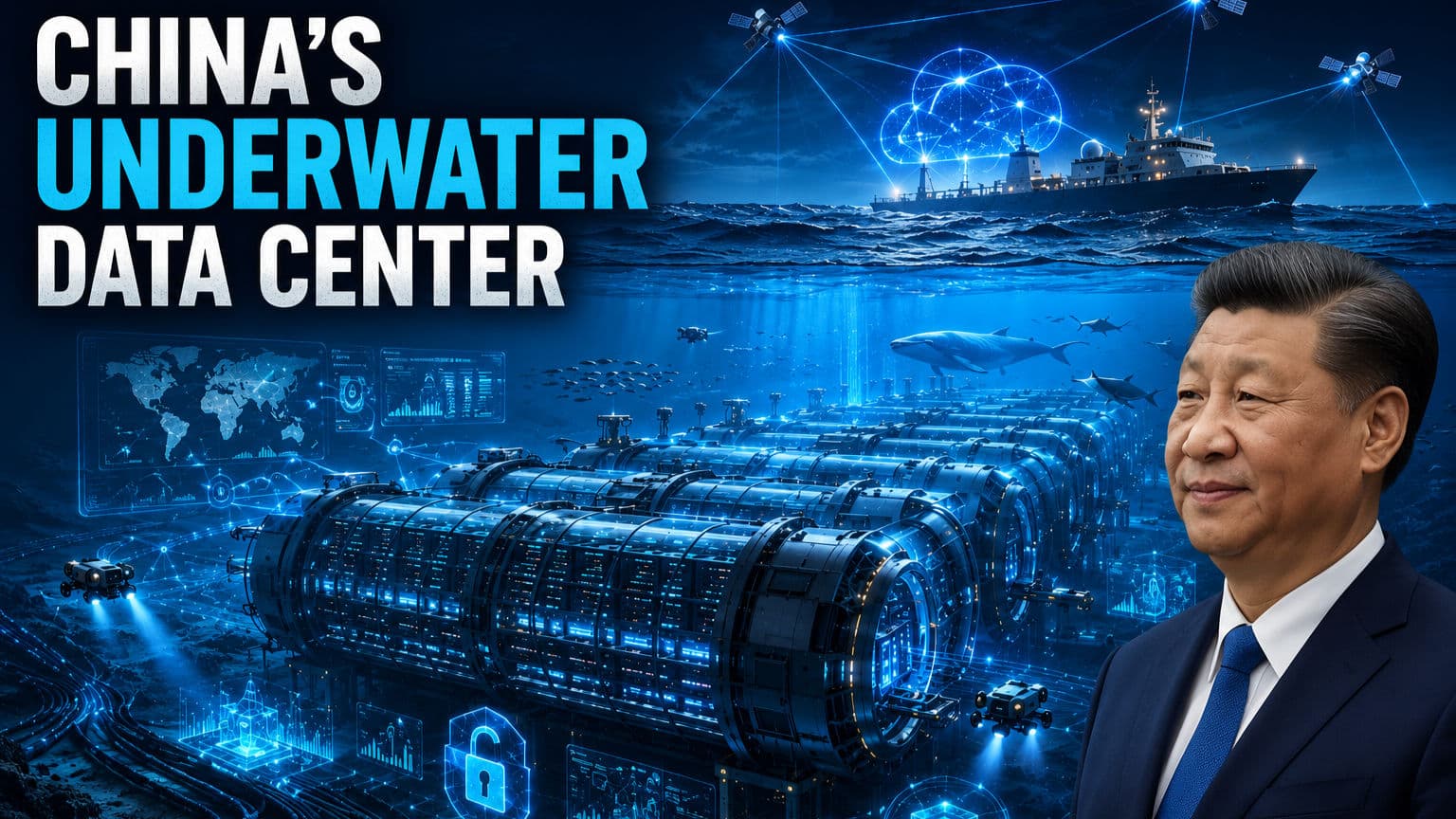
The world's first commercial underwater data center went live near Shanghai in May 2026. The $226 million facility sits 35 meters below the surface of the East China Sea, about six miles off the coast of Shanghai's Lingang Special Area, houses roughly 2,000 servers, and draws more than 95% of its electricity from an offshore wind farm with over 200 turbines.
Work on the facility began after agreements were finalised in June 2025. Construction was completed in October 2025. Initial trials began in February 2026 before the facility entered full commercial operation in May.
The facility was built by HiCloud Technology — a private engineering company specializing in subsea data center infrastructure — in partnership with state-backed China Telecom, energy company Shenergy Group, and infrastructure group CCCC Third Harbor Engineering. The 24 MW facility houses nearly 2,000 servers including GPU clusters from China Telecom and LinkWise, and is expected to process artificial intelligence, big data annotation, and 5G infrastructure workloads.
The servers are sealed inside pressure-resistant submarine-grade capsules — modular units that can be lowered to the ocean floor and connected into a cluster. No humans work inside. No humans can work inside. Maintenance access requires bringing modules to the surface, which is designed to happen infrequently because the underwater environment itself dramatically reduces hardware failure rates.
How the Cooling Actually Works
The engineering is elegant in its simplicity. Unlike conventional land-based data centers that rely heavily on industrial chillers and HVAC systems, the Shanghai facility uses surrounding seawater as a massive passive heat sink. A representative from HiCloud Technology explained the process: servers generate hot air, which is drawn into backplane air conditioners that change the refrigerant in copper pipes from liquid to gas. The gas rises to the cooling layer of the upper module by its own buoyancy, where it exchanges heat with a heat exchanger through seawater and changes back from gas to liquid. Gravity then returns it to the server room, forming a heat exchange system that requires no power.
Read that last part again. The heat exchange system requires no power. The ocean does the work. The buoyancy cycle runs on physics, not electricity.
The facility achieves a Power Usage Effectiveness (PUE) below 1.15 by using seawater as a passive coolant, cutting total power consumption by 22.8% compared to equivalent land-based facilities. It also uses zero freshwater — a real constraint as data center construction accelerates in water-stressed regions.
To put PUE in context: the industry average is around 1.5, meaning that for every unit of energy used for computing, another 0.5 units go toward cooling and overhead. Google's best data centers achieve around 1.1. This underwater facility at 1.15 is among the most energy-efficient large-scale data centers currently in operation on Earth — not through advanced cooling technology, but through the passive thermodynamics of the ocean itself.
Beyond cooling efficiency, the facility cuts land use by more than 90% compared with above-ground data centers. In a world where data center construction is facing increasing resistance from local communities over land use, noise, and water consumption, the underwater model eliminates several of the most contentious planning objections simultaneously.
Microsoft Did This First — Then Stopped
The obvious question is why this has not happened before. The answer is that it has — at research scale — and the results were extraordinary.
Microsoft ran its own underwater data center experiment — Project Natick — testing submerged data center capsules off the coast of California in 2015, followed by a larger deployment off Scotland's Orkney Islands in 2018. Microsoft's trials found that sealed underwater environments could reduce hardware failure rates by limiting exposure to oxygen and human interference. The company later discontinued the programme commercially and did not move it into large-scale deployment.
The Microsoft results were striking. Hardware failure rates underwater were significantly lower than equivalent land-based deployments. The sealed environment, free from oxygen corrosion, humidity fluctuations, and human handling, turned out to be extraordinarily gentle on server hardware. The Project Natick team reported that servers deployed underwater failed at about one-eighth the rate of those in conventional data centers.
Microsoft stopped anyway. The reasons cited were economics and the difficulty of servicing submerged equipment — if something fails, you cannot simply send a technician to swap a component. You have to surface the module, repair it, and redeploy it. At research scale with a small cluster, that is manageable. At commercial scale, the logistics become more complex.
China turned the same concept into a working commercial facility and is already planning a 500-megawatt expansion.
The difference is not technical innovation — the underlying physics are identical. The difference is execution philosophy. Microsoft treated Project Natick as a research experiment with no predetermined commercial path. China treated it as an infrastructure problem to be solved at scale, with government backing, state telecom partners, and a commercial client base committed from day one.
Why This Matters for AI Infrastructure
The timing is not coincidental. The underwater data center went live in May 2026 — precisely when AI infrastructure demand is growing faster than land-based data center construction can keep pace with.
The numbers are significant. A typical hyperscale data center being built today to serve AI workloads is measured in hundreds of megawatts to gigawatts. The Shanghai underwater facility at 24 megawatts is, as Gizmodo noted, more of a first commercial proof-of-concept than a capacity replacement for land-based facilities at current scale.
But the expansion plan tells the real story. China is already planning a 500-megawatt expansion of the underwater data center concept. At that scale, the economics become genuinely transformative. A 500-megawatt underwater facility running at PUE 1.15 versus a land-based equivalent at PUE 1.5 represents enormous ongoing energy savings — not just for operational cost, but for the carbon footprint of AI computation globally.
The renewable energy component compounds this advantage. The data center is positioned between the first and second phases of Lingang's offshore wind farm, meaning the power source and the cooling medium are the same body of water. The offshore wind turbines generate electricity; the ocean absorbs the heat. It is a remarkably integrated system.
The Honest Limitations
Any engineering breakthrough deserves honest examination of its constraints.
Scale. At 24 megawatts, this facility is orders of magnitude smaller than the gigawatt-class data centers being built to serve frontier AI training. It is not replacing land-based infrastructure — it is demonstrating that an alternative model is commercially viable. The expansion to 500 megawatts, if it proceeds, will be the more meaningful proof point.
Maintenance complexity. The inability to send technicians inside is a feature for reliability in normal operation but a constraint during hardware failures. Surfacing a module for repairs is a logistically complex operation that adds time and cost compared to replacing a component in a land-based rack. The design philosophy accepts this trade-off on the basis that failure rates are low enough that maintenance frequency is manageable.
Environmental questions. Data centers don't need freshwater to function, but the heat transfer from servers to ocean raises questions about local thermal impact that are not yet fully characterized for large-scale deployments. A 24-megawatt facility in the East China Sea is a negligible thermal load. A network of 500-megawatt facilities raises different questions about cumulative thermal discharge into marine environments.
Geopolitical context. This facility runs on Chinese government-backed infrastructure, serves Chinese state telecom workloads, and operates in Chinese territorial waters. The technology itself is not inherently geopolitical, but the first mover advantage in underwater data center infrastructure has strategic implications for who controls the physical layer of AI computation in different maritime regions.
What Comes Next
China is not the only country moving in this direction. A Peter Thiel-backed startup called Panthalassa is developing wave-powered floating data centers designed to operate far offshore using ocean water for passive cooling while drawing electricity from onboard renewable energy systems. The concept of ocean-adjacent or ocean-submerged data centers is transitioning from Microsoft's abandoned experiment to a recognized infrastructure category with multiple serious commercial entrants.
For India, the implications are worth watching. India has 7,500 kilometers of coastline, significant offshore wind potential in the Bay of Bengal and Arabian Sea, and rapidly growing AI infrastructure demand that is currently served almost entirely by land-based data centers dependent on freshwater cooling. The technical model demonstrated by HiCloud in Shanghai is directly applicable to Indian coastal geography.
The engineering is proven. The economics are demonstrably favorable. The question is whether Indian infrastructure investment — public or private — will treat this as a serious option for the next generation of data center capacity, or whether the response will be the same as Microsoft's: impressive experiment, commercially discontinued.
The Bigger Picture
The AI infrastructure race is ultimately a race about energy and cooling as much as it is about model quality and compute. The countries and companies that figure out how to run more computation per kilowatt of electricity, with less freshwater, on less land, win a compounding advantage that compounds with every model generation.
China just demonstrated that the ocean floor is a viable answer to the cooling problem. The facility is operational, commercially serving real workloads, powered almost entirely by renewable energy, and planning a twenty-times expansion.
Microsoft ran the same experiment for eleven years, published the results, and stopped. China read the results and built a business.
The gap between those two responses says more about the current state of AI infrastructure competition than any benchmark comparison.
Published by APXTECK — AI Infrastructure Analysis and Technology Strategy for Indian Businesses. We help Indian developers and businesses understand the technologies shaping the next decade of digital infrastructure. Talk to us →
Article Comments
You must be signed in to post comments.
Sign In to Join the Discussion →No comments approved yet. Be the first to share your thoughts!
About the Author

Praveen Kumar
Founder & Full-Stack Developer, APXTECK
Founder & Full-Stack Developer at APXTECK. He writes about technology, business, cybersecurity, AI, and topics that help readers understand complex subjects in a simple and practical way.
Related Insights

Mandatory Certificates and Registrations Every Indian Startup Needs in 2026

Ponytail: The Open-Source Skill That Makes Your AI Agent Code Like a Lazy Senior Developer

America Banned Their Chips. China Built a World-Class AI Anyway — And Gave It Away for Free

Spider-Man: Brand New Day — Everything We Know About Marvel's Biggest Spider-Man Reboot

The Paperclip Company: How Claude + OpenAI Are Building Businesses With Zero Employees

How AI Is Helping Small Businesses Save Time, Reduce Costs, and Grow Faster in 2026

How AI Is Transforming the Entertainment Industry in 2026: Movies, Music, Gaming & Streaming