

The Paperclip Company: How Claude + OpenAI Are Building Businesses With Zero Employees

Praveen Kumar
What Is Paperclip AI — Actually?
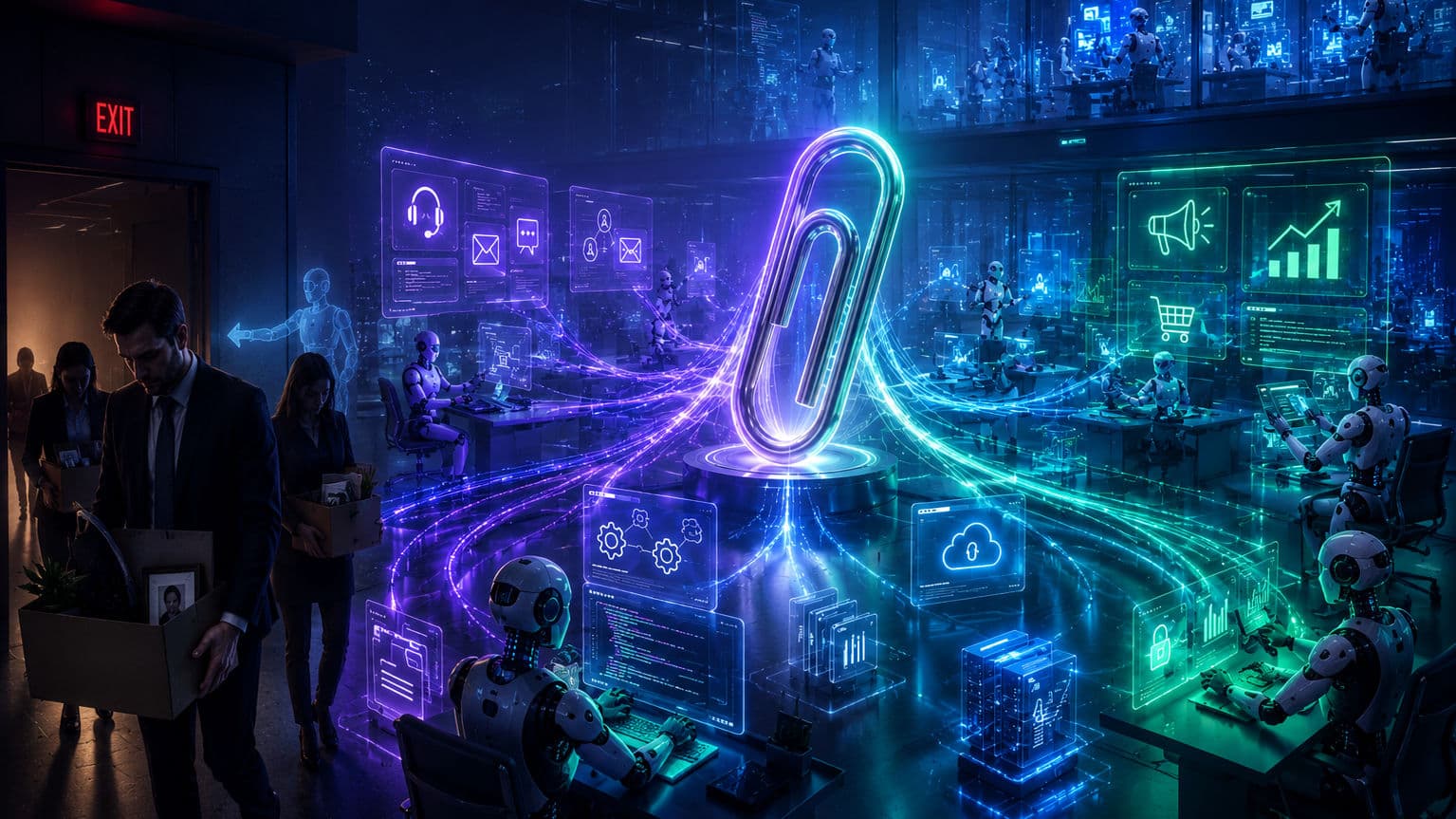
Paperclip AI is a platform that promises to build and run a company for you using nothing but AI agents. You give it a business name and a goal, and an AI "CEO" called Zeus hires AI employees to handle marketing, coding, sales, and more.
The origin story is more practical than philosophical. Dotta was running an automated hedge fund and found himself managing over 20 Claude Code terminal windows simultaneously. There was no shared context between agents, no cost tracking across sessions, and no way to recover state after a system reboot. Paperclip grew directly out of that operational frustration.
This is the key insight most people miss. Paperclip AI does not make individual AI agents smarter. It solves a different, harder problem — coordination. Getting twenty Claude windows to work together toward a shared goal, with shared memory, shared budgets, and shared accountability, is an entirely different engineering challenge than making one Claude window smarter.
If you think of an individual AI agent like Claude or ChatGPT as an employee, Paperclip is the company. The key shift is not just using AI as a tool, but treating AI agents as autonomous team members with defined roles, budgets, and accountability. The difference between "using AI tools" and "running AI agents" is coordination. A single ChatGPT prompt is a tool. Fifteen agents working together with shared goals, budget limits, and audit trails is an organisation.
The Zero-Employee Company Is Already Happening
This is not theoretical. Real founders are already running real businesses this way.
Nat Eliason built an AI agent called Felix using an AI agent framework. Felix operates autonomously, earning over $100,000 in revenue with a target of $1 million. Aaron Sneed runs 15 custom GPT agents as a "council" — each agent has a specific role. Together, they save Sneed over 20 hours per week.
Tech platforms have pioneered a model in which the vast majority of labor is provided by contractors, not employees. The question is no longer whether, but when we will see employee-free enterprises.
And the economics are becoming undeniable. When Claude API costs ₹11 per million tokens and a full-time employee costs ₹30,000 to ₹1,00,000 per month — the math is shifting in ways that cannot be ignored.
How Claude and OpenAI Fit Into This Picture
Paperclip AI is not an AI model itself. It is an orchestration layer — the management infrastructure that sits on top of existing AI models. The team has been rapidly expanding runtime support, adding Gemini CLI and Cursor, OpenCode, and Pi adapters. The trajectory suggests continued expansion to cover every major agent runtime in the ecosystem.
Claude, in this architecture, plays the role of the actual worker. When the Zeus CEO agent decides it needs a blog post written, it spins up a Claude agent with a specific role, a specific budget, and a specific deliverable. When it needs code written, it spins up another Claude instance as a developer. When it needs market research, another agent handles that — possibly using a different model entirely depending on cost and task requirements.
This is why claude ai searches surged +40% in July 2026 on Google Trends. Developers are not just curious about Claude as a chatbot anymore. They are evaluating it as an employee — as a component in an autonomous business system that runs without human intervention.
OpenAI's GPT models play a similar role. The zero-employee company does not pledge loyalty to one AI provider. It routes tasks to whichever model handles that task best and cheapest — Claude for writing and coding, GPT for reasoning-heavy tasks, Gemini for long-context document processing.
What This Actually Looks Like in Practice
Imagine an Indian startup founder who wants to run a content marketing agency. With Paperclip AI and a Claude API key, the setup looks something like this:
The founder defines the company goal — produce and publish ten SEO-optimized blog posts per week for clients. Zeus, the AI CEO, analyzes the goal and spins up a team. A Content Strategist agent researches keywords and plans topics. A Writer agent — running on Claude — drafts each post. An Editor agent reviews and refines. A Publisher agent formats and schedules. A Reporting agent sends the weekly summary.
The founder's job shifts from doing the work to reviewing outputs and setting goals. One person commands the output of what previously required a five-person team.
Whether you are using AI to source creators or Paperclip to manage internal operations, the tools are now in place for a single person to command the output of a 50-person firm. The question for 2026 is not how many employees you can hire, but how well you can orchestrate the ones you build.
The Honest Limitations — What Does Not Work Yet
Anyone telling you the zero-employee company is fully solved today is overselling it. A real test of Paperclip AI in 2026 revealed uncomfortable gaps.
The risks showed up in a weekend test: hallucinated data presented as fact in marketing materials and business plans. Unreviewed code pushed to production with broken layouts. Security vulnerabilities and logic errors are basically guaranteed. Autonomous outreach — cold emails sent on your behalf that you never saw. One bad email to the wrong person and your brand takes a hit, or you are violating regulations. No escalation path: when an AI agent makes a bad call, there is nobody to catch it.
Paperclip requires meaningful technical ability to set up and operate. You need comfort with command-line tools, Node.js, pnpm package management, environment variables, and reading documentation. This is not a no-code experience. There is no managed cloud version as of mid-2026. You are entirely responsible for your own infrastructure.
For Indian businesses, three additional friction points apply. First, most of these tools are built for English-language workflows — Hindi and regional language support is thin. Second, Indian regulatory requirements around customer data, communications, and financial operations add constraints that autonomous agents cannot navigate without human oversight. Third, the infrastructure costs of running persistent agents around the clock add up faster than the API costs alone suggest.
What the Paperclip Maximizer Warning Still Means
Here is where the philosophical origin of the name becomes practically relevant.
The problem with the paperclip maximizer is not that the machine is malevolent. The problem is that it is not. It has no concept of malevolence, or kindness, or humanity. Each decision is logical. Each step follows from the last.
When you instruct a Paperclip AI company to "maximize revenue," it will pursue that goal with the same indifference. It may send emails that damage your reputation. It may generate content that is factually wrong. It may optimize a metric that looks like the goal but is not actually the goal. It does not know the difference between a good customer relationship and a quick sale. It does not care.
This is why the most successful zero-employee company implementations in 2026 are not fully autonomous — they are human-in-the-loop systems. The AI does the execution. A human defines the goal, reviews critical outputs, and sets the ethical guardrails. Invest in governance. Budget controls, audit trails, human checkpoints. These are not overhead. They are infrastructure.
The paperclip maximizer thought experiment was never really about paperclips. It was about the danger of optimizing for a metric without understanding the values behind it. That warning is more relevant now than when Bostrom wrote it in 2003.
What This Means for Indian Developers and SMBs
The zero-employee company is not a threat to replace — it is a tool to deploy. The Indian businesses that will win in the next five years are not the ones with the most employees. They are the ones that figure out which tasks should be automated and build the governance to make automation trustworthy.
For Indian developers specifically, Paperclip AI and its successors represent a genuine opportunity. Building, configuring, and managing multi-agent systems for clients is a skill gap that currently has very few practitioners in India. The developer who masters Claude agent orchestration, multi-agent coordination, and automated workflow governance in 2026 will be extremely valuable in 2027 and beyond.
For Indian SMBs, the practical starting point is not a zero-employee company — it is a one-employee company with AI handling the repeatable work. Start with one agent for one task. Content generation, lead research, customer support responses, invoice drafting. Validate that it works. Then expand.
The paperclip company is real. The question is whether you will be the one building it — or the one it is built to compete with.
Published by APXTECK — AI Automation & Full-Stack Development for Indian SMBs. We help Indian businesses deploy AI agents, build automation workflows, and create production-ready web platforms. Talk to us about your AI project →
Article Comments
You must be signed in to post comments.
Sign In to Join the Discussion →No comments approved yet. Be the first to share your thoughts!
About the Author

Praveen Kumar
Founder & Full-Stack Developer, APXTECK
Founder & Full-Stack Developer at APXTECK. He writes about technology, business, cybersecurity, AI, and topics that help readers understand complex subjects in a simple and practical way.
Related Insights

Spider-Man: Brand New Day — Everything We Know About Marvel's Biggest Spider-Man Reboot

How AI Is Helping Small Businesses Save Time, Reduce Costs, and Grow Faster in 2026

How AI Is Transforming the Entertainment Industry in 2026: Movies, Music, Gaming & Streaming

Why the India–Australia Uranium Deal Matters: Energy Security, Strategic Partnership & Future Impact

Meta Glass AI Explained: Features, Benefits, Use Cases & Everything You Need to Know in 2026

Satluj Movie Explained: The True Story Behind Punjab's Darkest

The Complete UI/UX Design Guide: How Great Design Turns Visitors into Loyal Customers