


NASA's Webb Telescope Finds Hidden Planet in Beta Pictoris System

Praveen Kumar
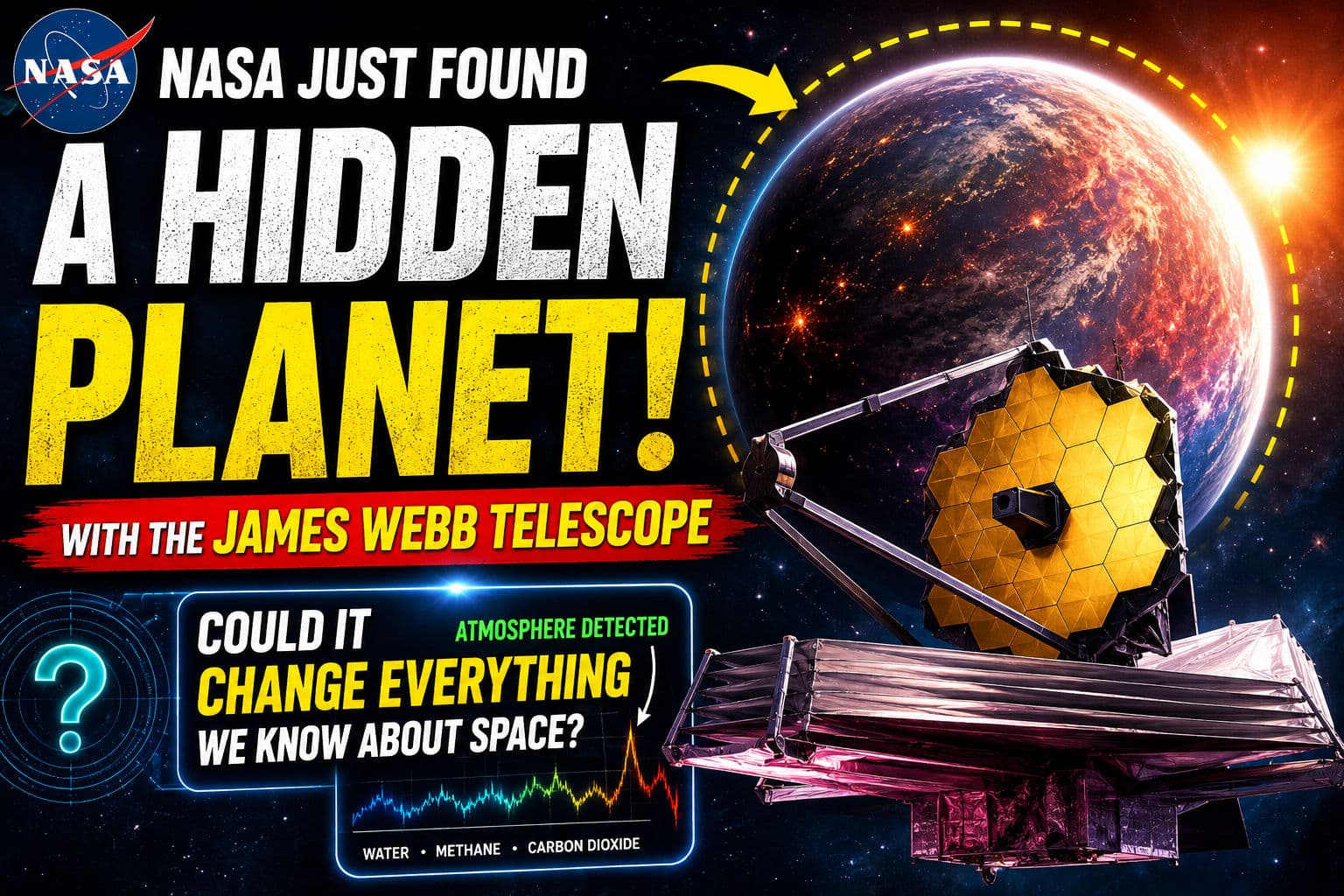
NASA's Webb Telescope Finds Hidden Planet in Beta Pictoris System
On July 15, 2026, NASA announced a discovery that has astronomers rethinking how we search for new worlds. Using the James Webb Space Telescope (JWST), scientists found a previously unknown giant planet lurking inside one of the most studied star systems in our Milky Way galaxy — and they found it using a method no one had successfully used to discover a planet before.
The planet is called Beta Pictoris d, and it has been hiding in plain sight for years.
What Exactly Did NASA Discover?
Astronomers using JWST discovered a third giant planet orbiting the young star Beta Pictoris, located about 63 light-years from Earth. The star was already known to host two planets — Beta Pictoris b (one of the first exoplanets ever directly imaged) and Beta Pictoris c.
The newly found Beta Pictoris d makes this only the second planetary system ever known to contain three directly imaged planets.
The study, led by Aidan Gibbs at the University of California, San Diego, was published in The Astrophysical Journal Letters on July 15, 2026.
"Beta Pictoris has long served as a laboratory for understanding how planetary systems form and evolve, and now we have another planet helping us tell that story," Gibbs said in the announcement.
Why Was Beta Pictoris d So Hard to Find?
Despite decades of observations with ground-based telescopes, the Hubble Space Telescope, and even JWST itself, Beta Pictoris d remained invisible. There are two key reasons.
It was buried inside a debris disk. Beta Pictoris is surrounded by one of the brightest known debris disks — a swirling cloud of dust, rock, and ice leftover from planet formation. This debris disk scattered and reflected so much light that traditional imaging techniques could not separate the planet from the background noise.
Traditional planet-hunting looks for light, not chemistry. Most directly imaged exoplanets are found by spotting a faint dot of light near a star. But in a system full of bright debris, a faint dot could be anything — an instrumental glitch, a clump of dust, or a background star. Researchers needed a way to confirm that the light source was genuinely a planet.
The Breakthrough Detection Method
This is where the discovery becomes truly groundbreaking.
Beta Pictoris d was not found the traditional way. Instead of relying on coronagraphic imaging (blocking out starlight to see planets), the team used moderate-resolution spectroscopy with JWST's Near-Infrared Spectrograph (NIRSpec).
Here is the key difference:
| Method | How It Works | Limitation |
|---|---|---|
| Coronagraphic Imaging | Blocks starlight and looks for faint dots | Cannot distinguish planets from dust clumps |
| Spectroscopic Detection | Analyzes the chemical fingerprint of light | Identifies planets by their unique atmospheric composition |
When JWST captured spectral data from the Beta Pictoris system, researchers noticed an unexpected bright source in the field. But as Jean-Baptiste Ruffio, the principal investigator from UC San Diego, explained: "We've learned not to trust bright blobs in images. They can be instrumental artifacts or other structures in the debris disk. By obtaining a spectrum at the same time as the image, we were able to quickly confirm our suspicions."
The spectrum revealed clear absorption features from methane (CH₄), carbon monoxide (CO), and water (H₂O) — unmistakable signatures of a planetary atmosphere. The planet's radial velocity measurements also confirmed it was genuinely orbiting Beta Pictoris, ruling out background stars or brown dwarfs.
This is the first directly imaged planet ever discovered primarily through spectroscopy. It opens an entirely new avenue for finding hidden worlds.
What Do We Know About Beta Pictoris d?
Based on the published research, here is what scientists have established so far:
| Property | Details |
|---|---|
| Name | Beta Pictoris d |
| Distance from Earth | ~63 light-years |
| Estimated Mass | 2–4 times Jupiter's mass |
| Orbital Distance | Greater than 30 AU from its star |
| Atmospheric Composition | Methane, carbon monoxide, water vapor |
| System Position | Widest orbit of the three known planets |
| Discovery Method | JWST NIRSpec + MIRI spectroscopy |
Scientists believe Beta Pictoris d may be responsible for carving the inner edge of the Beta Pictoris debris disk — essentially acting as a gravitational sculptor that shapes the architecture of its entire system.
Interestingly, an independent team using the Very Large Telescope (VLT) in Chile also confirmed the planet around the same time, using a different instrument called ERIS. When they went back through archival data, they found the planet had been captured in earlier observations but was never identified — it truly had been hiding in plain sight for over a decade.
Why the Beta Pictoris System Matters
Beta Pictoris is not just any star. Since the discovery of its debris disk in 1983, it has been one of the most important laboratories for studying how planetary systems form. Here is why scientists keep coming back to it:
- It is young. At roughly 20 million years old, Beta Pictoris is still actively forming planets, giving us a rare window into processes that shaped our own solar system billions of years ago.
- It is close. At 63 light-years away, it is one of the nearest systems with directly imaged planets, making detailed study possible.
- It is rich. The system contains planets, exocomets, complex dust structures, and now a third confirmed giant planet — a complete planetary system in the making.
- It is evolving. JWST previously observed a "cat's tail" feature in the debris disk, thought to be the remnant of a collision between two objects roughly the size of a small moon.
With three confirmed planets and a wealth of other structures, Beta Pictoris is essentially a time capsule showing us what the early days of a planetary system look like.
Other Jaw-Dropping JWST Discoveries in 2025–2026
Beta Pictoris d is far from the only headline-making discovery JWST has delivered recently. Here are some of the most significant findings from the past year:
The Pulsar Planet That Defies Physics (January 2026)
JWST observed PSR J2322-2650b, a Jupiter-mass planet orbiting a rapidly spinning neutron star. The planet has a helium-and-carbon-dominated atmosphere, with soot clouds floating through the air and potentially diamonds condensing deep within. It completes a full orbit in under eight hours and is stretched into a lemon shape by the pulsar's extreme gravity. No existing theory explains how such a planet could form.
Rock Clouds That Vanish Every Night (May 2026)
On the distant exoplanet WASP-94A b, located nearly 700 light-years away, JWST discovered a weather cycle unlike anything on Earth. Clouds made of rocky minerals gather every morning and completely disappear by evening. It was the clearest look scientists have ever had at cloud cycling on a Hot Jupiter.
A Saturn-Sized Planet with Earth-Like Temperatures (May 2026)
TOI-199b, a gas giant about the size of Saturn located over 330 light-years away, was found to have surprisingly Earth-like temperatures and a methane-rich atmosphere. It is one of the first known "temperate" gas giants ever studied in detail.
A Planet That Survived Its Star's Death (July 2026)
WD 1856 b, a Jupiter-sized planet orbiting a white dwarf (a dead star the size of Earth), was found to have an atmosphere — the first time an atmosphere has been detected around a white dwarf planet. The planet should have been destroyed when its star died, but it survived, offering a glimpse into what might happen to our own solar system billions of years from now.
How the James Webb Telescope Actually Works
For those less familiar with the technology, here is a quick overview of what makes JWST so powerful:
- Location: JWST orbits the Sun about 1.5 million kilometres from Earth at the second Lagrange point (L2), far from Earth's heat interference.
- Mirror: Its primary mirror is 6.5 metres across, made of 18 gold-coated beryllium segments. It had to fold origami-style to fit inside the rocket.
- Sunshield: A five-layer sunshield the size of a tennis court protects the instruments from infrared radiation, providing the equivalent of SPF 1 million.
- Infrared Vision: Unlike Hubble (which primarily sees visible light), JWST sees in infrared, letting it peer through dust clouds and detect faint heat signatures from distant objects.
- Instruments: Key instruments include NIRSpec (spectroscopy), NIRCam (imaging), MIRI (mid-infrared), and NIRISS (interferometry).
The combination of extreme cold, infrared sensitivity, and spectroscopic capability is exactly what made the Beta Pictoris d discovery possible. As researcher Michael Zhang explained, ground-based telescopes cannot do this because Earth's own heat interferes with infrared observations.
What This Means for the Future of Space Exploration
The Beta Pictoris d discovery is not just about one planet. It establishes spectroscopic detection as a viable method for finding exoplanets — and that has massive implications.
Planets hiding in debris disks can now be found. Many young planetary systems are surrounded by thick dust that blocks traditional imaging. Spectroscopy cuts through that limitation by identifying planets through their atmospheric chemistry rather than their light alone.
Archival data becomes a treasure trove. Once scientists knew what to look for, they found Beta Pictoris d in older observations that had already been taken and stored. This means hundreds or thousands of existing JWST datasets could contain undiscovered planets waiting to be identified.
Multi-planet systems become easier to map. By combining imaging with spectroscopy, astronomers can build more complete pictures of complex systems — understanding not just where planets are, but what they are made of and how they interact with their environment.
FAQ
Is Beta Pictoris d habitable?
No. Beta Pictoris d is a gas giant 2–4 times the mass of Jupiter. It has no solid surface and its atmospheric conditions are extremely different from Earth. However, studying its atmosphere helps scientists understand planetary formation processes that may also apply to smaller, potentially habitable worlds.
How far away is Beta Pictoris d?
The Beta Pictoris system is approximately 63 light-years from Earth. In astronomical terms, that is relatively close — it is one of the nearest systems with directly imaged planets.
Can we see Beta Pictoris d with amateur telescopes?
No. While the star Beta Pictoris is visible to the naked eye from the Southern Hemisphere, the planet itself is far too faint and close to its star to be resolved with consumer telescopes. Detecting it required JWST's advanced instruments.
What makes this discovery different from other exoplanet discoveries?
This is the first time a directly imaged exoplanet was discovered primarily through spectroscopy — analyzing its atmospheric fingerprint — rather than traditional imaging. This technique could transform how we search for planets in complex environments.
How many exoplanets has JWST discovered?
JWST has contributed to the discovery and characterisation of dozens of exoplanets since its launch in December 2021. However, its primary strength is in studying exoplanet atmospheres in detail, rather than bulk discovery (which missions like TESS handle).
What is a debris disk?
A debris disk is a ring of dust, rock fragments, and ice orbiting a star. It is the leftover material from the star and planet formation process — similar to our solar system's asteroid belt and Kuiper Belt, but often much larger and brighter.
Conclusion
The discovery of Beta Pictoris d is a landmark moment for astronomy. Not because we found another giant planet — we have catalogued thousands — but because of how it was found. Spectroscopic detection opens a new chapter in exoplanet science, one where hidden worlds can be identified by their chemical fingerprints even when they are invisible to direct imaging.
JWST continues to prove that our understanding of the universe is far from complete. Every time we develop a new way of looking, we find something we did not expect.
And in a system that astronomers have studied for over 40 years, a giant planet was sitting right there the whole time, waiting for the right instrument and the right technique to reveal it.
Interested in how cutting-edge technology is reshaping industries here on Earth? At APXTECK, we help Indian SMBs leverage AI, automation, and modern web development to build systems that actually work. Get in touch with us to explore what is possible for your business.
Article Comments
You must be signed in to post comments.
Sign In to Join the Discussion →No comments approved yet. Be the first to share your thoughts!
About the Author

Praveen Kumar
Co-Founder & DirectorFull-Stack Developer, APXTECK
Praveen Kumar is the Co-Founder and Full-Stack Developer at APXTECK, an AI-powered IT agency helping Indian SMBs grow through web development, automation, and AI integration. He builds production-grade systems using Node.js, Next.js, PostgreSQL, and modern AI APIs. When he is not shipping code, he is writing about practical technology that actually works for Indian businesses.
Related Insights

Why Whale Vomit Is Worth Millions: The Truth About Ambergris and the Fragrance Industry

OnePlus' Global Strategy Shift: What Oppo's Business Restructuring Could Mean for Smartphone Users

The 3 Careers That Will Pay the Most in 2026–2030 — AI, Quantum, and the End of Engineering Silos

GPT-5.6 vs Grok 4.5 vs Claude Fable 5 — I Built the Same GTA Game With All Three. Here Is the Honest Result.

OmniRoute: The Free Open-Source Tool That Connects Claude Code, Cursor, and Codex to 1.6 Billion Free Tokens Every Month

How to Grow Your Business: The 4 Powerful Growth Strategies Explained

Microsoft's Record 570 Security Fixes: What Every Business and IT Team Should Learn About Modern Cybersecurity