


Why Whale Vomit Is Worth Millions: The Truth About Ambergris and the Fragrance Industry

Praveen Kumar
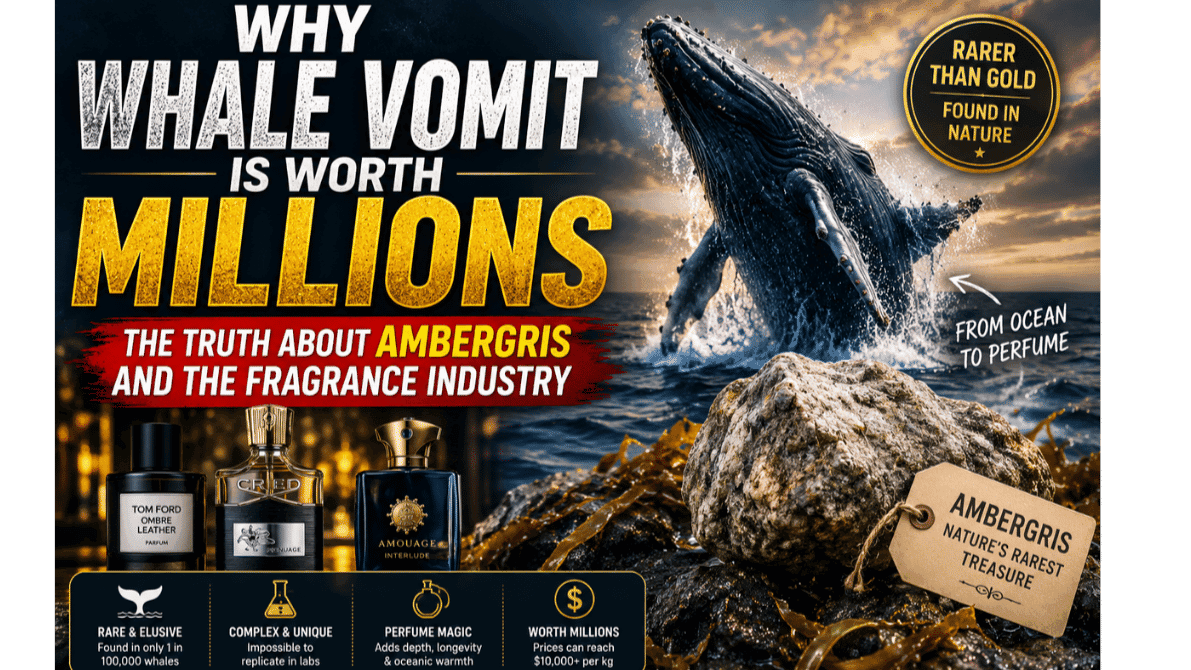
Why Whale Vomit Is Worth Millions: The Truth About Ambergris and the Fragrance Industry
Few substances on Earth carry a stranger origin story than ambergris. It forms inside the intestines of sperm whales, spends years floating across open oceans, and eventually washes ashore as a waxy, sun-bleached lump that can be worth more than gold per gram.
In 2025, premium-grade ambergris fetched between $40,000 and $65,000 per kilogram on the global market. The entire ambergris market was valued at over $600 million. And the substance driving all this demand? It is, quite literally, a byproduct of whale digestion — commonly (and somewhat inaccurately) known as "whale vomit."
Here is the full story of how one of the most unusual materials on the planet became indispensable to the global fragrance industry — and why the tide may be turning.
What Is Ambergris, Exactly?
Ambergris is a solid, waxy substance produced in the digestive system of sperm whales (Physeter macrocephalus). Despite its popular nickname, it is almost certainly not vomit. Modern research suggests it is expelled as excrement, though the exact mechanism remains debated.
Here is how it forms. Sperm whales feed primarily on squid — giant squid, colossal squid, and Humboldt squid, among others. While the soft flesh is digested, the hard, sharp beaks sometimes pass into the intestines and irritate the lining. In response, the whale coats the irritating mass with a fatty, waxy secretion to protect its tissues. Over months or even years, this material hardens into a dense lump.
Eventually, the whale expels the mass into the ocean. From there, sunlight and salt water go to work. The surface oxidises, the colour fades from jet black to grey or white, and the sharp, foul smell mellows into something altogether different — a complex, warm, musky aroma that perfumers have coveted for centuries.
Only an estimated 1 to 5 percent of the world's sperm whale population produces ambergris, making it exceptionally rare. Global annual natural supply is estimated at fewer than 2,000 to 3,000 kilograms in most years.
What Does Ambergris Smell Like?
Describing the smell of ambergris is notoriously difficult because it changes dramatically with age.
| Stage | Colour | Texture | Scent |
|---|---|---|---|
| Fresh (newly expelled) | Jet black | Soft, sticky, clay-like | Strong, foul, barnyard-like |
| Partially aged | Dark brown to grey | Firmer, waxy | Marine, sharp, musky |
| Fully aged (ocean-cured) | Silver-grey to white | Hard, chalky crust | Warm, sweet, earthy, tobacco-like |
The fully aged material is what perfumers want. People who have smelled it describe notes of warm skin, soft tobacco, clean animal musk, sun-dried seaweed, and a faint underlying sweetness. The aroma can reportedly persist for up to 300 years.
What makes it especially remarkable is its dual function in perfumery. Ambergris works both as a fragrance note (adding a distinctive warm, skin-like aura) and as a fixative (helping other scents in a perfume last longer and project more effectively on the skin).
A Brief History of Ambergris in Perfumery
The relationship between ambergris and fragrance stretches back millennia.
- Ancient China called it "dragon's spittle fragrance," believing it fell from sleeping dragons above the sea.
- Ancient Egypt used it as incense in religious ceremonies.
- Medieval Europe employed it as an aphrodisiac and even as a remedy against the Black Death.
- Ancient Greece added it to wine to intensify its intoxicating effects.
By the 19th century, ambergris was a status symbol of the European aristocracy. Queen Victoria's signature perfume, Creed's Fleurs de Bulgarie (created in 1845), combined Bulgarian rose with ambergris. Elizabeth I had her gloves perfumed with it, reportedly finding that the scent lingered even after washing.
In the early 20th century, nearly every fine perfume contained some form of animal-derived note — ambergris chief among them. Some of the world's most iconic fragrances, including Chanel No. 5 and Givenchy Amarige, have historically listed ambergris among their ingredients.
Why Is Ambergris So Expensive?
Several factors converge to make ambergris one of the most expensive natural raw materials on Earth.
Extreme Rarity
Only a tiny fraction of sperm whales produce ambergris. The global annual supply is measured in thousands of kilograms — a minuscule amount compared to demand from luxury fragrance houses, pharmaceutical companies, and specialty food artisans. You cannot farm it, cultivate it, or predict where it will appear.
Unpredictable Supply Chain
Unlike virtually every other commodity, ambergris has no controlled supply chain. It appears at random — washed up on a beach, floating in the open ocean, or occasionally found inside the carcass of a deceased whale. The entire supply depends on chance discovery.
Quality Depends on Ocean Aging
The best ambergris has spent decades floating at sea, slowly oxidising and developing its complex scent profile. A piece that has cured for 20 to 30 years is far more valuable than freshly expelled material, which is essentially useless in perfumery. You cannot accelerate this process artificially.
Extreme Buyer Concentration
The commercial buyer universe for ambergris is remarkably small — an estimated fewer than 500 institutional buyers worldwide account for the majority of commercial volume. This creates a relationship-intensive market where a single high-quality specimen can command extraordinary prices.
Recent Pricing
| Grade | Price Range (2025) |
|---|---|
| Premium (white/grey, fully aged) | $40,000–$65,000 per kg |
| Medium (grey, partially aged) | $15,000–$35,000 per kg |
| Low (dark, unrefined) | $5,000–$12,000 per kg |
To put this in perspective, gold was trading at roughly $70,000 to $95,000 per kilogram through 2025. Premium ambergris routinely approaches — and sometimes exceeds — the price of gold.
The Legal Minefield: Where Is Ambergris Legal?
This is where things get complicated. The legal status of ambergris varies dramatically from country to country.
| Country/Region | Legal Status | Notes |
|---|---|---|
| United Kingdom | Legal | Naturally beached ambergris is freely tradeable |
| European Union | Legal (most nations) | France, home to luxury perfumery, permits trade of naturally expelled ambergris |
| New Zealand | Legal | Major source; active beachcombing community |
| Australia | Legal | Beached ambergris is tradeable |
| United States | Illegal | Banned under the Endangered Species Act; penalties up to $50,000 and imprisonment |
| India | Illegal | Banned under the Wildlife Protection Act, 1972; sperm whales are protected under Schedule II |
The core legal debate hinges on whether ambergris is a "wildlife product" (since it comes from an endangered species) or a "waste product" (since the whale expels it naturally without harm). Countries following the CITES framework generally treat it as waste and permit trade. Countries like the United States and India treat it as a derivative of a protected species and ban it outright.
Ambergris Smuggling in India
In India, despite the ban, ambergris smuggling remains a persistent problem. The substance's enormous black-market value — often exceeding ₹1 crore per kilogram — makes it an attractive target for wildlife trafficking networks.
Recent high-profile seizures include a 5.75 kg haul worth approximately ₹10 crore in Goa (June 2025), a 3.18 kg seizure valued at ₹3.01 crore in Ahmedabad (January 2026), and an 18.1 kg interception at the Tuticorin coast by the Directorate of Revenue Intelligence. Authorities believe many of these operations are linked to interstate and international smuggling networks that exploit India's long coastline and proximity to Sri Lanka.
The Rise of Synthetic Ambergris: Ambroxan and Its Alternatives
Given the ethical concerns, legal restrictions, and sheer scarcity of natural ambergris, the fragrance industry has been developing synthetic alternatives for decades. The most important of these is Ambroxan (also known as ambroxide or Ambrox).
What Is Ambroxan?
Ambroxan is a synthetic molecule (chemical formula C₁₆H₂₈O) designed to replicate the scent profile and fixative properties of natural ambergris. It was first synthesised by Swiss chemical company Firmenich in the 1950s, derived from sclareol, a naturally occurring compound found in clary sage (Salvia sclarea).
Today, several major flavour and fragrance houses produce their own versions:
| Product Name | Manufacturer | Source |
|---|---|---|
| Ambrox Super | dsm-firmenich | Clary sage (sclareol) |
| Ambrofix | Givaudan | Sugar cane (biotechnological process, since 2009) |
| Ambroxan | Kao Corporation | Chemical synthesis |
| Cetalox | Firmenich | Chemical synthesis (creamier variant) |
How Does Ambroxan Compare to Natural Ambergris?
Ambroxan successfully replicates many of the most desirable qualities of aged ambergris — the warm, woody-amber scent, the musky depth, and the fixative longevity. It can last over 400 hours on a smelling strip.
However, purists argue that synthetic alternatives cannot fully capture the complexity and depth of natural ambergris, which develops its character over decades of ocean aging. The debate mirrors similar discussions around natural versus synthetic musk, sandalwood, and oud.
Famous Fragrances Using Ambroxan
Ambroxan has become one of the most widely used ingredients in modern perfumery. Notable fragrances featuring it prominently include:
- Dior Sauvage — François Demachy's blockbuster uses ambroxan as a structural backbone
- Molecule 02 (Escentric Molecules) — A single-molecule fragrance made entirely of Ambrox, created by perfumer Geza Schön
- Creed Aventus — Uses Firmenich's Ambrox Classique in its base
- Mr. Burberry Element (Burberry) — Features ambergris-type notes alongside green almond and juniper
How to Identify Ambergris on the Beach
If you live near the coast — especially in New Zealand, Australia, the UK, or parts of Africa — the fantasy of finding a lump of "floating gold" is understandable. But misidentifications are extremely common. Here is a practical field guide.
The Four-Check Test
Check 1: Visual appearance. Look for a natural chalky or powdery white crust over a mottled grey, brown, or black interior. Ambergris rarely has a uniform colour.
Check 2: Weight. Ambergris is surprisingly light for its size and floats in seawater. If it sinks, it is not ambergris.
Check 3: The hot needle test. Touch a heated needle or pin to a small spot on the surface. Genuine ambergris softens, leaves a glossy residue, and releases a distinctive white smoke with a musky, complex scent.
Check 4: Interior examination. If there is a chipped edge, look for tiny dark fragments inside — these are often squid beak pieces embedded in the waxy matrix.
Common Misidentifications
Paraffin wax, palm oil residues, sewer grease ("fatbergs"), pumice, and melted bottle glass are all frequently mistaken for ambergris. If you are unsure, contact a museum, a marine mammal expert, or a reputable dealer who can test for the presence of ambrein (the key chemical compound) in a laboratory.
Important: If you are in India or the United States, even possessing ambergris is illegal. Do not collect it — report the find to local authorities instead.
The Future of Ambergris and the Fragrance Industry
The ambergris market is at an inflection point. Several forces are reshaping its future.
Demand is growing. The global ambergris market is projected to reach approximately $1 to $1.7 billion by 2034, driven by luxury fragrance houses, pharmaceutical applications, and niche artisan perfumeries that prize rare natural ingredients.
Synthetics are dominant but not universal. Ambroxan and its variants now power the vast majority of commercial fragrances. However, a segment of ultra-high-end perfumers continues to use natural ambergris for its irreplicable complexity, treating it the way fine dining treats truffles — synthetic alternatives exist, but the real thing carries a mystique no lab can manufacture.
Regulation is tightening. By 2026, an estimated 35 to 40 percent of commercially traded ambergris passes through verified, documented supply chains, up from roughly 20 to 25 percent in 2022. This is projected to exceed 60 percent by 2030 as governments formalise trade rules.
Ethics are shifting consumer preferences. The broader trend toward cruelty-free, vegan, and sustainably sourced beauty products is steadily eroding demand for natural animal-derived ingredients across the industry. For mainstream fragrance, the synthetic future is already here.
FAQ
Is ambergris actually whale vomit?
Not exactly. While ambergris has been called "whale vomit" for centuries, modern research suggests it is most likely expelled as excrement from the whale's intestines, not vomited from the stomach. The misnomer persists because it is more memorable (and frankly, more dramatic) than "whale intestinal secretion."
Why is ambergris illegal in India?
India prohibits the possession, sale, and transport of ambergris under the Wildlife Protection Act of 1972. Sperm whales are listed as a protected species under Schedule II (upgraded to Schedule I in the 2022 amendment) of the Act. Any derivative of a protected species is treated as a prohibited wildlife product, regardless of whether the animal was harmed.
Can I legally buy ambergris perfume?
Yes, in most countries. Perfumes containing natural ambergris or synthetic ambroxan are legal to buy and wear virtually everywhere. The restrictions apply to trading in raw ambergris itself, not to finished consumer products. Most modern fragrances use synthetic alternatives anyway.
How can I tell if my perfume contains real ambergris?
In practice, it is very difficult to tell. Most fragrances marketed with "ambergris" notes use synthetic Ambroxan. If a perfume uses genuine natural ambergris, it will typically be from a niche or ultra-luxury house, and it will almost certainly be priced accordingly. The ingredient list may reference "ambrein" or "ambergris tincture" rather than "ambroxan."
What is the most expensive ambergris ever found?
Several finds have made headlines for their extraordinary value. In recent years, a 100-kilogram boulder of white ambergris found by a Thai fisherman reportedly fetched offers exceeding $3 million. Finds worth ₹10 crore or more have been seized in India alone.
Is ambergris used in food?
Historically, yes. Ambergris has been used to flavour wine, chocolate, and coffee in various cultures over the centuries. Some collectors still dissolve small amounts in hot beverages. However, food-grade use is extremely niche today and subject to the same legal restrictions as other forms of trade.
Conclusion
Ambergris sits at a fascinating intersection of biology, chemistry, luxury commerce, law, and ethics. A substance that begins as a whale's digestive defence mechanism ends up in some of the most exclusive perfumes on Earth, commanding prices that rival precious metals.
But the story is evolving. Synthetic alternatives like Ambroxan have made the warm, musky character of ambergris accessible to mass-market perfumery without any dependence on whales. Regulatory frameworks are tightening. Consumer preferences are shifting toward sustainable and cruelty-free products.
Natural ambergris will likely retain its mystique among collectors and ultra-niche perfumers for decades to come — much like natural pearls coexist alongside cultured ones. But for the fragrance industry as a whole, the future smells synthetic, sustainable, and no less extraordinary.
The ocean still holds its secrets. But the days of building a billion-dollar industry on chance encounters with floating whale waste are quietly drawing to a close.
Curious about how technology is transforming traditional industries? At APXTECK, we help Indian SMBs harness AI, automation, and modern web development to build smarter businesses. Talk to us about what we can build together.
Article Comments
You must be signed in to post comments.
Sign In to Join the Discussion →No comments approved yet. Be the first to share your thoughts!
About the Author

Praveen Kumar
Co-Founder & DirectorFull-Stack Developer, APXTECK
Praveen Kumar is the Co-Founder and Full-Stack Developer at APXTECK, an AI-powered IT agency helping Indian SMBs grow through web development, automation, and AI integration. He builds production-grade systems using Node.js, Next.js, PostgreSQL, and modern AI APIs. When he is not shipping code, he is writing about practical technology that actually works for Indian businesses.
Related Insights

OnePlus' Global Strategy Shift: What Oppo's Business Restructuring Could Mean for Smartphone Users

NASA's Webb Telescope Finds Hidden Planet in Beta Pictoris System

The 3 Careers That Will Pay the Most in 2026–2030 — AI, Quantum, and the End of Engineering Silos

GPT-5.6 vs Grok 4.5 vs Claude Fable 5 — I Built the Same GTA Game With All Three. Here Is the Honest Result.

OmniRoute: The Free Open-Source Tool That Connects Claude Code, Cursor, and Codex to 1.6 Billion Free Tokens Every Month

How to Grow Your Business: The 4 Powerful Growth Strategies Explained

Microsoft's Record 570 Security Fixes: What Every Business and IT Team Should Learn About Modern Cybersecurity