


Claude Tag Makes AI a Teammate. That's the Trap.

Praveen Kumar
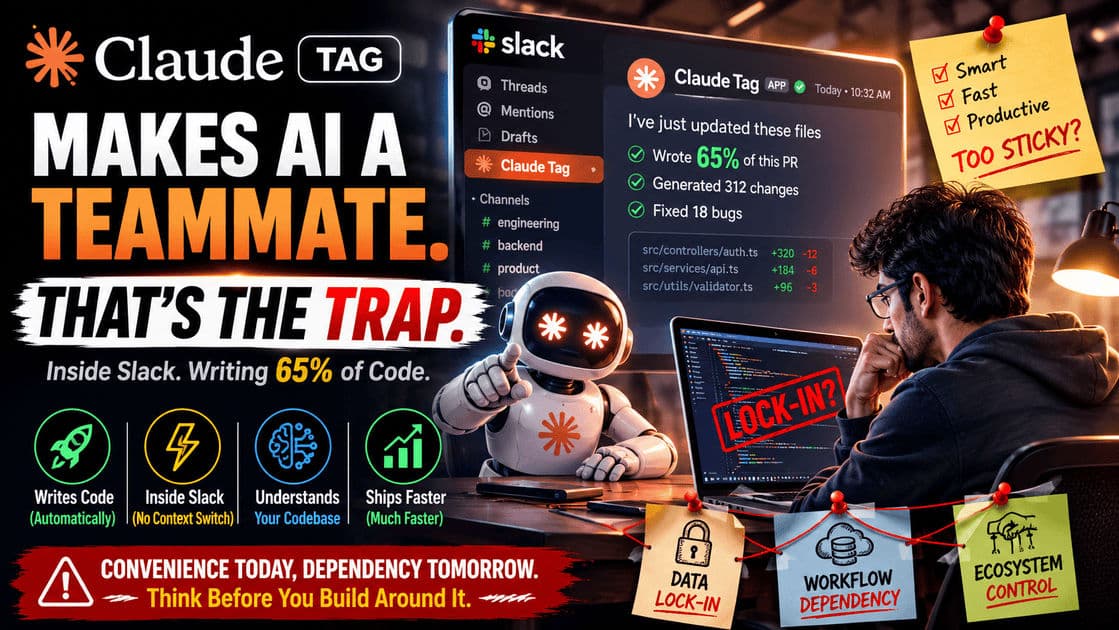
Claude Tag Makes AI a Teammate. That's the Trap.
Every AI product until now has followed the same interaction model: you open a window, you type a prompt, you get an answer, you close the window. The AI exists in its own tab, separate from where your team actually works.
On June 23, 2026, Anthropic broke that pattern. Claude Tag puts Claude directly inside your Slack workspace — not as a bot you DM privately, but as a shared teammate that lives in your channels, sees what the team discusses, learns your company's patterns, and does work autonomously while posting updates in the same threads where your humans coordinate.
The internal numbers are striking. Anthropic's own product team reports that 65% of their code is now written by their internal version of Claude Tag. Not generated in a separate IDE and pasted back. Written by an AI that sits in the same Slack channels where the engineering team plans, debates, and ships.
This is the most architecturally significant shift in how AI integrates with teams since ChatGPT launched. And almost nobody in the Indian dev community is talking about it — partly because it's locked behind Enterprise and Team pricing, and partly because the implications take time to sink in.
What Claude Tag Actually Does (Beyond the Marketing)
Let me be specific about what shipped, because the hype cycle is already distorting this.
Shared Context, Not Private Chat
The old Claude Slack integration worked like a personal assistant. You DM'd Claude, it responded to you, nobody else saw the conversation. Claude Tag inverts this. When you invite Claude into a channel, it becomes a single shared instance visible to everyone. Any team member can tag it, hand it a task, or pick up where someone else left off. The context is the channel's context, not yours.
This matters more than it sounds. When a developer tags Claude in a thread to debug an API integration, and then leaves for the day, another developer can jump into the same thread tomorrow morning and Claude already knows the full context — what was tried, what failed, what the current hypothesis is.
Autonomous Task Execution
Tag Claude with a task and it doesn't just answer — it works. It breaks complex tasks into stages, executes them using connected tools (GitHub, Gmail, internal APIs via MCP servers), and posts progress updates back into the thread. Your team reviews and approves at decision points while Claude handles the investigation, implementation, and follow-up.
The incident response workflow is the clearest example. When a page fires, someone tags Claude in the incident channel. It pulls relevant graphs, diffs the recent deploy, identifies a likely root cause, tags the author of the problematic change, proposes a fix, and — if approved — opens a PR and monitors the recovery. The entire loop happens inside the Slack thread, with humans approving at checkpoints and Claude doing the legwork.
Ambient Mode
This is where it gets genuinely interesting and genuinely expensive. With ambient mode enabled, Claude passively monitors the channel conversation and proactively surfaces insights, flags potential issues, or suggests follow-ups — without anyone tagging it. It's the difference between a teammate you have to ask and a teammate who notices things on their own.
The cost implication is significant: ambient mode reads the channel stream continuously, consuming tokens for every message it processes. In a busy channel with hundreds of messages per day, this burns through credits fast. Anthropic provides spend caps, but you need to set them before turning ambient mode on, not after.
Persistent Memory
The longer Claude Tag lives in your channels, the more it learns about how your company operates — who owns what systems, how decisions get made, what your deployment process looks like, what your team's communication style is. This context accumulates over weeks and months, making Claude increasingly effective and increasingly difficult to replace.
That last point is by design. And it's the part of Claude Tag that every technical leader needs to think about carefully before adopting.
The Lock-In Dynamics Nobody Is Discussing
Here's the conversation I keep having with Indian startup founders and dev leads: "Should we adopt Claude Tag?" And here's my honest answer: probably yes, but not without understanding what you're signing up for.
The Context Trap
Swap the model — that's easy. Swap the accumulated context of months of team conversations, learned workflows, institutional knowledge, and operational patterns — that's impossible. Once Claude Tag has been embedded in your team's Slack for a year, migrating away doesn't just mean switching an API endpoint. It means starting from zero on everything the AI learned about how your company works.
This is a new category of vendor lock-in. We've dealt with data lock-in (migrating databases), platform lock-in (moving off AWS), and tool lock-in (switching from Jira to Linear). Context lock-in is different because the locked-in asset isn't a data format or an API contract — it's accumulated understanding that's harder to quantify and harder to export.
The Pricing Pressure Point
Claude Tag is consumption-based, running on Opus 4.8 at $5 per million input tokens and $25 per million output tokens. Anthropic is offering introductory credits through September 1, 2026, which softens the initial cost, but the long-term billing depends entirely on how much your team uses it.
For an Indian startup on the Team plan, the math starts at ₹10,500/month minimum (5 seats × $25/seat at current exchange rates) before any token consumption. Add active Claude Tag usage across multiple channels — especially with ambient mode on — and you're looking at ₹25,000-₹75,000/month depending on activity levels. That's a meaningful expense for a 10-person Indian startup.
For comparison, a 10-person Indian SaaS startup's entire Slack bill is typically ₹4,000-₹8,000/month. Claude Tag could cost 3-10x your Slack subscription.
What Anthropic Gets Right
Credit where it's due: the governance model is well-designed. Admins control which channels Claude can access, which tools it can call, and what spend limits apply per channel. Billing is transparent (consumption-based, not hidden), and all Claude actions are logged in an activity feed. These are enterprise-grade controls that most AI-in-Slack implementations skip entirely.
The agent identity model is also genuinely novel. Claude Tag runs under your organization's identity and permissions, not the individual user's. This means access control is scoped at the channel level, not the person level, which is the correct architecture for a shared team agent.
The Open-Source Alternative (And Why It Matters)
Within days of Claude Tag's launch, open-source alternatives appeared. The most notable are Open Claude Tag (by developer Anil Matcha) and Open Tag (by the creator of CopilotKit). Both replicate the core concept — a shared AI agent living in your Slack channels — with three critical differences.
First, they're model-agnostic. You can plug in Claude, GPT, Gemini, or a locally-hosted model via LiteLLM or similar routing layers. No vendor lock-in on the model layer.
Second, they're self-hosted. Your company's conversations, context, and accumulated knowledge stay on your own infrastructure. For Indian companies handling client data under NDAs, or healthcare and fintech startups with data residency requirements, this isn't a nice-to-have — it's a legal necessity.
Third, they're free to run (minus your hosting costs and model API fees). The 5-seat Team plan minimum doesn't apply. A 3-person Indian startup can set this up for the cost of a $5/month VPS plus whatever model API they choose.
The Honest Trade-Off
Open-source alternatives don't match Claude Tag's polish. The ambient mode is less sophisticated, the tool integrations are less battle-tested, and you're responsible for your own infrastructure, reliability, and security. Setting up Open Claude Tag requires Node.js 20+, Docker, and familiarity with Slack Bot tokens, API keys, and channel configuration. If your team doesn't have someone comfortable with DevOps, the setup cost in engineering time may exceed what you'd pay Anthropic for six months of Claude Tag.
The decision framework is simple: if you're a 50+ person company already paying for Claude Enterprise, Claude Tag is a no-brainer — add it to your existing plan and pilot it in one engineering channel. If you're a 5-15 person Indian startup where ₹50,000/month matters, start with the open-source version, prove the workflow value, and decide whether the polish justifies the premium later.
Why This Matters More Than Another AI Feature Launch
Claude Tag isn't really about Slack. It's about a structural shift in how AI fits into work.
AI Becomes Ambient, Not On-Demand
The current model — open a tab, type a prompt, get an answer — is a human-initiated, synchronous interaction. Claude Tag introduces ambient AI: an agent that's always present, always accumulating context, and capable of acting proactively without being asked. That's a fundamentally different relationship between humans and AI systems.
For Indian development teams, this changes the daily rhythm of work. Instead of context-switching between Slack and Claude.ai, the AI is already where the conversation is happening. It reads the discussion about a deployment issue, surfaces relevant logs, proposes a solution, and waits for approval — all inside the same thread where the humans are coordinating.
The Team AI Pattern Is Going to Be Everywhere
Anthropic built this for Slack, but the pattern — a persistent, shared AI agent embedded in the tool where your team already works — is going to replicate across every collaboration platform. Microsoft is building similar capabilities into Teams with Copilot. Google will do it in Chat. Every project management tool, every CRM, every support platform will eventually embed a shared AI agent that follows the team's conversations and acts autonomously.
The companies and developers who figure out this pattern now — how to manage shared AI context, how to scope permissions, how to control costs, how to preserve optionality — will have a significant operational advantage in 18 months when every enterprise tool ships their own version.
What Indian Teams Should Do Right Now
Here are three actionable steps based on where your team sits.
If you're on Claude Enterprise or Team already: Turn on Claude Tag in one engineering channel with a ₹5,000 spend cap. Run it for two weeks. Measure what it automates versus what it gets wrong. You'll know within a sprint whether it changes your team's velocity.
If you're a small team (under 10 people): Set up Open Claude Tag or Open Tag on a basic VPS. Start with one channel and one model. The goal isn't matching Claude Tag's capabilities — it's learning the "AI teammate" workflow pattern so your team is ready when the tools mature and pricing drops.
If you're building products for teams: Pay close attention. The "shared AI agent in a collaboration channel" is a new interaction paradigm. If your product has any kind of team collaboration — project management, customer support, developer tooling — this pattern is coming to your category. Building for it now means you're ahead of the platform vendors.
The deeper lesson is the one the YouTube influencers accidentally got right: AI just became a co-worker who never leaves. The question isn't whether to invite it onto your team. The question is whether you own the context it accumulates, or whether that context becomes the most expensive thing you can't export.
Own your context. Everything else is swappable.
Published by APXTECK — AI-powered IT solutions for Indian developers and SMBs. Need help setting up AI team agents or evaluating Claude Tag for your workflow? Visit apxteck.com/services.
Article Comments
You must be signed in to post comments.
Sign In to Join the Discussion →No comments approved yet. Be the first to share your thoughts!
About the Author

Praveen Kumar
Co-Founder & DirectorFull-Stack Developer, APXTECK
Praveen Kumar is the Co-Founder and Full-Stack Developer at APXTECK, an AI-powered IT agency helping Indian SMBs grow through web development, automation, and AI integration. He builds production-grade systems using Node.js, Next.js, PostgreSQL, and modern AI APIs. When he is not shipping code, he is writing about practical technology that actually works for Indian businesses.
Related Insights

I Mastered Claude So You Don't Have To (Beginner to Advanced)

Vibe Coding Is a Trap (Escape Before It's Too Late)

Stop Forcing Your Business to Fit Basic Software | APXTECK

LLM vs AI Agents: What's the Difference and Which One Should You Use in 2026?

Meta's Brain-to-Text AI Works. The Real Question Is Who Controls It.

Grok 4.5 Is Not the Best AI Model. It Might Be the Smartest Bet.
Google's 8 Free AI Tools That Replace Your Entire Paid Stack