


Stop Forcing Your Business to Fit Basic Software | APXTECK

Praveen Kumar
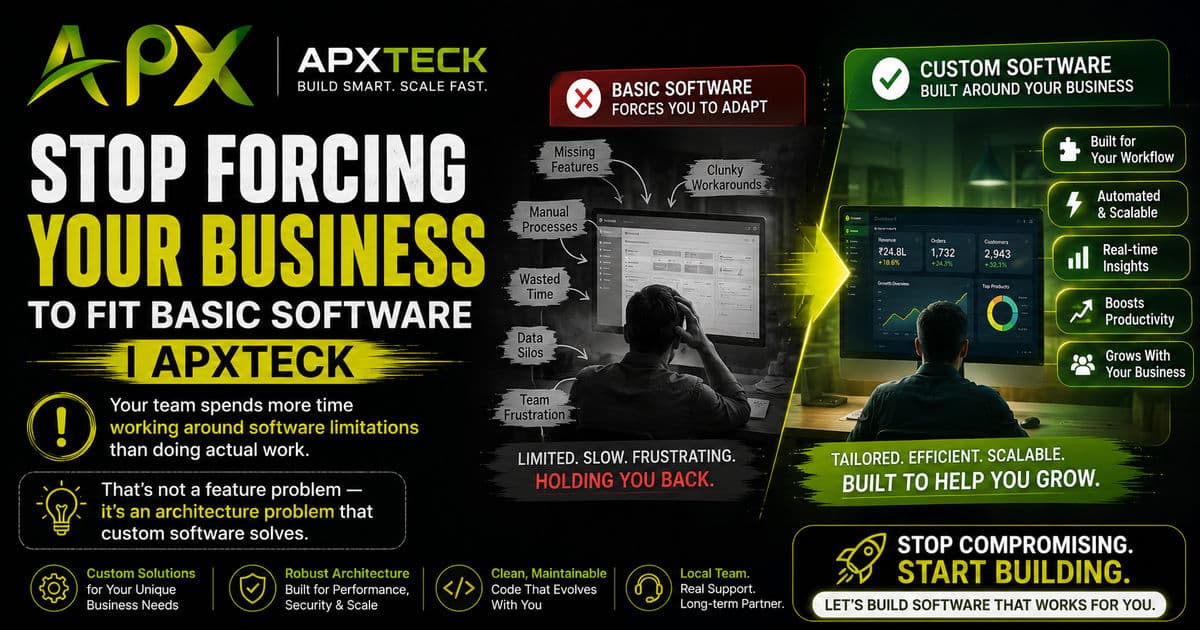
Your Software Should Work for You. Not the Other Way Around.
Here's a scene that plays out in thousands of Indian SMBs every single day: your operations manager opens Zoho to check an order, switches to a Google Sheet to update inventory because Zoho's stock module doesn't handle your warehouse logic, copies the customer's details into a WhatsApp message because your CRM doesn't integrate with your actual communication channel, then manually emails an invoice from Tally because nothing in your stack talks to anything else.
Three tools. Four tabs. Five minutes of copy-pasting for every single order. Multiply that across 50 orders a day, five team members, six days a week. You're burning 25+ hours of productive labour every week on work that software was supposed to eliminate.
And here's the part that really hurts: you're paying ₹15,000-₹40,000 per month across these subscriptions for the privilege of working around their limitations.
This isn't a bug. It's the fundamental design flaw of off-the-shelf software. It was built for everyone, which means it was built for no one in particular. And the moment your business does anything slightly different from the generic template — which every growing Indian business eventually does — you start bending your operations to fit the software instead of the other way around.
At APXTECK, we build the opposite: software that bends to your business. This post is about recognizing when you've outgrown generic tools and what the alternative actually looks like.
The Hidden Tax You're Already Paying
The average SMB runs 87 distinct SaaS applications. According to Zylo's SaaS Management Index, 34% of those are unused or underused. That's not just wasted subscription money — it's wasted mental energy, wasted training time, and wasted onboarding cycles for every new hire who has to learn a dozen disconnected tools just to do their job.
But the real cost isn't the subscription fee. It's the workaround tax.
Research from Retool's 2026 Build vs. Buy Report found that tailored workflows boost productivity 30-50% over generic tools for businesses with non-standard operations. That gap exists because your team isn't spending time doing their job — they're spending time translating between systems that don't understand your business.
A practical rule: if your team spends more than 20% of their time working around a software tool's limitations — maintaining parallel spreadsheets, doing manual data entry between systems, or training staff to "adjust to the software" — you've outgrown it. The tool is no longer serving you. You're serving the tool.
Major SaaS vendors raised prices 15-25% in 2025-2026 while pushing customers toward enterprise plans that most Indian SMBs don't need. 35% of businesses have already replaced at least one SaaS product with custom-built software this year. That number is growing because founders are doing the math and realizing the "cheap" subscription was never cheap.
The Five Signs You've Outgrown Off-the-Shelf Software
Not every business needs custom software. Generic tools work perfectly well for standardized processes — email, basic accounting, team messaging. But there are clear signals that tell you when off-the-shelf has become a liability instead of an asset.
Your Workarounds Have Workarounds
The first workaround is always "just use a spreadsheet for that part." Then the spreadsheet gets complicated, so someone builds a macro. Then the macro breaks when the SaaS vendor updates their export format. Then someone starts maintaining a separate tracking document to keep the spreadsheet accurate. At this point, you have a shadow IT system held together by one person's memory. When that person goes on leave, operations slow to a crawl.
If this sounds familiar, you don't need a better spreadsheet. You need software that handles the workflow natively.
Your Data Lives in Five Different Places
Your customer data is in Zoho. Your order data is in Shopify. Your payment data is in Razorpay's dashboard. Your inventory is in a Google Sheet. Your support tickets are in Freshdesk. And every Monday morning, someone spends two hours manually combining reports from all five systems to give you a picture of last week's business performance.
That picture is already outdated by the time it reaches your desk. And it's probably wrong, because manual data aggregation introduces errors at every transfer point.
The Vendor's Roadmap Doesn't Include Your Problem
You submitted a feature request eight months ago. It's still "under consideration." Meanwhile, the vendor shipped three features you'll never use — dark mode, an AI chatbot that answers questions nobody asks, and a redesigned dashboard that moved all your buttons. Your actual problem — the one costing your team hours every week — remains unsolved because it's too niche for the vendor to prioritize.
You're not their only customer. You're one of thousands. Your workflow is a rounding error in their product decisions.
Per-Seat Pricing Is Becoming a Tax
Your SaaS stack charges per user. You started with five seats. Now you have twenty. The functionality hasn't changed — but your bill has quadrupled. You're paying ₹200-₹500 per user per month across multiple tools, and every new hire increases your software cost before they've produced a single rupee of revenue.
Custom software eliminates per-seat licensing entirely. You own the code. Adding a user costs nothing. That economic difference compounds dramatically as you scale.
Compliance Requirements Don't Fit the Template
GST invoicing, TDS calculations, RBI reporting requirements, sector-specific compliance documentation — Indian businesses operate under regulatory frameworks that global SaaS products handle as afterthoughts. If you're spending time manually adjusting outputs to meet compliance requirements that your software should handle automatically, you're paying for a tool that doesn't understand your market.
What Custom Software Actually Means in 2026
When Indian SMB owners hear "custom software," they often imagine a ₹50-lakh enterprise project that takes 18 months and requires a dedicated IT department to maintain. That was true a decade ago. It's not true today.
Modern custom software development — the kind we do at APXTECK — uses frameworks and architectures that dramatically reduce build time and cost. A well-scoped custom system for an Indian SMB typically runs ₹3-15 lakh depending on complexity, builds in 4-12 weeks, and costs a fraction of what you'd pay in accumulated SaaS subscriptions over three years.
Here's what's changed: the tooling has caught up. Next.js handles the frontend. Node.js and Express power the backend. PostgreSQL with Prisma ORM manages your data. Razorpay handles payments natively — no third-party plugin, no broken webhook, no prayer. AI APIs from OpenAI or Gemini can be integrated directly into your workflow for automation that actually understands your data. And deployment on AWS Mumbai or Vercel means your application runs fast for Indian users, not from a server in Virginia.
The result is software that does exactly what your business needs, nothing more, nothing less. No features you'll never use. No workflows you have to twist your operations to accommodate. No vendor deciding to sunset the tier you depend on.
The Real Cost Comparison Most People Get Wrong
The standard objection to custom software is: "SaaS is ₹2,000/month. Custom development costs lakhs. How is custom cheaper?"
That math only works if you look at month one. Let's look at year three.
A team of 20 people paying ₹300/user/month across three SaaS tools (CRM, project management, invoicing) spends ₹2.16 lakh per year. Over three years, that's ₹6.48 lakh — before price increases. Add the 15-25% annual price hikes that major SaaS vendors have been implementing, and you're looking at ₹7.5-8 lakh over three years. Add the productivity cost of workarounds — even a conservative estimate of 5 hours per week across the team at ₹300/hour — and you're bleeding another ₹2.34 lakh per year, or ₹7 lakh over three years. Total three-year cost of "cheap" SaaS: ₹14-15 lakh in subscriptions plus lost productivity.
A custom system built for ₹8-10 lakh, with annual maintenance at 20% of build cost (₹1.6-2 lakh/year), costs ₹11-14 lakh over the same three years. No per-seat fees. No price hikes. No workaround tax. And you own the code — it's an asset, not a rental.
The break-even point for most Indian SMBs lands between 18 and 36 months. After that, custom software gets cheaper every year while SaaS gets more expensive.
What APXTECK Builds (And How We Think About It)
At APXTECK, we don't start with technology. We start with your workflow.
Before writing a single line of code, we map how your business actually operates — not how a SaaS vendor thinks businesses should operate. Where does data enter your system? How does it flow between teams? Where do people currently resort to manual work, copy-pasting, or spreadsheet gymnastics? What decisions need real-time data that's currently arriving a day late?
That map becomes the architecture. The technology choices follow from the problem, not the other way around.
Web Applications That Replace Your SaaS Stack
A single, integrated web application that handles your orders, inventory, customer communication, invoicing, and reporting — built specifically for how your team works. Not five separate tools duct-taped together. One system where data flows automatically from order to fulfilment to invoice to report without anyone copying and pasting anything.
AI Automation That Understands Your Data
Generic AI chatbots give generic answers. AI systems built on your actual business data — your product catalog, your customer history, your pricing rules, your support patterns — give answers that are specific, accurate, and useful. We integrate AI directly into your workflows: automated lead qualification, intelligent customer support, predictive inventory management, smart document processing.
Workflow Automation That Runs Without You
The processes your team does manually every day — generating reports, sending follow-up emails, updating inventory across channels, reconciling payments — can be automated with systems that trigger on events, run on schedules, and only surface exceptions that need human judgment. Your team stops doing repetitive work and starts doing the work that actually grows the business.
The Honest Framework: When to Stay on SaaS, When to Go Custom
I'm not going to tell you every business needs custom software. That would be dishonest and bad advice.
Stay on SaaS when your workflows are standard — email, basic HR, simple accounting, team chat. When the SaaS tool genuinely fits your process without significant workarounds. When you have fewer than 10 users and the per-seat cost is negligible. When the problem you're solving is the same problem every other business your size solves.
Consider custom when your workarounds consume more than 20% of your team's time. When you need five or more tools to handle a single workflow. When per-seat pricing is scaling faster than your revenue. When compliance requirements demand specific data handling that generic tools can't provide. When the workflow that differentiates your business from competitors is being forced into a template designed for your competitors.
Go custom now when your feature requests have been sitting on a vendor's roadmap for months with no movement. When a SaaS vendor has announced a price increase or tier discontinuation that affects your plan. When you're scaling to 20+ users and the subscription math stops making sense. When a competitor has launched a proprietary system that automates a workflow you're still doing manually.
You can't buy a competitive advantage off a shelf if your competitors have access to the exact same shelf.
Stop Adjusting. Start Building.
Every month you spend training your team to work around software limitations is a month your competitor might spend building software that eliminates those limitations entirely. The gap between businesses that adapt to generic tools and businesses that build tools adapted to them is widening — and in 2026, with AI-powered development reducing build times and costs dramatically, the barrier to going custom has never been lower for Indian SMBs.
Your business isn't generic. Your customers aren't generic. Your workflows aren't generic. Your software shouldn't be either.
If your team is spending more time fighting their tools than using them, that's not a training problem. That's an architecture problem. And architecture problems have architecture solutions.
Talk to us. We'll map your current workflow, identify where generic software is costing you time and money, and show you exactly what a custom system built for your business would look like — scope, timeline, and cost. No pressure, no 47-slide pitch deck. Just an honest conversation about whether custom software makes sense for your specific situation.
Published by APXTECK — Custom software, AI automation, and workflow engineering for Indian SMBs. apxteck.com/contact
Article Comments
You must be signed in to post comments.
Sign In to Join the Discussion →No comments approved yet. Be the first to share your thoughts!
About the Author

Praveen Kumar
Co-Founder & DirectorFull-Stack Developer, APXTECK
Praveen Kumar is the Co-Founder and Full-Stack Developer at APXTECK, an AI-powered IT agency helping Indian SMBs grow through web development, automation, and AI integration. He builds production-grade systems using Node.js, Next.js, PostgreSQL, and modern AI APIs. When he is not shipping code, he is writing about practical technology that actually works for Indian businesses.
Related Insights

LLM vs AI Agents: What's the Difference and Which One Should You Use in 2026?

Meta's Brain-to-Text AI Works. The Real Question Is Who Controls It.

Grok 4.5 Is Not the Best AI Model. It Might Be the Smartest Bet.

Google's 8 Free AI Tools That Replace Your Entire Paid Stack

The Complete UI/UX Design Guide for Businesses in 2026: Improve User Experience and Increase Conversions

Next.js vs React: Which Framework Is Better for High-Performance Websites in 2026?

Why Your Business Needs a Custom Web Application to Scale in 2026