


Cloud PCs for Indian Developers: Is Neverinstall Worth It?

Praveen Kumar
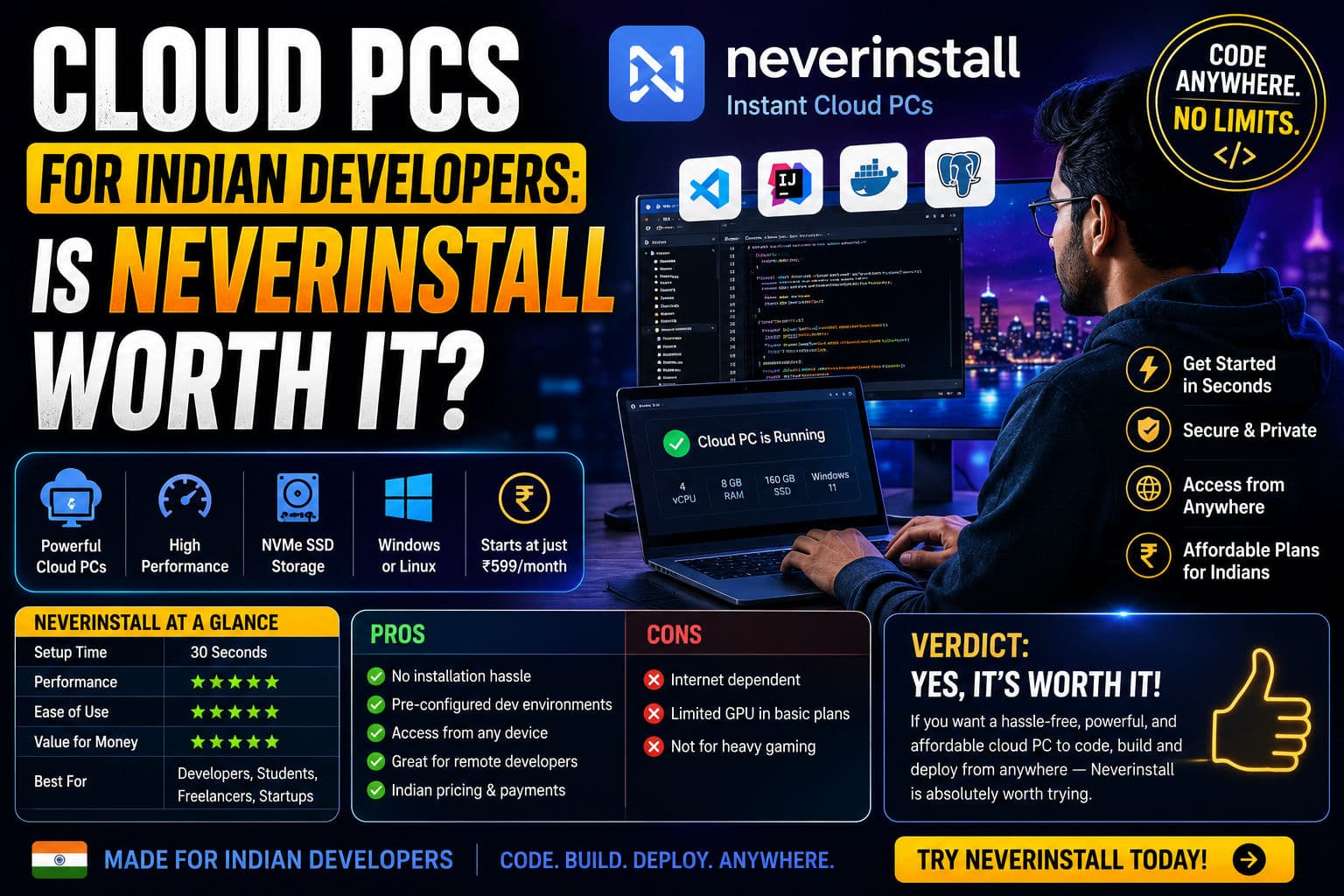
Your Laptop Is Not the Problem — Your Infrastructure Is
Here's a scenario every Indian developer knows too well. You're running VS Code, a local PostgreSQL instance, Docker, and Chrome with 40 tabs. Your 8GB RAM laptop starts sweating. The fan sounds like a JET Airways takeoff. And then everything freezes.
The instinct is to upgrade hardware. Spend ₹80,000–₹1,20,000 on a new machine, wait for a sale, maybe pick something up on Flipkart's Big Billion Days. But what if the real answer is that you don't need a powerful local machine at all?
That's the pitch behind cloud PCs — platforms like Neverinstall, Vagon, and Shadow PC that give you a full desktop environment running in your browser, powered by remote servers with hardware you could never afford locally. The concept is simple: your browser becomes your operating system, and someone else handles the compute.
But does it actually work for Indian developers? Let's break this down honestly.
What Neverinstall Actually Does
Neverinstall is a Bengaluru-based startup (founded in 2019, backed by Speciale Invest and Equirus InnovateX) that provides cloud-hosted virtual desktops accessible through your browser. You sign up, pick an application — PyCharm, Chrome, Figma, Blender, whatever — and it launches on a remote machine that you interact with through a browser tab.
The headline numbers are impressive. Users report internet speeds of 2.5–3 Gbps on the cloud machine itself, 8 vCPU with 28GB RAM on their Windows plans, and the promise of running resource-heavy applications without touching your local hardware.
The experience, from what users describe, is surprisingly smooth. You can run PyCharm, write Python code, execute it, and everything feels responsive — no lag spikes, no freezing, no thermal throttling because your local CPU isn't doing the work.
What You Get on the Free Tier
Neverinstall offers a free plan, but it's limited. Users report roughly 5 hours of usage, restricted application selection, and only Singapore or Tokyo server options — which matters for latency if you're in India. The paid Individual plan runs $90/month (~₹7,500) for 100 hours of cloud PC usage.
That pricing is the first reality check. ₹7,500 per month for 100 hours means you're paying roughly ₹75 per hour of compute. If you're coding 6–8 hours a day, you'll burn through that allocation in about two weeks.
The Indian Developer's Real Question: Does the Math Work?
Let's do the comparison Indian developers actually care about.
Option A: Buy a decent development laptop. A Lenovo IdeaPad or HP Victus with 16GB RAM, i5/Ryzen 5, 512GB SSD costs ₹55,000–₹70,000. That's a one-time cost. It lasts 3–4 years. Monthly amortized cost: roughly ₹1,500–₹1,800/month. You own it. It works offline. No internet dependency.
Option B: Use Neverinstall's paid plan. ₹7,500/month for 100 hours. Over 12 months, that's ₹90,000 — more than the cost of a solid laptop. And you still need a basic machine to run the browser. Plus a fast, stable internet connection, which isn't guaranteed in tier-2 and tier-3 Indian cities.
Option C: Use the free tier for specific tasks. This is where Neverinstall makes more sense for most Indian developers. Don't use it as your daily driver. Use it when you need burst compute — spinning up a heavy IDE for a quick test, running a resource-intensive build, or accessing a Windows-only tool from a Linux machine.
When Cloud PCs Actually Make Sense in India
The cost math doesn't work for replacing your primary development machine. But cloud PCs solve specific problems that local hardware can't.
Client demos from anywhere. You're freelancing and need to show a client a resource-heavy application running smoothly. Launch Neverinstall from your ₹25,000 Chromebook, demo with zero stuttering, close the session. You look professional without carrying a workstation.
Testing across environments. You develop on Linux but need to test something on Windows. Instead of dual-booting or running a local VM that eats your RAM, spin up a cloud Windows desktop for an hour. Test, close, done.
Onboarding developers on a budget. You're running a small agency or startup. Instead of buying five machines at ₹60,000 each (₹3,00,000 total), you provision cloud desktops for your team. For short-term projects or contractors, this makes financial sense because you're not stuck with depreciating hardware.
Working from a tier-2 city with unreliable power. This sounds counterintuitive since cloud PCs need internet, but if you have good 4G/5G but an old machine, the compute offloading can mean your old laptop just needs to handle a browser tab — nothing more. Your code, your data, and your processing stay in the cloud.
The Honest Limitations Nobody Talks About
Internet Dependency Is a Dealbreaker for Many
Neverinstall's own streaming protocol is optimized for low-bandwidth networks (they claim 3G support), but real-world user reviews tell a different story. Unstable connections cause lag, dropped sessions, and lost work. In India, where broadband quality varies wildly between metros and smaller cities — and where ISP throttling during peak hours is common — this is a real concern.
If your Airtel or Jio connection hiccups during a debugging session, your entire development environment freezes. That's not a minor inconvenience. That's lost work.
Latency Matters More Than Speed
The 3 Gbps speed on the cloud machine is impressive, but irrelevant for your experience. What matters is the latency between your browser and Neverinstall's servers. With servers primarily in Singapore and Tokyo, Indian developers are looking at 40–80ms latency in best cases. That's fine for coding and browsing, but noticeable if you're doing anything that requires real-time responsiveness — graphic design, video editing, or even fast terminal navigation.
Security Concerns Are Valid
User reviews on Product Hunt and G2 highlight a real worry: you're running your code, accessing your APIs, and potentially entering credentials on a machine controlled by a third party. For hobby projects, that's fine. For client work involving sensitive data, payment integrations, or proprietary codebases, you need to think carefully about what you're putting on a shared cloud environment.
Server Availability Is Limited
Multiple user reviews mention only Singapore and Tokyo servers being available. For Indian developers, that means your cloud PC is physically 3,000–5,000 km away. Until Neverinstall (or a competitor) sets up Indian data centers, the experience will always have a latency floor that local hardware simply doesn't.
How Neverinstall Compares to Alternatives
| Feature | Neverinstall | Vagon | AWS WorkSpaces | GitHub Codespaces |
|---|---|---|---|---|
| Target user | Developers, SMBs | Creatives, teams | Enterprise | Developers (code only) |
| Server locations | Singapore, Tokyo | 20+ regions | Mumbai available | Global |
| Free tier | Yes (limited) | No | No | 60 hrs/month free |
| Paid pricing | ~₹7,500/mo (100 hrs) | ~₹5,000/mo+ | ~₹2,500/mo+ | ~₹900/mo+ |
| Full desktop | Yes | Yes | Yes | No (terminal/IDE only) |
| Indian data center | No | No | Yes (Mumbai) | Yes |
| Best for | Burst compute, demos | Design, 3D work | Enterprise VDI | Pure coding |
If you're a developer who specifically needs an IDE and terminal, GitHub Codespaces is the smarter choice — it's cheaper, has Indian data center support, and integrates directly with your repos. Neverinstall's advantage is the full desktop experience: running non-dev applications, GUI tools, and anything that isn't just a code editor.
The Real Takeaway for Indian Devs and SMBs
Cloud PCs are not a laptop replacement. Not at current pricing, not with Indian internet infrastructure, and not with server locations limited to Southeast Asia. Anyone telling you otherwise is selling you a dream that the math doesn't support.
But cloud PCs are an excellent supplementary tool. Use them for burst compute, client demos, cross-platform testing, and short-term team onboarding. Neverinstall, specifically, deserves credit for being one of the few Indian startups building in this space — the Bengaluru team is solving a real problem, and their streaming protocol is genuinely well-optimized.
My recommendation: sign up for the free tier, run a speed test, try launching your heaviest IDE, and see if the latency works for your location. If it does, use it strategically. If it doesn't, GitHub Codespaces or AWS WorkSpaces with the Mumbai region will give you a better experience for pure development work.
The future of development in India isn't about buying more expensive hardware. It's about knowing when to compute locally and when to compute in the cloud. The developers who figure out that balance will ship faster and spend less.
What APXTECK Uses and Recommends
At APXTECK, we've tested most of these tools while building production systems for our clients. Our stack is local-first for core development (Node.js, Next.js, PostgreSQL), but we use cloud compute strategically for CI/CD, staging environments, and client demos. If you're an Indian SMB trying to figure out the right infrastructure setup — whether it's cloud PCs, managed hosting, or hybrid workflows — we've been through the same decisions and can help you avoid the expensive mistakes.
Published by APXTECK — AI-powered IT solutions for Indian businesses. apxteck.com/contact
Article Comments
You must be signed in to post comments.
Sign In to Join the Discussion →No comments approved yet. Be the first to share your thoughts!
About the Author

Praveen Kumar
Co-Founder & DirectorFull-Stack Developer, APXTECK
Praveen Kumar is the Co-Founder and Full-Stack Developer at APXTECK, an AI-powered IT agency helping Indian SMBs grow through web development, automation, and AI integration. He builds production-grade systems using Node.js, Next.js, PostgreSQL, and modern AI APIs. When he is not shipping code, he is writing about practical technology that actually works for Indian businesses.
Related Insights

Dhamaal 4 Review & Box Office Collection: Hit or Flop?

Sonam Wangchuk's 20 July March: Why India's Education Crisis Matters

Samsung Flex Titanium: The Technology That Could Transform the Future of Foldable Smartphones

Why Whale Vomit Is Worth Millions: The Truth About Ambergris and the Fragrance Industry

OnePlus' Global Strategy Shift: What Oppo's Business Restructuring Could Mean for Smartphone Users

NASA's Webb Telescope Finds Hidden Planet in Beta Pictoris System

The 3 Careers That Will Pay the Most in 2026–2030 — AI, Quantum, and the End of Engineering Silos