

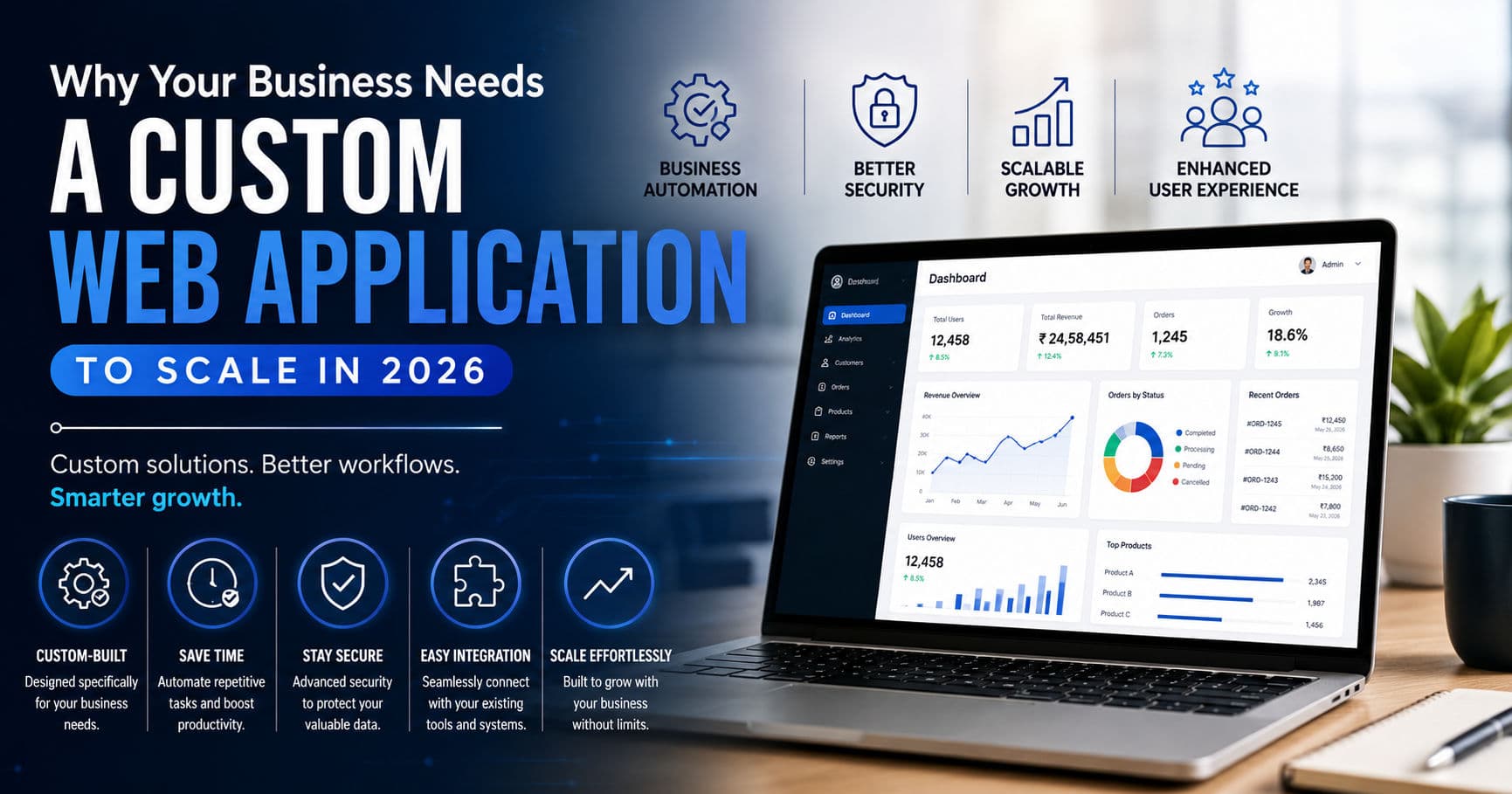
Why Your Business Needs a Custom Web Application to Scale in 2026

Amol Khodre
Introduction
Imagine trying to grow your business while using software that wasn't built for your workflow.
Your sales team maintains spreadsheets manually. Customer inquiries are scattered across emails and WhatsApp. Inventory is updated in one system, while accounting runs on another. Every department works hard, yet valuable time is lost because systems don't communicate with each other.
This is a challenge that many growing businesses face.
As organizations expand, off-the-shelf software often becomes a limitation rather than a solution. Features you don't need clutter the interface, while the functionality you actually require is missing. Employees spend more time adapting to the software instead of the software adapting to the business.
This is where custom web applications make a real difference.
Rather than forcing businesses to change their processes, custom software is designed around existing workflows, helping teams work faster, make better decisions, and scale efficiently.
In 2026, businesses are investing in custom web applications not simply because they're modern—but because they provide flexibility, stronger security, better performance, and long-term business value.
Table of Contents
- What Is a Custom Web Application?
- Why Businesses Are Moving Away from Generic Software
- Key Benefits of Custom Web Applications
- Better Security and Data Protection
- Automation That Saves Time
- Scalability for Business Growth
- Improved Customer Experience
- Real-World Business Examples
- Technologies Behind Modern Web Applications
- Why APXTECK Recommends Custom Solutions
- Frequently Asked Questions
- Final Thoughts
"Technology should adapt to your business—not force your business to adapt to technology."
What Is a Custom Web Application?
A custom web application is software designed specifically to meet the unique needs of your business. Unlike ready-made platforms that offer the same features to every company, a custom application is built around your workflows, goals, and customers.
Think of it this way:
Buying off-the-shelf software is like purchasing a ready-made suit. It may fit reasonably well, but it was never designed specifically for you.
A custom web application, on the other hand, is like a tailor-made suit—created to match your exact requirements.
Whether you manage a retail chain, healthcare clinic, logistics company, educational institute, or manufacturing business, a custom solution gives you complete control over how your software works.
Why Businesses Are Moving Beyond Generic Software
Generic software works well during the early stages of a business.
However, as companies grow, they often face challenges such as:
- Multiple disconnected software platforms
- Manual data entry
- Duplicate records
- Slow reporting
- Limited automation
- Restricted customization
- Higher subscription costs
- Poor scalability
These issues reduce productivity and make business growth more difficult.
Custom web applications eliminate these limitations by connecting departments, automating repetitive tasks, and creating a centralized system where everything works together.
"Growth should create new opportunities—not new operational problems."
1. Built Around Your Business
Every organization follows different processes.
For example:
A hospital manages patient appointments.
A manufacturing company tracks inventory.
A school manages student records.
A retail chain monitors multiple store locations.
Trying to use the same software for all these industries rarely delivers the best results.
Custom applications are developed specifically for your business model, making daily operations simpler and more efficient.
2. Better Productivity Through Automation
Many businesses still spend hours performing repetitive tasks manually.
Examples include:
- Creating invoices
- Managing attendance
- Processing customer inquiries
- Sending reminders
- Preparing reports
- Updating inventories
- Tracking orders
Automation reduces these manual activities significantly.
Employees spend less time on repetitive work and more time focusing on customers and business growth.
3. Stronger Security
Data has become one of the most valuable assets for any organization.
Customer information, financial records, employee data, and business reports require strong protection.
Unlike generic software, custom applications allow businesses to implement security features based on their own requirements.
Examples include:
- Multi-Factor Authentication (MFA)
- Role-Based Access Control
- Data Encryption
- Secure API Authentication
- Activity Logs
- Automatic Backups
- IP Restrictions
These measures help reduce cybersecurity risks while improving compliance with industry standards.
4. Scalability Without Limitations
Business growth should never be limited by software.
Whether you're serving:
- 100 customers
- 10,000 customers
- 1 million users
your software should continue performing efficiently.
Modern custom applications use scalable technologies that allow businesses to expand without rebuilding their entire system.
As your organization grows, new modules, integrations, and users can be added without disrupting existing operations.
5. Seamless Integration
Businesses rarely use a single software platform.
Instead, they work with multiple tools such as:
- CRM Systems
- Payment Gateways
- ERP Platforms
- HR Software
- Accounting Applications
- Marketing Tools
- WhatsApp Business API
- Email Automation
- Cloud Storage
Custom web applications connect these systems through APIs, creating one centralized digital ecosystem.
Instead of switching between multiple dashboards, employees can access everything from a single platform.
6. Improved Customer Experience
Customers expect fast, secure, and intuitive digital experiences.
Slow websites, confusing dashboards, and outdated interfaces often lead to lost business opportunities.
Custom web applications help deliver:
- Faster loading pages
- Mobile-friendly interfaces
- Personalized dashboards
- Online booking
- Secure customer portals
- Live notifications
- Real-time tracking
- Better accessibility
A better digital experience increases customer satisfaction and strengthens brand loyalty.
Continue Learning with APXTECK
Looking to explore more technology insights?
👉 Next.js vs React: Which Framework Should You Choose for Your Business Website?
👉 Complete UI/UX Design Guide
👉 Technical SEO in 2026
👉 Explore More Technology Insights
Article Comments
You must be signed in to post comments.
Sign In to Join the Discussion →No comments approved yet. Be the first to share your thoughts!
About the Author

Amol Khodre
Director & Co-Founder at APXTECK SOLUTIONS PRIVATE LIMITED
Director & Co-Founder at APXTECK SOLUTIONS PVT. LTD. He specializes in driving enterprise digital transformation and building scalable web architectures. With a strong foundation in full-stack development and modern UI/UX design, he is passionate about crafting intuitive and robust digital solutions for businesses.
Related Insights

Why Your Business Needs a Custom Web Application to Scale in 2026

UPI MDR Is Back — Ashneer Grover Is Half Right | APXTECK

Amodei Wants to Slow AI. Indian SMBs, Read This First | APXTECK

How Blinkit's Free Ambulance Became Its Best Marketing Move

GPT-6 Astra: OpenAI’s New AI Model Could Change Software Development and Business Work

AI-Powered Cyberattacks Are Rising: Why Every Business Needs Stronger Cybersecurity Now

How Next.js and Generative Search Help Builders Win Leads