


Vibe Coding Is a Trap (Escape Before It's Too Late)

Praveen Kumar
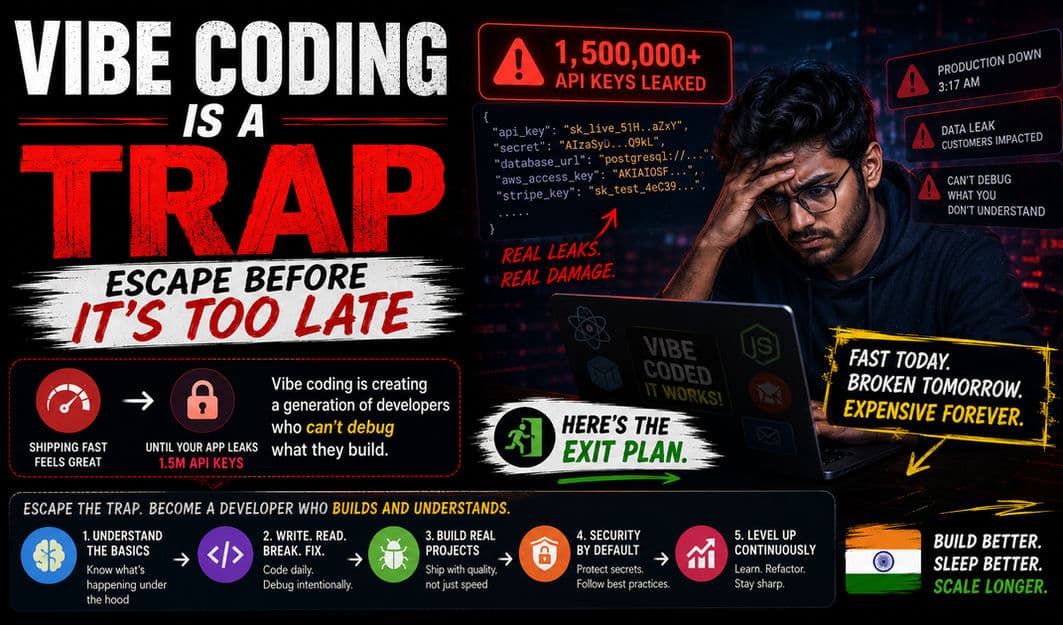
You're Not Coding. You're Approving Code You Don't Understand.
There's a moment every vibe coder hits — usually around 2 AM, in production, when something breaks — where they stare at 400 lines of AI-generated code and realize they have no idea what any of it does. They didn't write it. They didn't review it. They typed "build me a payment integration" into Cursor or Claude Code, hit accept on everything that looked roughly correct, and shipped it.
That moment is coming for a lot of Indian developers and founders right now. And I'm writing this because the hype machine around vibe coding is dangerously one-sided.
Every week on Twitter and LinkedIn, someone shares a video of building a "full SaaS app in a weekend" using AI. Designers shipping backends. Marketers building internal tools. Founders launching MVPs without writing a single line of code. The demos look incredible. The production reality is something else entirely.
Andrej Karpathy coined the term "vibe coding" in early 2025 — describing what you want in plain language and letting AI write the code. By 2026, 92% of US developers use some form of AI coding assistance daily. Gartner forecasts that 60% of all new software code will be AI-generated this year. The adoption curve isn't the problem. The false confidence is.
The Numbers That Nobody Puts in the Demo Videos
Let me give you the data points the vibe coding evangelists conveniently leave out of their threads.
40-62% of AI-generated code contains security vulnerabilities. Not edge-case bugs that surface under extreme load — actual security holes. IDOR flaws that let any logged-in user access any other user's data. Missing authorization checks. Exposed API keys. The kind of stuff that gets your startup on a breach notification list.
In March 2026, Georgia Tech's Vibe Security Radar tracked 35 new CVE entries directly caused by AI-generated code — up from just six in January. The trend line is accelerating, not flattening.
That same month, a hyped AI platform shipped a vibe-coded app that leaked 1.5 million API keys because the founder never ran a single security review before going live.
Across 2.23 million AI-generated code samples studied by the Cloud Security Alliance, 19.7% contained at least one hallucinated package name — a dependency that doesn't actually exist. Worse: 43% of those hallucinated names reappeared consistently on every run. That's not a random error — it's a predictable attack surface. Attackers can register those fake package names and inject malicious code that your AI-generated project will automatically install.
63% of developers report spending more time debugging AI-generated code than writing the equivalent code manually. And a METR study found something striking: experienced developers were 19% slower when using AI coding tools, even though they predicted they'd be 24% faster.
The velocity illusion is real. You feel faster. The Jira board looks incredible. But the codebase underneath is accumulating a type of technical debt that's fundamentally harder to pay down than the traditional kind.
The Two Types of Technical Debt (And Why Vibe Coding Creates the Worse One)
Traditional technical debt works like this: you wrote a quick solution, you know why it's quick, and you know exactly how to fix it when you come back. You made a conscious trade-off. Speed now, cleanup later. The debt is understood.
Vibe coding debt is different: the code works, you don't understand why it works, and when it breaks in production you're reading code you didn't write, trying to debug logic you never learned. The debt is invisible — until it isn't.
This distinction matters enormously for Indian startups. You ship an MVP with vibe coding. You get users. You raise a seed round. Now you need to scale. You hire developers. They open the codebase and find 15,000 lines of AI-generated code with no consistent architecture, no documentation, contradictory patterns across modules, and security holes baked into the foundation. The "rewrite vs. fix" conversation starts at month three.
I've seen this happen with three different Indian D2C and SaaS startups in the last six months. The MVP-to-production gap isn't a technical problem. It's a comprehension problem. Nobody on the team fully understands the code they shipped.
The Skill Atrophy Problem Is Already Here
Stack Overflow flagged it in January 2026: over-reliance on coding bots is causing measurable skill atrophy among developers. A Deloitte study found that over 40% of junior developers admit to deploying AI-generated code they don't fully understand.
Here's what atrophy actually looks like in practice: a developer who vibe-codes for 18 months loses the ability to debug a null pointer exception without AI assistance. They can't trace a request through middleware. They can't read a stack trace and identify the root cause. They can't architect a database schema from scratch because they've never had to reason about normalization, indexing, or query performance — Claude always handled that part.
For Indian developers specifically, this is a career risk that nobody is talking about honestly. The Indian tech job market is already brutally competitive. Stanford research shows a 20% employment drop for developers aged 22-25 since 2022. If you're a junior developer in Bangalore or Pune whose only skill is describing features to an AI tool, you're competing against every non-technical person who can do the exact same thing. Your edge as a developer was supposed to be that you understand how software works under the hood. Vibe coding erases that edge.
Simon Willison drew the clearest line I've seen on this: if an LLM wrote every line of your code, but you've reviewed, tested, and understood it all — that's not vibe coding, that's using an LLM as a typing assistant. His golden rule: "I won't commit any code to my repository if I couldn't explain exactly what it does to somebody else." That's the standard. If you can't meet it, you're not coding — you're gambling.
The Security Problem That Should Scare Every Indian Founder
Here's the part of vibe coding that makes security researchers physically uncomfortable: the vulnerabilities in AI-generated code are often invisible by design.
Not bugs that throw errors. Not crashes that surface in testing. Logical flaws that pass all your tests, look completely correct on review, and only reveal themselves under adversarial conditions.
The most common pattern: AI models generate API endpoints that correctly authenticate the user but fail to verify that the authenticated user has permission to access the specific resource they're requesting. Your app passes every functional test — user logs in, user sees data, user performs actions. But any logged-in user can access any other user's data by changing a single ID parameter in the URL.
For Indian SMBs handling Aadhaar data, UPI transaction records, or customer financial information, this isn't a hypothetical risk — it's a compliance nightmare waiting to happen. RBI's data security requirements, CERT-In's incident reporting mandates, and the Digital Personal Data Protection Act all create legal exposure when user data leaks through code nobody actually reviewed.
And then there's the indirect prompt injection problem. A January 2026 meta-analysis of 78 studies on agentic coding assistants found that attack success rates exceed 85% when adaptive attack strategies are used. The attack works like this: a poisoned README or documentation file contains embedded instructions. Your AI coding agent reads the file, follows the hidden instruction, and the developer watching the output sees code being written — not an attack in progress. The model has no awareness of your threat model, your compliance requirements, or your infrastructure. It predicts what code should look like next. That's it.
Where Vibe Coding Actually Works (Yes, There Are Valid Uses)
I'm not anti-AI coding. I use Claude Code daily. I use AI to generate boilerplate, explore unfamiliar APIs, prototype UI components, and scaffold project structures. The difference is in how I use it.
Vibe coding works for throwaway prototypes and internal tools that never touch production data. It works for exploring an idea — "show me what a dashboard for this data might look like" — when the output is a conversation starter, not a deployment artifact. It works for learning, when you're using AI-generated code as a teaching tool to understand patterns you'll then implement yourself.
It works as a starting point, not an end point. The moment you accept AI output without understanding it, reviewing it, and taking ownership of it — you've stopped coding and started hoping.
Here's a practical framework for deciding when AI-generated code is safe to ship:
Internal tools with no external users and no sensitive data? Vibe coding is probably fine. Standard CRUD operations with well-understood patterns? AI-generated code with human review works. Payment processing, authentication, authorization, data handling? Write it yourself or review every single line the AI generates. Security-critical endpoints? Don't vibe code at all. Period.
The Escape Plan: How to Use AI Without Falling Into the Trap
If you're already deep in the vibe coding workflow, here's how to climb out without losing the speed benefits.
Rule 1: Never Ship Code You Can't Explain
Before committing any AI-generated code, ask yourself: "Can I explain what every function in this file does to another developer?" If the answer is no, you don't understand it well enough to debug it at 2 AM when it breaks. Read it. Trace the logic. Understand the edge cases. Then commit.
Rule 2: Separate Generation From Review
The person who prompts the AI should not be the only person who reviews the output. If you're a solo founder, at minimum run a static analysis security scan (SAST) on every file before it hits production. Tools like Semgrep, Snyk, and SonarQube catch the classes of vulnerabilities that AI models consistently introduce.
Rule 3: Keep Your Fundamentals Sharp
Spend at least 20% of your coding time writing code from scratch — no AI assistance. Pick a small project, a coding challenge, or a specific module in your production app, and build it manually. This isn't nostalgia. It's insurance. The debugging skills, the architectural intuition, the ability to trace a request through your stack — these atrophy if you don't exercise them.
Rule 4: Use AI as a Power Tool, Not a Replacement
The best developers in 2026 aren't the ones who vibe code the fastest. They're the ones who use AI for the tedious 80% (boilerplate, tests, documentation, refactoring) and apply human judgment to the critical 20% (architecture decisions, security boundaries, business logic, performance optimization).
This is the difference between using a power drill and letting the power drill decide where the holes go.
Rule 5: Review AI Code Like You'd Review a Junior Developer's PR
Would you merge a junior developer's pull request without reading it? Without checking for security issues? Without understanding the architectural implications? Then don't do it with AI-generated code either. AI is a prolific junior developer who writes fast, never complains, and has zero judgment about what matters. Treat its output accordingly.
The Real Skill in 2026 Isn't Prompting. It's Judgment.
The defining tension of this year isn't whether AI can write code — it obviously can. It's whether the people shipping that code understand the difference between software that works in a demo and software that's secure, maintainable, and reliable in production.
Vibe coding lowers the barrier to generating software. It does not lower the barrier to building good software. Those are fundamentally different things, and conflating them is how startups end up on breach notification lists.
If you're an Indian developer or founder reading this, here's the uncomfortable truth: the speed advantage of vibe coding is temporary. Everyone has access to the same AI tools. The lasting advantage belongs to developers who understand what the AI generates, can evaluate its quality, can fix its mistakes, and can architect systems that don't collapse under real-world load.
Don't be the developer who can't code without AI. Be the developer who's dangerous with it.
Published by APXTECK — AI-powered development and automation for Indian SMBs. apxteck.com/contact
Article Comments
You must be signed in to post comments.
Sign In to Join the Discussion →No comments approved yet. Be the first to share your thoughts!
About the Author

Praveen Kumar
Co-Founder & DirectorFull-Stack Developer, APXTECK
Praveen Kumar is the Co-Founder and Full-Stack Developer at APXTECK, an AI-powered IT agency helping Indian SMBs grow through web development, automation, and AI integration. He builds production-grade systems using Node.js, Next.js, PostgreSQL, and modern AI APIs. When he is not shipping code, he is writing about practical technology that actually works for Indian businesses.
Related Insights

I Mastered Claude So You Don't Have To (Beginner to Advanced)

Claude Tag Makes AI a Teammate. That's the Trap.

Stop Forcing Your Business to Fit Basic Software | APXTECK

LLM vs AI Agents: What's the Difference and Which One Should You Use in 2026?

Meta's Brain-to-Text AI Works. The Real Question Is Who Controls It.

Grok 4.5 Is Not the Best AI Model. It Might Be the Smartest Bet.

Google's 8 Free AI Tools That Replace Your Entire Paid Stack