


How Business Automation Saves 20+ Hours of Manual Work Weekly

Praveen Kumar
Your Team Isn't Slow. Your Workflows Are Stuck in 2015.
Every Indian SMB owner I talk to says some version of the same thing: "We need to hire more people. We can't keep up."
And almost every time, the real problem isn't headcount. It's that three people are spending half their day doing work a well-built automation could handle in seconds — copying data between spreadsheets, sending follow-up emails manually, chasing invoices, updating trackers, generating the same report every Monday morning.
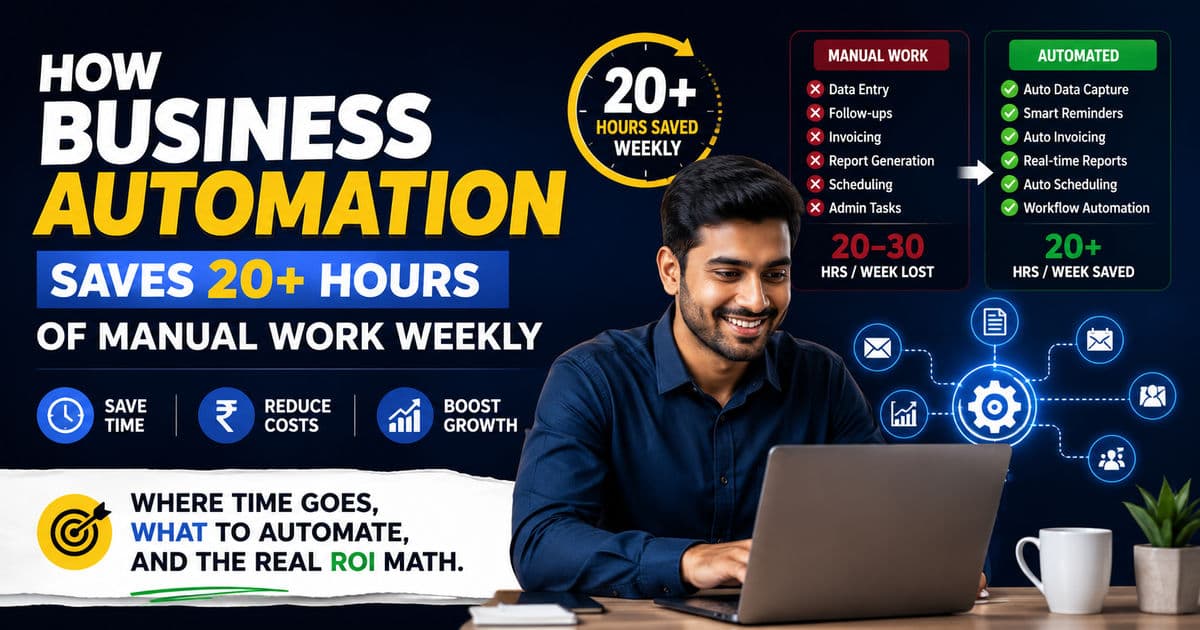
I've audited workflows for SMBs doing ₹50L to ₹15 Cr in annual revenue. The pattern is remarkably consistent: 20 to 30 hours of combined team time per week is burned on repetitive, rule-based tasks that require zero judgment, zero creativity, and zero human decision-making. That's roughly one full-time employee's worth of productive hours — evaporating into busywork every single week.
Business automation isn't about replacing people. It's about stopping the absurd waste of making humans do a machine's job so those same humans can do work that actually moves the business forward.
The 20-Hour Audit: Where Manual Work Actually Hides
Most SMB owners dramatically underestimate how much time their team loses to manual processes because the work is scattered across small, invisible tasks. No single task feels like a problem. But stacked together, they're a silent tax on your entire operation.
Here's where those 20+ hours typically hide, based on patterns I've seen across dozens of Indian SMBs:
| Task Category | Typical Weekly Hours Lost | Who Gets Stuck With It |
|---|---|---|
| Lead capture and follow-up | 4–6 hours | Sales team, founder |
| Invoice generation and payment reminders | 3–5 hours | Accounts, office manager |
| Data entry across multiple tools | 3–4 hours | Operations, admin staff |
| Customer query routing and responses | 3–5 hours | Support, founder |
| Report generation and data compilation | 2–3 hours | Manager, founder |
| Internal status updates and coordination | 2–4 hours | Everyone |
| Social media posting and scheduling | 1–2 hours | Marketing, founder |
| Total | 18–29 hours | Your entire team |
That ₹18–29 hours is conservative. In businesses that still run significant portions of their operations through WhatsApp groups and shared Google Sheets — which is the majority of Indian SMBs under ₹10 Cr — the number is often higher.
The Five Automations That Deliver the Fastest ROI
Not every automation is worth building on day one. Some save minutes. Others save entire roles. The trick is starting with the automations that free up the most hours per rupee invested — and then compounding from there.
Automation 1: Lead Capture to CRM Pipeline — Zero Manual Entry
Hours recovered: 4–6 per week
Here's what happens in most Indian SMBs today. A lead comes in through the website contact form. Someone checks the inbox, copies the details into a Google Sheet or CRM. They assign it to a sales rep via WhatsApp message. The rep follows up — if they remember. If not, the lead dies silently.
The automated version: a website form submission triggers a workflow that creates a contact record in your CRM, assigns it based on geography or product interest, sends an instant acknowledgment email or WhatsApp message to the lead, and creates a follow-up task for the assigned rep with a deadline. If the rep doesn't act within 24 hours, it escalates.
Every step happens without a single person touching it. The sales team's first interaction with the lead is the actual sales conversation — not data entry.
The tools to build this range from n8n (self-hosted, free) to Make or custom webhook integrations, depending on your stack. Total setup cost for an Indian SMB: ₹15,000–₹50,000 one-time, with near-zero ongoing costs if self-hosted.
Automation 2: Invoice Generation and Payment Follow-Ups
Hours recovered: 3–5 per week
Manual invoicing is one of those tasks that feels fast until you count the steps: pull the order details, open the invoice template, fill in line items, calculate GST, export as PDF, email it, log it somewhere, and then — the worst part — manually follow up on overdue payments three, seven, and fourteen days later.
An automated invoicing workflow generates the invoice the moment an order is confirmed or a service is delivered, applies the correct GST slab based on product or service category, sends it via email and WhatsApp with a payment link (Razorpay or similar), and triggers polite but persistent follow-ups on a schedule until payment clears. No human chases payments. The system does it with the consistency that no human team can sustain.
The compounding effect here is real: faster invoicing means faster payments means healthier cash flow. For Indian SMBs where cash flow timing is often the difference between growth and survival, this single automation can materially impact the business.
Automation 3: Customer Query Classification and Routing
Hours recovered: 3–5 per week
Most SMBs handle customer queries through a shared inbox or — more commonly in India — a WhatsApp Business number that two or three people monitor. The process is chaos: queries pile up, nobody knows who's handling what, customers get duplicate responses or no response at all, and urgent issues get buried under routine questions.
AI-powered query classification changes this completely. Using an LLM API, every incoming message can be automatically classified by type (billing, technical, sales, feedback), urgency (critical, normal, low), and routed to the right person or team — instantly. Routine questions like "What are your business hours?" or "Where's my order?" can get auto-responses generated from your knowledge base without any human involvement.
This isn't theoretical. The APIs to build this exist today at costs that would shock most SMB owners. OpenAI's GPT-4o mini or Google's Gemini Flash can classify and respond to queries for fractions of a paisa per message. At typical Indian SMB query volumes — 50 to 200 messages per day — your monthly AI API bill stays under ₹2,000.
Automation 4: Recurring Report Generation
Hours recovered: 2–3 per week
Every Monday morning, someone in your company opens three spreadsheets, two dashboards, and a WhatsApp group, manually compiles last week's numbers, formats them into a presentable summary, and sends it to the founder or management team.
This ritual is pure waste.
An automated reporting workflow pulls data directly from your database, CRM, payment gateway, and analytics platform, generates a formatted summary — daily, weekly, or monthly — and delivers it via email or Slack at a scheduled time. If specific metrics cross a threshold (revenue drops below target, support tickets spike, conversion rate dips), it triggers an alert immediately instead of waiting for the weekly review.
The value isn't just the hours saved. It's the speed of decision-making. Problems that used to surface on Monday morning now surface in real-time.
Automation 5: Internal Handoffs and Status Coordination
Hours recovered: 2–4 per week
This is the least glamorous automation on the list and one of the highest-impact ones.
In most Indian SMBs, internal coordination runs on verbal updates, WhatsApp pings, and "just checking in" messages. A sales rep closes a deal but forgets to notify operations. Operations prepares the delivery but doesn't update the client-facing team. The customer calls asking for a status update and nobody has a clear answer.
Automated internal handoffs mean that when a deal moves to "won" in the CRM, an order record is auto-created in the operations system, the delivery team gets notified with all relevant details, and the customer receives a confirmation with next steps. When a support ticket is resolved, the account manager gets a summary. When a project milestone is completed, the invoice workflow triggers.
No chasing. No "did you see my message?" No dropped balls.
The Real ROI Math for Indian SMBs
Let me put numbers to this because vague promises of "saving time" aren't useful.
Assume a 15-person Indian SMB with an average fully-loaded employee cost of ₹35,000/month (including salary, benefits, and overhead). That's roughly ₹200/hour per team member.
| Metric | Before Automation | After Automation |
|---|---|---|
| Weekly hours on manual tasks | 25 hours | 3–5 hours (oversight only) |
| Weekly hours recovered | — | 20+ hours |
| Monthly hours recovered | — | 80–90 hours |
| Monthly value of recovered hours | — | ₹16,000 – ₹18,000 |
| Annual value of recovered hours | — | ₹1.9L – ₹2.2L |
| Automation setup cost (one-time) | — | ₹1.5L – ₹4L |
| Ongoing monthly cost (APIs + hosting) | — | ₹5,000 – ₹12,000 |
| Payback period | — | 8–14 months |
And this calculation only counts the direct labour cost savings. It doesn't account for faster lead response times improving conversion rates, faster invoicing improving cash flow, fewer dropped customer queries improving retention, or faster internal coordination reducing delivery errors. Factor those in, and the payback period shrinks to under six months for most businesses.
The Automation Sequence That Actually Works
The biggest mistake I see SMBs make with automation is trying to automate everything simultaneously. They hire someone, hand over a list of thirty processes, and expect everything to run within a month. The project stalls, half the automations break because they were built without understanding edge cases, and the team loses confidence in the entire concept.
The sequence that works is simpler and more disciplined.
Month 1: Automate lead capture and CRM pipeline. This is high-visibility, immediately measurable, and builds internal confidence that automation actually works.
Month 2: Automate invoicing and payment follow-ups. This directly impacts cash flow, which gets the founder's full attention and buy-in for further investment.
Month 3: Add customer query classification and auto-routing. This reduces the daily noise for whoever is managing support, freeing them to handle complex issues.
Month 4: Automate recurring reports and internal handoffs. By this point, the team understands how automations work, trusts them, and actively starts asking "can we automate this too?"
Each phase builds on the last. Each phase has a measurable outcome. And each phase is small enough that if something goes wrong, you fix it without disrupting the entire business.
Automation Doesn't Replace Judgment. It Replaces Drudgery.
The concern I hear most from SMB founders is: "What if the automation makes a mistake? What if it sends the wrong invoice? What if it routes a critical query to the wrong person?"
Valid concerns. And the answer is that well-built automations include human checkpoints where they matter. The invoice is auto-generated but a team member reviews before it sends — or you run it without review for routine transactions and flag exceptions for human approval. The query classification routes automatically but escalates to a human when confidence is low.
Automation doesn't remove humans from the loop. It removes humans from the parts of the loop that don't require human thinking — the copying, the pasting, the formatting, the following up, the remembering to check. Your team's expertise is better spent on closing deals, solving customer problems, making strategic decisions, and building relationships. Not updating spreadsheets.
Stop Hiring for Problems You Should Be Automating
If your first response to operational overload is "we need to hire someone," pause and audit first. Map out every repetitive task your team does this week. Tag the ones that follow a fixed rule and require no judgment. Add up the hours.
If that number is anywhere near 20 — and it almost always is — you don't need another hire. You need a workflow that doesn't sleep, doesn't forget follow-ups, and doesn't need to be reminded twice.
The 20 hours you reclaim aren't just cost savings. They're the hours where your team starts doing work that actually grows the business instead of just keeping it running.
Published by APXTECK — AI-powered business automation for Indian SMBs that want to scale without scaling headcount. See our automation solutions → apxteck.com/services
Article Comments
You must be signed in to post comments.
Sign In to Join the Discussion →No comments approved yet. Be the first to share your thoughts!
About the Author

Praveen Kumar
Co-Founder & DirectorFull-Stack Developer, APXTECK, chatgpt, google
Praveen Kumar is the Co-Founder and Full-Stack Developer at APXTECK, an AI-powered IT agency helping Indian SMBs grow through web development, automation, and AI integration. He builds production-grade systems using Node.js, Next.js, PostgreSQL, and modern AI APIs. When he is not shipping code, he is writing about practical technology that actually works for Indian businesses.
Related Insights

The SMB Guide to Scaling Down Enterprise Tech on a Budget

Why Traditional SEO Is Dead: Preparing for Generative Search

Next.js ISR: The Real Weapon for Better Search Rankings

How to Architect a Multi-Tenant SaaS That Actually Scales

Mobile App Development for B2B Enterprise Software

How AI Can Multiply Organic Traffic for Coaching Institutes

How Healthcare Clinics Are Using Custom Software Development to Double Operational Efficiency