


How to Architect a Multi-Tenant SaaS That Actually Scales

Praveen Kumar
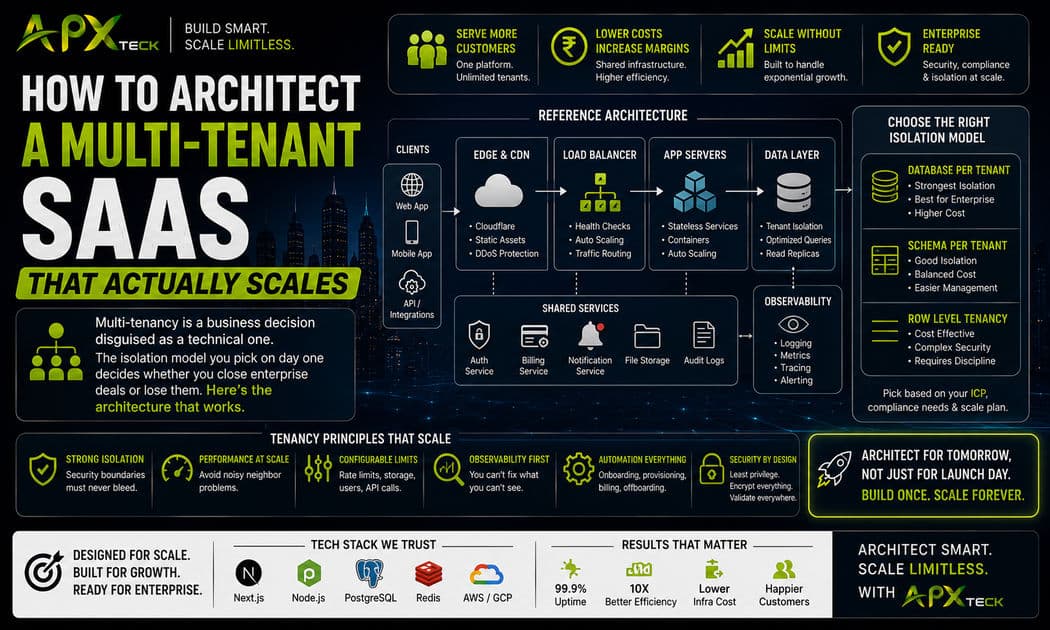
How to Architect a Multi-Tenant SaaS That Actually Scales
India's SaaS market generated $16.2 billion in revenue in 2025 and is projected to reach $58.4 billion by 2033, growing at 16.9% CAGR. There are now 250 Indian SaaS companies generating $10 million or more in ARR. And for every one of them, there are hundreds of founders stuck at ₹1-5 crore ARR, often because the architecture they built at the MVP stage can't support the enterprise deals they need to grow.
The most common architectural bottleneck? Multi-tenancy.
Multi-tenancy — serving multiple customers from a single application instance — sounds simple in concept. In practice, it's a set of decisions about data isolation, security, performance boundaries, and billing logic that will either make your product enterprise-ready or make it a liability the moment a prospect's security team sends you a questionnaire.
Most guides on multi-tenant architecture present it as a purely technical choice between three database models. It's not. It's a business decision that determines your cost of goods sold, your ability to pass compliance audits, your pricing model flexibility, and whether your largest customer's heavy queries destroy the experience for everyone else.
Here's how to think about it — and how we architect multi-tenant systems at APXTECK using Node.js, PostgreSQL, and Prisma ORM.
The Three Isolation Models (And What They Actually Cost You)
Every multi-tenant SaaS uses one of three data isolation patterns — or increasingly, a hybrid of them. The choice isn't about which is "best." It's about which trade-offs match your business stage and customer profile.
Pool: Shared Database, Shared Schema
All tenants share the same database and the same tables. Every row has a tenant_id column that identifies which customer owns it. A query for tenant A's data includes a WHERE tenant_id = 'A' filter, and tenant B's data is invisible.
This is the most cost-efficient model. One database to monitor, one set of migrations to run, one backup strategy to maintain. Infrastructure costs stay nearly flat as you add tenants. For a SaaS product with 100-10,000 small-to-medium tenants and no hardcore compliance requirements beyond basic SOC 2, this is usually the right starting point.
The risk is data leaks. If a developer forgets the tenant_id filter on a single query — in a report, an export endpoint, a background job — data from one tenant leaks to another. At best, it's embarrassing. At worst, it's a lawsuit.
This is where PostgreSQL's Row-Level Security becomes essential. RLS moves isolation from your application code (where it can be forgotten) into the database engine itself (where it's enforced automatically). You define a policy that says "rows are visible only when tenant_id matches the current session's tenant context." The database enforces this on every query, regardless of what the application code does. It's not a replacement for writing correct queries — it's a safety net that catches the mistakes your team will inevitably make.
Bridge: Shared Database, Separate Schemas
One database instance, but each tenant gets its own PostgreSQL schema inside it. Tenant A's orders table lives in schema_a.orders. Tenant B's lives in schema_b.orders. Stronger logical isolation than the pool model, without the cost of running separate database instances.
This model works well when you have 10-100 tenants who need demonstrable data separation for compliance but don't warrant dedicated infrastructure. Enterprise pilots and mid-market customers often land here. The trade-off is operational complexity: schema migrations must be applied across every tenant schema, and schema count can become unwieldy at scale.
Silo: Dedicated Database Per Tenant
Each tenant gets their own database instance. Complete physical isolation. One tenant's heavy query cannot affect another's performance. Backups, restores, and data exports are per-tenant by default. Audit conversations become trivially easy: "show me the isolated database" is a much simpler answer than explaining RLS policies.
This is the most expensive model. Running 200 tenants means operating 200 database instances — each needing monitoring, backups, version management, and security patches. A 2025 study found that single-tenant deployments typically utilize only a fraction of available computing resources, compared to much higher utilization in multi-tenant setups. You're paying for idle capacity across every instance.
But for enterprise customers with regulatory requirements (HIPAA in healthcare, PCI DSS in fintech, data residency mandates), dedicated databases are often non-negotiable. The inability to offer this option loses enterprise deals.
The Hybrid Reality
Here's my actual recommendation, and it's what most mature SaaS platforms run in production: start with a shared pool using PostgreSQL RLS for your standard tier. When a customer's requirements or usage volume warrants it, promote them to a dedicated schema or dedicated database.
Design your architecture from day one so that tenants can be promoted between isolation levels without a full rebuild. This means your tenant resolution layer, your query middleware, and your migration tooling should all support routing to different backends based on the tenant's configuration. It's more work upfront, but it's dramatically less work than redesigning your data layer when your first ₹50 lakh annual contract requires dedicated infrastructure.
Tenant Resolution: How Your App Knows Who's Asking
Before any database query runs, your application needs to identify which tenant is making the request. There are three standard approaches, and the choice affects your routing, your SSL configuration, and your customers' perception of your product.
Subdomain-based resolution (tenant-a.yourapp.com) is the most common SaaS pattern. It's clean, it's immediately recognizable, and it works with wildcard DNS and wildcard SSL certificates. Your middleware extracts the subdomain from the request hostname, looks up the tenant record, and sets the tenant context for the entire request lifecycle.
Path-based resolution (yourapp.com/tenant-a/) is simpler to set up but feels less polished. It works for internal tools and admin panels where branding doesn't matter.
Custom domain resolution (app.tenant-a.com) is what enterprise customers expect. They want their team to see their own domain, not yours. This requires provisioning SSL certificates per custom domain (Let's Encrypt automates this), managing DNS verification, and maintaining a mapping table between custom domains and tenant IDs. It's more infrastructure work, but it's often the feature that closes enterprise deals.
In a Node.js application, tenant resolution should happen in a single middleware layer that runs before any route handler. The resolved tenant context — tenant ID, database connection string, feature flags, plan limits — should be attached to the request object (or stored in AsyncLocalStorage for automatic propagation through async call chains). Every downstream function reads from this context. No function should ever accept a raw tenant ID as a parameter.
Authentication and Authorization Per Tenant
Multi-tenant authentication has a specific complexity that single-tenant apps don't face: the same user might exist across multiple tenants, users might need different roles in different tenants, and an admin in one tenant should have zero visibility into another tenant's data.
The architecture that works cleanly: users belong to one or more tenant memberships, each membership has a role (owner, admin, member, viewer), and the JWT or session token encodes both the user ID and the active tenant ID. When a user switches between tenants (if they belong to multiple), the token is reissued with the new tenant context.
Authorization checks happen at two levels. The API layer validates that the authenticated user has the required role for the requested action within the active tenant. The database layer (via RLS) ensures that even if the API layer has a bug, the query physically cannot return data from a different tenant.
This double-enforcement — application-level authorization plus database-level RLS — is what separates production-grade multi-tenant systems from apps that are one missed WHERE clause away from a data breach.
The Noisy Neighbor Problem
This is the operational challenge that most multi-tenant architecture discussions mention but few address practically.
In a shared database, one tenant running a massive CSV export, a complex analytics query, or an aggressive API integration can saturate database connections and degrade performance for every other tenant on the same instance. A 2025 study found that memory-intensive workloads cause more cross-tenant interference than CPU-bound ones — so monitoring CPU alone won't catch the problem.
The mitigation strategy has multiple layers. Per-tenant statement timeouts prevent any single query from monopolizing database resources — 30 seconds for standard tenants, with a higher limit for enterprise tenants whose plans justify the capacity. Per-tenant rate limiting on API endpoints ensures that one integration-heavy customer can't exhaust your connection pool. Tenant-scoped cache keys in Redis ensure that one tenant's cache evictions don't affect another's cache hit rates. And monitoring with tenant-tagged metrics lets you identify which specific tenant is causing performance degradation before other customers notice.
The nuclear option: if a tenant consistently exceeds resource thresholds, your system should automatically promote them to a dedicated resource tier — either a dedicated schema, a dedicated read replica, or a dedicated database. This is the hybrid model in action, and it only works if you designed the promotion path from the beginning.
Billing and Subscription Management
Multi-tenant billing has a specific architectural pattern that's worth getting right early, because retrofitting it is painful.
Every tenant has a plan (free, starter, growth, enterprise). Every plan defines limits — number of users, API calls per month, storage quota, feature access. Your application needs to enforce these limits at the API layer, not just display them in the dashboard.
The clean architecture: a plans table defines limits, a subscriptions table links tenants to plans with billing cycle dates, and a usage tracking system (event-based, writing to Redis counters or a time-series table) records consumption. Middleware checks usage against plan limits before processing requests.
For Indian SaaS products, Razorpay Subscriptions handles recurring billing with UPI, cards, and net banking. The webhook flow matters: Razorpay sends payment status events to your endpoint, your application updates the subscription status, and if payment fails after retry attempts, the tenant is downgraded or suspended. Make this idempotent — every webhook should be safe to process multiple times without duplicating charges or state changes.
The Stack That Works for Indian SaaS
Here's the production stack we use at APXTECK for multi-tenant SaaS, and why each piece earns its place.
Node.js with Express or Fastify for the API layer. Async I/O handles concurrent tenant requests efficiently. The JavaScript/TypeScript talent pool in India is the largest of any backend ecosystem, which matters for hiring and long-term maintainability.
PostgreSQL for the database. RLS support is the primary reason — no other mainstream database provides engine-level tenant isolation this mature. The jsonb column type handles tenant-specific configuration without schema changes, and the query planner handles multi-tenant workloads with predictable performance up to millions of rows.
Prisma ORM for database access. Type-safe queries catch tenant_id filtering mistakes at compile time. Prisma's middleware system allows injecting tenant context into every query automatically. And Prisma Migrate handles schema migrations consistently across environments.
Redis for caching, rate limiting, and session storage — all with tenant-scoped keys.
Next.js for the frontend — server-rendered dashboards with subdomain-based routing and tenant-aware middleware.
This isn't a theoretical recommendation. It's what we ship to production, and it handles the specific challenges of multi-tenant SaaS — isolation, performance, and operational simplicity — at the cost point Indian SaaS startups operate at.
What Indian SaaS Founders Get Wrong
After building multi-tenant systems, here are the patterns I see founders repeat.
They skip tenant isolation entirely at the MVP stage. The logic is "we only have 5 customers, we'll add isolation later." Later never comes, because by the time you have 50 customers, adding RLS to every table requires touching every query in the codebase. Start with RLS from day one. The incremental effort is minimal. The cost of retrofitting is enormous.
They pick the wrong isolation model for their market. A horizontal SaaS serving freelancers doesn't need dedicated databases. A vertical SaaS targeting Indian hospitals processing patient data probably does. Match the model to your customers' compliance requirements, not to what's easiest to build.
They forget background jobs. Every multi-tenant bug I've seen in production involves a background job — a cron task, a queue worker, a report generator — that processes data without tenant context, because the developer assumed tenant context was only relevant in the HTTP request path. Every background job must receive explicit tenant context. No exceptions.
They don't test for cross-tenant leaks. Write integration tests that create two tenants, insert data for both, authenticate as tenant A, and verify that tenant B's data is completely invisible across every API endpoint. Run these tests in CI on every pull request. This single testing practice catches more multi-tenant bugs than any code review.
Start Right, Scale Right
The Indian SaaS ecosystem is growing at 24% CAGR. Private equity investment hit $1.38 billion in just the first seven months of 2025. The capital is there. The market is there. The founders who will capture it are the ones whose architecture supports enterprise requirements from the start — not the ones who build a prototype and hope to fix the foundation later.
Multi-tenancy is a solved problem architecturally. PostgreSQL RLS, a clean tenant resolution layer, double-enforcement of access control, and a hybrid-ready isolation model give you a foundation that works at 10 tenants and at 10,000. The decisions aren't complicated. They just need to be made deliberately, early, and with your customers' security requirements in mind — not just your engineering team's convenience.
Published by APXTECK — custom SaaS development, backend architecture, and AI-powered automation for Indian startups. Let's architect your multi-tenant platform →
Article Comments
You must be signed in to post comments.
Sign In to Join the Discussion →No comments approved yet. Be the first to share your thoughts!
About the Author

Praveen Kumar
Co-Founder & DirectorFull-Stack Developer, APXTECK, chatgpt, google
Praveen Kumar is the Co-Founder and Full-Stack Developer at APXTECK, an AI-powered IT agency helping Indian SMBs grow through web development, automation, and AI integration. He builds production-grade systems using Node.js, Next.js, PostgreSQL, and modern AI APIs. When he is not shipping code, he is writing about practical technology that actually works for Indian businesses.
Related Insights

Mobile App Development for B2B Enterprise Software

How AI Can Multiply Organic Traffic for Coaching Institutes

How Healthcare Clinics Are Using Custom Software Development to Double Operational Efficiency

What Is GEO and Why It's the Next Big Frontier Beyond SEO
Wearables, Data, and Dollars: The Business of Athlete Optimization

Stop Building Features, Start Building Value for Your SaaS

The ROI of Tech: Investing in IT Solutions That Actually Pay Off