


Mobile App Development for B2B Enterprise Software

Praveen Kumar
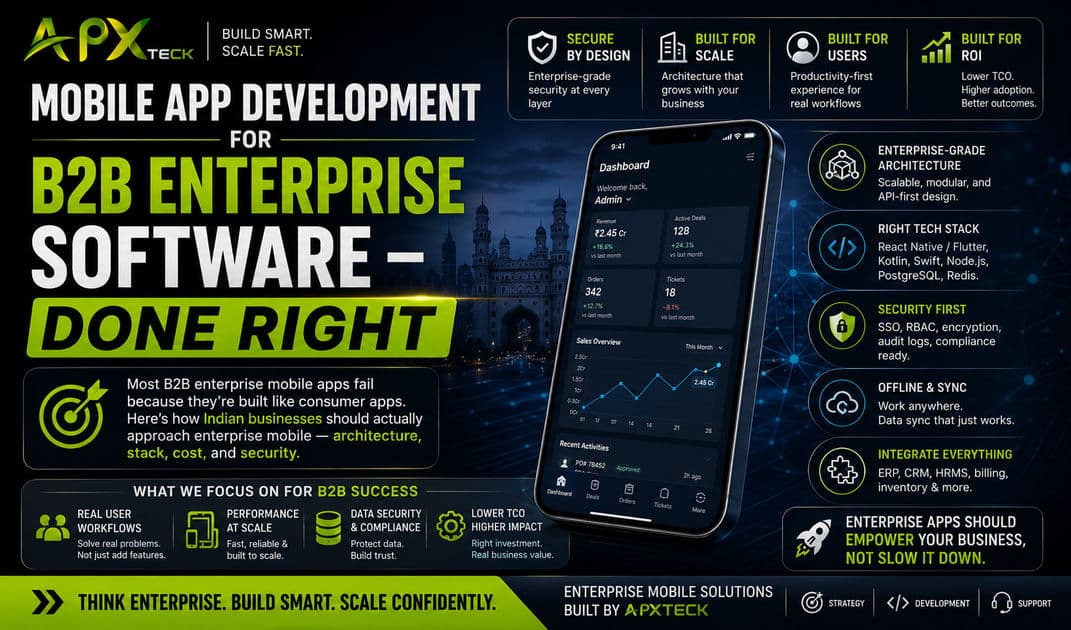
Mobile App Development for B2B Enterprise Software — Done Right
Your sales team is closing deals from airport lounges. Your warehouse manager in Pune needs inventory counts in real time. Your field technicians need to submit inspection reports from locations with barely any network signal. And you're still asking them to VPN into a desktop-only dashboard from 2019.
This is the B2B enterprise mobile gap — and it's costing Indian businesses real money. According to IDC Research, enterprises using purpose-built mobile apps achieve 2.5x faster revenue growth compared to those relying on off-the-shelf software. McKinsey's research shows enterprise mobility delivers productivity gains of 20-40% for knowledge workers and field teams. Yet 40% of enterprise mobile projects fail, and the reason is almost always the same: they're architected like consumer apps instead of enterprise systems.
This guide is for founders, CTOs, and technical decision-makers at Indian SMBs and mid-market companies who need to build mobile apps that actually work in enterprise environments — not just look pretty in a demo.
Why B2B Enterprise Mobile Is Fundamentally Different from Consumer Mobile
The first mistake most development teams make is treating an enterprise mobile project like a scaled-up consumer app. The requirements are nothing alike.
Enterprise Apps Are Workflow Infrastructure, Not Content Surfaces
A consumer app needs to be delightful. An enterprise app needs to be reliable. Your CRM mobile app isn't competing with Instagram for attention — it's competing with the spreadsheet your sales team currently uses because the desktop CRM is too slow on their phone's browser.
Enterprise mobile apps serve six core categories: CRM for pipeline visibility on the go, ERP for operations management, HRM for attendance and onboarding, BI/analytics dashboards for real-time decision-making, communication tools for distributed teams, and field force management for technicians and delivery personnel. Each one has integration requirements, role-based access controls, compliance constraints, and offline needs that consumer apps simply never deal with.
The Indian Enterprise Context Adds Complexity
India's enterprise mobile device market is growing at a CAGR of 17.3% through 2033, but the operating environment is harder than most guides acknowledge. Your field team in Tier-2 cities deals with patchy connectivity. Your workforce uses a mix of ₹8,000 Android devices and company-issued phones running outdated OS versions. Over 55% of mobile devices used at work are running vulnerable operating systems — and that's a global figure. In India's SMB segment, the number is almost certainly higher.
Any enterprise mobile architecture that assumes constant high-bandwidth connectivity, uniform device capabilities, or up-to-date security patches is going to fail in the Indian market. This isn't a nice-to-know — it's a hard architectural constraint.
The Stack Decision: React Native vs. Flutter vs. Native
Every enterprise mobile project starts with this question, and most articles answer it with a useless "it depends." Here's an actual opinion.
For 80% of Indian B2B Projects, Cross-Platform Is the Right Call
Building separate native iOS (Swift) and Android (Kotlin) codebases doubles your development cost, doubles your maintenance burden, and requires two specialist teams. Cross-platform frameworks like React Native and Flutter let you share up to 70% of code across platforms while delivering near-native performance. For most B2B apps — CRMs, dashboards, approval workflows, field reporting — cross-platform is not a compromise. It's the smart engineering decision.
Native makes sense only when you need deep hardware integration (AR-based maintenance apps, Bluetooth device control) or when performance requirements are extreme (real-time video processing, complex 3D visualization). For the average enterprise workflow app, native is overkill and an unnecessary budget drain.
React Native vs. Flutter: The Real Tradeoff
Both are production-ready in 2026. The choice comes down to your existing team and infrastructure.
Pick React Native if your engineering team already works in JavaScript or TypeScript, you have a web product built in React that shares business logic with the mobile app, or you need to integrate with a deep ecosystem of existing JavaScript libraries. React Native's 2026 architecture (JSI and the Fabric renderer) has eliminated most of the old performance complaints. Meta still actively maintains it, and the JavaScript talent pool in India is massive.
Pick Flutter if you're starting from scratch with no existing JS infrastructure, your app demands highly custom UI with complex animations, or you want the tightest possible consistency between iOS and Android interfaces. Flutter compiles to native ARM code and performs excellently, but the Dart developer pool in India is smaller than the JS pool, which can affect hiring and long-term maintenance costs.
For the average Indian SMB building its first enterprise mobile app — particularly if it already has a Node.js or Next.js web backend — React Native is usually the pragmatic choice. The framework familiarity alone saves weeks of onboarding.
What It Actually Costs in India
Let's talk real numbers. Mobile app development in India ranges widely, but for B2B enterprise projects, here's what the market looks like in 2026:
An MVP with core workflow features (15-20 screens, basic role-based access, API integrations) costs ₹3-7 lakh using React Native or Flutter. A mid-complexity enterprise app with custom UI, multiple integrations, offline sync, and admin panels runs ₹10-25 lakh. A full-featured enterprise platform with BI dashboards, real-time data, advanced security, and multi-role architecture costs ₹35 lakh to ₹1 crore and above.
Cross-platform development saves 30-40% compared to building two separate native apps. That's not a marketing claim — it's a function of maintaining one codebase instead of two. The backend is often the most expensive part of the build, not the screens. And maintenance runs 15-20% of the initial build cost annually — a line item most project budgets conveniently forget.
Architecture That Actually Works for Enterprise
This is where most Indian development agencies reveal their consumer-app DNA. They build a pretty frontend, hook it to a REST API, and call it enterprise-ready. That's not how enterprise mobile works.
API-First Design Is Non-Negotiable
Your mobile app is one client. Your web dashboard is another. Your partner portal might be a third. If you're building tightly coupled mobile-to-backend integrations, you've already lost.
Enterprise mobile architecture should be API-first: a well-documented, versioned REST or GraphQL API layer that serves every client consistently. This decoupled approach means your mobile team and backend team can work in parallel, your API can serve future clients you haven't imagined yet, and swapping out or upgrading the mobile frontend doesn't require rebuilding the backend.
In practice, this means designing your API contracts before writing your first mobile screen. Tools like Prisma ORM on top of PostgreSQL give you type-safe database access that maps cleanly to API schemas — and that's the stack we use at APXTECK precisely because it forces this kind of disciplined architecture.
Offline-First Isn't Optional in India
Google's offline-first design guidelines are now considered baseline for enterprise development, and for good reason. In India, "offline-first" isn't an edge case — it's the default for any app used by field teams outside metro areas.
This means local data caching with SQLite or Hive, conflict resolution strategies for when offline edits sync back to the server, queue-based request handling that retries when connectivity returns, and a UI that clearly shows users what's synced and what's pending. The apps that skip offline support end up with frustrated field teams who either stop using the app entirely or resort to writing things down on paper and entering them later — defeating the entire purpose of going mobile.
Role-Based Access Control Needs to Be Granular
Consumer apps have two roles: logged in and logged out. Enterprise apps might have a field technician who can submit reports but not approve them, a regional manager who can approve reports and view team dashboards, a finance head who can see cost data but not HR records, and a super-admin who can configure workflows and manage user permissions.
This isn't a feature you bolt on later. Role-based access control (RBAC) needs to be designed into your data model, your API authorization layer, and your mobile UI from day one. Every API endpoint should validate permissions server-side, regardless of what the mobile client displays. The client can hide a button; the server must enforce the rule.
Security: Zero-Trust or Nothing
Here's my most opinionated take: if your enterprise mobile app still relies on VPN-based security, you're already compromised in spirit. Gartner projects that 60% of enterprises will phase out legacy VPN access in favor of Zero-Trust Network Access by 2027. The direction is clear.
Why Zero-Trust Matters for Mobile
Zero-trust architecture operates on one principle: never trust, always verify. Every access request is authenticated based on user identity, device health, location, and behavior — not based on whether the device is "inside the network."
For mobile enterprise apps, this translates into concrete architectural decisions. Use SSO with providers like Okta, Azure AD, or Auth0 rather than storing credentials locally. Replace session-based trust with short-lived access tokens validated on every API call. Implement device attestation to verify the phone hasn't been jailbroken or rooted. Encrypt data at rest and in transit — always, not selectively.
The stakes are real: 63% of enterprise mobile apps contain at least one critical security flaw, and enterprises lose an average of $1.85 million per mobile data breach. For an Indian SMB, a single breach can be existential. Spending an extra ₹2-5 lakh on proper security architecture during development is dramatically cheaper than the cost of recovering from a breach.
API Security Is the Real Attack Surface
In 2026, mobile apps are API-driven ecosystems. Your APIs are the attack surface — not the mobile client itself. Every API endpoint must validate authentication tokens, enforce rate limiting, sanitize inputs, and return only the data the requesting role is authorized to see.
The most common enterprise mobile security failures aren't sophisticated zero-day exploits. They're broken authentication on API endpoints, excessive data exposure where the API returns more fields than the client needs, and missing rate limiting that allows brute-force attacks. These are preventable with basic engineering discipline. The problem is that most agencies don't treat API security as a first-class concern.
What Most Agencies Get Wrong
After building systems for Indian SMBs, I've seen the same failure patterns repeat. Here's what to watch for.
They Skip Discovery and Jump to Wireframes
Enterprise mobile projects need a proper discovery phase — understanding existing workflows, mapping integration points, defining user roles, documenting compliance requirements. An agency that shows you wireframes in week one hasn't understood the problem.
They Underestimate Integration Complexity
Your mobile app needs to talk to your ERP, your accounting software, your payment gateway, your communication tools. Each integration is a separate engineering problem with its own authentication, data format, rate limits, and failure modes. Budget at least 30-40% of your development timeline for integration work.
They Don't Plan for Adoption
The most technically brilliant enterprise app delivers zero ROI if employees don't use it. Change management — training, onboarding UX, gradual rollout, feedback loops — needs to be in your project plan from sprint one. If your agency treats "user adoption" as the client's problem, find a different agency.
The Practical Roadmap for Indian B2B Companies
If you're an Indian SMB or mid-market company considering your first enterprise mobile app, here's the sequence that actually works.
Start with one workflow. Don't try to mobilize your entire operation at once. Pick the workflow with the most obvious inefficiency — field reporting, order approvals, inventory checks — and build a focused app that solves that one problem well. Measure time saved in the first 90 days. That data is your internal business case for expanding.
Choose cross-platform (React Native or Flutter) unless you have a specific technical reason for native. Invest the savings in proper API architecture and security.
Design offline-first from day one. Don't add offline support as a "phase 2" afterthought. Retrofitting offline capabilities into an app designed for always-on connectivity is expensive and fragile.
Budget for security and maintenance upfront. Allocate ₹2-5 lakh for security architecture during development, and plan for 15-20% of build cost annually for maintenance, updates, and OS compatibility fixes.
And most importantly — treat the mobile app as part of your system architecture, not as a standalone project. The app is a client. The API is the product. Build accordingly.
Published by APXTECK — AI-powered web development and enterprise solutions for Indian businesses. Let's build your B2B mobile app →
Article Comments
You must be signed in to post comments.
Sign In to Join the Discussion →No comments approved yet. Be the first to share your thoughts!
About the Author

Praveen Kumar
Co-Founder & DirectorFull-Stack Developer, APXTECK, chatgpt, google
Praveen Kumar is the Co-Founder and Full-Stack Developer at APXTECK, an AI-powered IT agency helping Indian SMBs grow through web development, automation, and AI integration. He builds production-grade systems using Node.js, Next.js, PostgreSQL, and modern AI APIs. When he is not shipping code, he is writing about practical technology that actually works for Indian businesses.
Related Insights

How to Architect a Multi-Tenant SaaS That Actually Scales

How AI Can Multiply Organic Traffic for Coaching Institutes

How Healthcare Clinics Are Using Custom Software Development to Double Operational Efficiency

What Is GEO and Why It's the Next Big Frontier Beyond SEO
Wearables, Data, and Dollars: The Business of Athlete Optimization

Stop Building Features, Start Building Value for Your SaaS

The ROI of Tech: Investing in IT Solutions That Actually Pay Off