


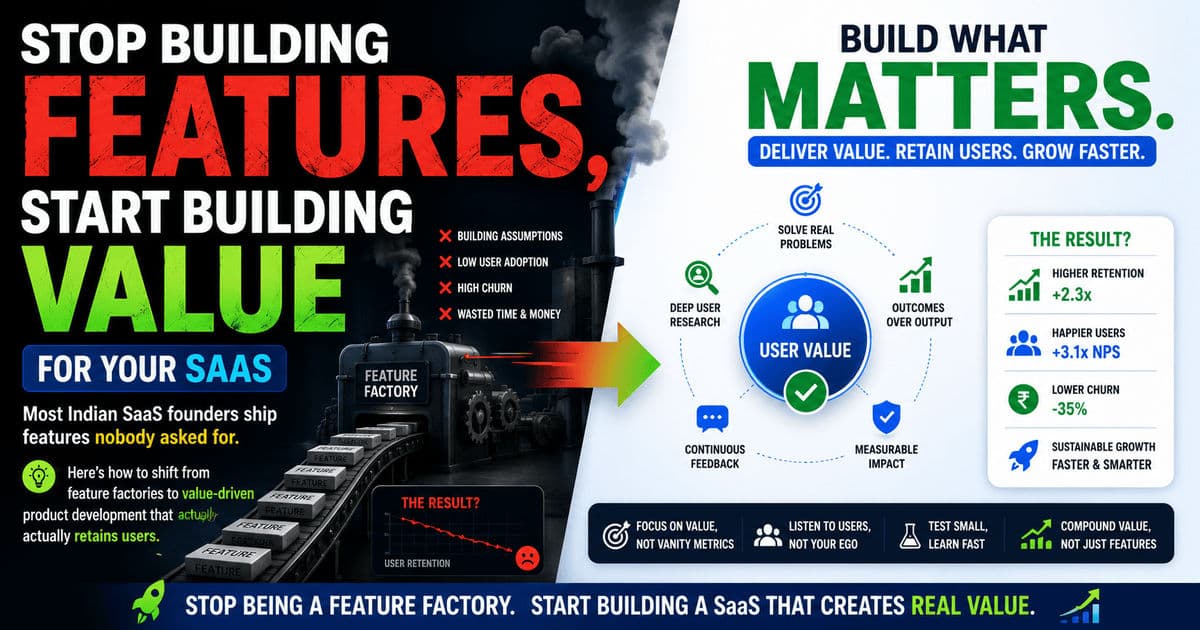
Stop Building Features, Start Building Value for Your SaaS

Praveen Kumar
You Shipped 14 Features Last Quarter — So Why Is Churn Still at 8%?
Here's a pattern I've seen play out with almost every early-stage Indian SaaS founder I've worked with: they treat their product roadmap like a feature buffet. Competitor added dark mode? Ship it. Three users requested CSV exports? Sprint it. Investor mentioned AI? Bolt on a chatbot.
Six months later, the product is bloated, the codebase is fragile, onboarding is confusing, and the churn rate hasn't moved. Sound familiar?
The problem isn't that you're building too slowly. The problem is that you're building the wrong things — and measuring progress by output (features shipped) instead of outcome (value delivered). This distinction is the single biggest unlock for SaaS product development, especially for Indian startups operating with tight runways and small teams.
The Feature Factory Trap Indian SaaS Teams Fall Into
Most Indian SaaS companies between ₹10L and ₹5Cr ARR operate as feature factories without realising it. The symptoms are obvious if you know where to look.
How Feature Factories Operate
A feature factory optimises for volume. The team ships constantly, the changelog is long, and everyone feels productive. But dig into the data and you'll find that 60-70% of those features get used by fewer than 5% of active users. That's not productivity — that's waste dressed up as momentum.
The root cause is almost always the same: the team conflates user requests with user needs. A customer says "I wish I could export to PDF," and the team builds a PDF exporter. But the actual need might be "I need to share a report with my CA who doesn't use this tool." The solution to that might be a shareable link with view-only access — cheaper to build, more useful, and applicable to ten other workflows.
Why This Hits Indian Startups Harder
Indian SaaS companies face a unique version of this trap. Many sell to Indian SMBs where ticket sizes are low (₹500-₹5,000/month), which means you can't afford high support costs or complex onboarding. Every unnecessary feature increases the surface area a user has to navigate, raises your support burden, and dilutes your core value proposition.
When you're charging ₹2,000/month and spending ₹800 in support costs per account partly because your product is confusing, your unit economics are broken — and no amount of feature shipping fixes that.
What Value-Driven SaaS Product Development Actually Looks Like
Value-driven development flips the model. Instead of asking "what should we build next?", you ask "what outcome should we enable next?" The difference sounds subtle, but it changes everything about how you prioritise, design, and measure.
Outcomes Over Outputs
An output is a feature. An outcome is a measurable change in user behaviour or business result. Here's the distinction in practice:
| Feature-Driven (Output) | Value-Driven (Outcome) |
|---|---|
| "We shipped a dashboard" | "Users check their key metrics 3x more often" |
| "We added Razorpay integration" | "Payment collection time dropped from 7 days to 1 day" |
| "We built an AI summary tool" | "Users spend 40% less time reviewing reports" |
| "We added team management" | "Account expansion revenue increased 25%" |
When you frame work in terms of outcomes, half the features on your roadmap suddenly look irrelevant. That's the point.
The ICE Framework With an Indian SaaS Twist
Most product teams know about ICE scoring — Impact, Confidence, Ease. But I'd argue Indian SaaS teams need to weight it differently.
Impact should be measured against retention, not acquisition. For Indian SMB SaaS, acquiring users is relatively cheap (content marketing, WhatsApp outreach, referrals). Keeping them is the hard part. So every feature should be scored on "does this make existing users more likely to stay and pay?"
Confidence should require evidence, not opinions. Before building, run a fake-door test, a concierge version, or at minimum, talk to 10 users who represent the target segment. "Our sales team thinks this would be great" is not confidence — it's speculation.
Ease should account for maintenance cost, not just build cost. A feature that takes two weeks to build but requires ongoing support, monitoring, and edge-case handling for months is not "easy." Indian startups undercount maintenance costs because they're invisible until they're drowning in Freshdesk tickets.
The Four Filters Every Feature Must Pass
Before anything goes on your sprint board, run it through these four filters. If it fails any one, it goes back to the backlog — or gets killed entirely.
Filter 1: Does It Serve Your Core Value Loop?
Every SaaS product has one core loop — the thing users come back to do repeatedly. For an invoicing tool, it's creating and sending invoices. For a CRM, it's logging and acting on deals. For a project management tool, it's tracking tasks.
Features that strengthen this core loop get priority. Features that sit adjacent to it are secondary. Features that have nothing to do with it are distractions, regardless of how many users requested them.
If you're building an invoicing SaaS and someone requests a built-in expense tracker, that's adjacent — maybe worth exploring later. But if they request a team chat feature, that's a distraction. Kill it.
Filter 2: Will It Reduce Time-to-Value for New Users?
Indian SMB users are impatient. They're evaluating your tool on a ₹500/month plan, often on a mobile device, between client calls. If they don't see value in the first 15 minutes, they're gone.
Every feature you add to the product either shortens or lengthens this time-to-value. A smart onboarding wizard that pre-configures settings based on industry shortens it. A 47-field settings page that the user has to wade through before they can do anything useful lengthens it.
Ask yourself: does this feature help a new user reach their first success moment faster? If not, it better be incredibly valuable to retained users.
Filter 3: Can You Measure Its Impact Within 30 Days?
If you can't define a metric that will move within 30 days of shipping, you probably don't understand the feature well enough to build it. This isn't about being data-obsessed — it's about being honest.
The metric doesn't have to be revenue. It could be activation rate, feature adoption, support ticket volume, or session frequency. But it has to be specific and observable. "Users will like it" is not a metric.
Filter 4: What Happens If You Don't Build It?
This is the most underused filter. For every feature on your roadmap, ask: what's the cost of not building this for the next six months? If the answer is "nothing really changes," that feature is not urgent — and probably not important either.
The features that matter are the ones where not building them has a clear, measurable cost: users churning, deals being lost, support costs climbing, or competitors pulling away on a specific capability.
How to Transition From Feature Factory to Value Engine
You can't flip a switch overnight, but you can start the transition in your next sprint cycle.
Step 1: Audit Your Last 20 Features
Pull up every feature you shipped in the last two quarters. For each one, answer three questions: How many users actively use it? Did it move any retention or engagement metric? Would you build it again knowing what you know now?
Most teams find that 30-40% of what they built was either unused or unmeasurable. That's not a failure — it's a baseline. Now you know the cost of operating without filters.
Step 2: Kill Your Internal Feature Request List
Feature request lists are where good prioritisation goes to die. They grow endlessly, create false expectations ("it's on the list!"), and bias teams toward building what's loudly requested rather than what's strategically important.
Replace it with a problem board. Instead of logging "User X wants PDF export," log "Users in the CA/accounting segment struggle to share financial reports externally." Problems can have multiple solutions, and the best solution might not be a feature at all — it might be better documentation, a template, or a workflow change.
Step 3: Implement a One-In-One-Out Rule
For every new feature you ship, identify one existing feature to deprecate, simplify, or merge. This forces discipline. It keeps your product lean, your codebase manageable, and your onboarding navigable.
Indian SaaS teams resist this because they worry about upsetting the three users who rely on some obscure feature. But maintaining features for 3 users while confusing 300 others is a bad trade. Communicate the change, offer a workaround, and move on.
Step 4: Tie Every Sprint to a Retention Metric
Stop measuring sprints by story points completed or features shipped. Measure them by impact on a retention-adjacent metric: activation rate, Day-7 retention, expansion revenue, NPS among paying users, or support ticket volume.
This changes the conversation in sprint planning from "what can we ship?" to "what will move the number?" — and that's exactly the shift you need.
The Compounding Effect of Value-Driven Development
Here's what happens when you make this shift consistently over two to three quarters. Your product gets simpler and more focused. Onboarding improves because there's less to explain. Support costs drop because there are fewer edge cases. Your developers spend less time maintaining unused features and more time deepening core capabilities. And your users start describing your product to others not as "it does everything" but as "it does this one thing really well."
That clarity is your competitive advantage — especially against larger, more bloated competitors.
For Indian SaaS companies selling at ₹1,000-₹5,000/month price points, this isn't a nice-to-have philosophy. It's survival. You don't have the margins to support feature bloat, the team size to maintain sprawling codebases, or the runway to build things that don't move the needle.
Build less. Build what matters. Measure obsessively. That's the new playbook.
Where APXTECK Fits In
At APXTECK, we help Indian SaaS founders and SMBs build products and systems that are lean, value-focused, and designed to scale without the bloat. Whether it's architecting your MVP, automating internal workflows with AI, or restructuring a codebase that's buckling under feature debt — we build with outcomes in mind, not feature counts.
If your product roadmap feels like a feature graveyard, let's fix that.
Published by APXTECK — AI-powered product development and automation for Indian businesses. https://apxteck.com/contact
Article Comments
You must be signed in to post comments.
Sign In to Join the Discussion →No comments approved yet. Be the first to share your thoughts!
About the Author

Praveen Kumar
Co-Founder & DirectorFull-Stack Developer, APXTECK
Praveen Kumar is the Co-Founder and Full-Stack Developer at APXTECK, an AI-powered IT agency helping Indian SMBs grow through web development, automation, and AI integration. He builds production-grade systems using Node.js, Next.js, PostgreSQL, and modern AI APIs. When he is not shipping code, he is writing about practical technology that actually works for Indian businesses.
Related Insights

The ROI of Tech: Investing in IT Solutions That Actually Pay Off

Why Uber Burned Its Yearly AI Budget in Only Four Months

Lightning-Fast Websites with Premier Next.js Development

Claude Code Loops Explained: Why Prompts Alone Won't Cut It

Are You Doing Dark Mode Wrong? 5 Psychological Color Mistakes Destroying Your UX

MCP Servers Are the Biggest Developer Productivity Shift of 2026

I Mastered Claude So You Don't Have To (Beginner to Advanced)