


The ROI of Tech: Investing in IT Solutions That Actually Pay Off

Praveen Kumar
The ROI of Tech: Investing in IT Solutions That Actually Pay Off
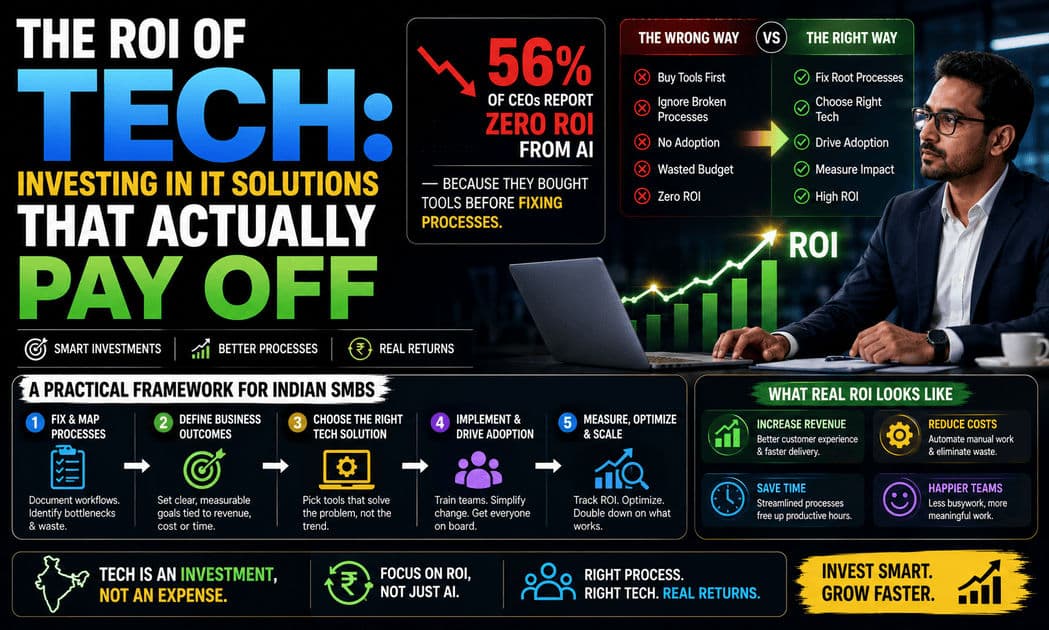
Here are two statistics that should be on every Indian business owner's wall. First: 91% of SMBs using AI say it boosted their revenue, according to Salesforce's 2025 SMB Trends Report surveying 3,350 businesses globally. Second: 56% of CEOs report zero measurable ROI from their AI investments, according to PwC's 2026 Global CEO Survey.
Both numbers are true. And the gap between them explains why some Indian businesses are thriving with technology while others are lighting money on fire.
The difference isn't the technology. It's the order of operations. The businesses getting ROI invested in fixing their processes first and adding technology second. The businesses getting zero ROI did the opposite — they bought tools, then tried to figure out what to do with them.
This post is the practical framework I use when advising Indian SMBs on tech investments. No vendor hype. No "digital transformation" jargon. Just a clear-eyed look at which IT investments actually pay off, in what order, and how quickly.
Why Most Tech Investments Fail (The Real Reason)
A study cited by Digital Applied found that 62% of small business digital transformations fail because companies buy technology before understanding their process gaps. That's not a technology problem — it's a sequencing problem.
I see this constantly with Indian SMBs. A Noida-based logistics company buys a ₹15 lakh ERP system before they've even mapped their existing workflows. A Bengaluru SaaS startup subscribes to five different AI tools before identifying which manual processes are actually costing them time. A Delhi retailer launches a ₹3 lakh website before figuring out what their customers actually search for.
The technology works. The business case doesn't — because nobody calculated the ROI before signing the purchase order.
The ROI Stack: Where to Invest First
Based on working with Indian SMBs across revenue ranges from ₹20 lakh to ₹50 crore, here's the investment sequence that consistently delivers the fastest payback.
Layer 1: Digitise Your Core Operations (Payback: 30-60 Days)
This is where Indian micro and small businesses should start, and it's the cheapest layer. According to Ken Research, Indian micro businesses spend only ₹50,000 annually on digital tools — and most of that goes to basic connectivity rather than operational tools.
The investments that pay off immediately at this layer are CRM software to replace Excel sheets and WhatsApp groups for lead tracking, cloud accounting (Tally on cloud, Zoho Books, or QuickBooks) for invoicing and GST compliance, and Google Workspace or Microsoft 365 for professional email and document collaboration.
The ROI here is straightforward to calculate. If your sales team is losing 3-5 leads per week because they're tracked in WhatsApp conversations that get buried, and your average deal size is ₹25,000, that's ₹3-5 lakh per year in lost revenue. A Zoho Bigin CRM subscription costs ₹7,000/year. That's a 40-70x return.
CRM specifically delivers 3-5x ROI in year one for Indian SMBs, with the first measurable improvements (faster lead response time) visible within 2-4 weeks of implementation.
Layer 2: Build Your Digital Presence (Payback: 3-6 Months)
Once internal operations are digitised, invest in how customers find and evaluate you. This means a professional website with clear service pages and a contact form, a Google Business Profile optimised for local search, and basic SEO targeting the keywords your customers actually use.
The ROI calculation here depends on your business model, but the pattern is consistent. An Indian B2B services company spending ₹1-2 lakh on a professional website with proper SEO typically sees the first organic leads within 60-90 days. If those leads convert at even 5% and your average project value is ₹2 lakh, the website pays for itself within the first quarter.
The mistake I see constantly: businesses spending ₹5-10 lakh on a "premium" website with animations and custom illustrations when a clean, fast, SEO-optimised site for ₹1-2 lakh generates more leads. The ROI on a ₹50,000 Google Ads budget driving traffic to a well-built landing page almost always beats the ROI on a ₹10 lakh design-heavy site with no traffic strategy.
Layer 3: Automate Repetitive Processes (Payback: 2-6 Months)
This is where the real efficiency gains happen, and it's where most Indian SMBs should focus their next ₹50,000-₹2 lakh of tech budget.
Back-office automation delivers the fastest payback in the entire digital transformation stack. Accounts payable automation, appointment scheduling, invoice processing, and email follow-up sequences all deliver payback periods under six months. The reason is simple: these are high-frequency, low-complexity tasks where human time is the most expensive input.
A practical example: an Indian consulting firm spends 15 hours per week on manual invoice generation, follow-up emails for overdue payments, and reconciliation with their accounting software. At a loaded cost of ₹500/hour for the person doing this work, that's ₹3.9 lakh per year. Automating this workflow with Zoho Invoice + Zapier costs ₹30,000-₹50,000/year. Payback period: under 6 weeks.
For Indian SMBs doing ₹1-50 crore in annual revenue, the three highest-ROI automation targets are lead follow-up sequences (auto-send personalised emails after form submissions), invoice and payment reminder automation, and customer onboarding workflows (auto-send welcome emails, collect documents, schedule kick-off calls).
Layer 4: AI Integration (Payback: Variable — This Is Where Discipline Matters)
AI is the layer where Indian SMBs either achieve exceptional ROI or waste money spectacularly. The global average is $3.70 returned for every $1 invested in AI, but that average hides enormous variance. Some businesses see 10x returns. Many see zero.
The data from IBM's 2025 study on Indian companies is telling: 76% of Indian IT decision-makers reported achieving ROI-driven results from their AI strategies. But the ones who succeeded had a critical commonality — they applied AI to specific, measurable processes rather than adopting AI as a general capability.
Here's my framework for AI investments that pay off for Indian SMBs.
High-ROI AI use cases (start here): customer support chatbots that handle 60-80% of routine queries (measurable reduction in support staff time), AI-powered content generation for marketing (measurable reduction in content creation cost per piece), automated data extraction from invoices and documents (measurable reduction in manual data entry hours), and AI-assisted code generation for development teams (measurable increase in developer output).
Low-ROI AI use cases (avoid these first): general-purpose AI assistants with no specific workflow integration ("let's give everyone a ChatGPT subscription and see what happens"), AI analytics dashboards on top of data you don't already track manually, and voice AI or chatbots for processes that don't have enough volume to justify the setup cost.
The difference is specificity. "We'll use AI to be more productive" is a recipe for zero ROI. "We'll use AI to reduce our customer support response time from 4 hours to 15 minutes and handle 70% of Tier 1 queries without human intervention" is a recipe for measurable returns.
The Numbers That Matter: How to Calculate IT ROI
Every tech investment should pass this four-question test before you commit budget.
What does this process cost us today? Quantify it in hours and rupees. If you can't measure the current cost, you can't measure the improvement. Be specific: "Our sales team spends 8 hours per week manually updating lead status in spreadsheets. At ₹600/hour loaded cost, that's ₹2.5 lakh per year."
What will it cost after implementing this technology? Include the subscription cost, implementation time, training period, and any ongoing maintenance. Don't forget the productivity dip during the first 2-4 weeks of adoption.
What is the payback period? Divide the total implementation cost by the monthly savings. If the payback period is longer than 12 months for a subscription tool, question whether the investment is worth it. The best SMB tech investments pay back in 3-6 months.
What is the opportunity cost of not investing? This is the question most Indian business owners skip. If your competitor has a professional website and you don't, what leads are you losing? If your competitor automates follow-ups and you don't, what deals are slipping through? Sometimes the ROI of tech isn't efficiency gained — it's revenue not lost to competitors who invested first.
The Indian SMB Tech Budget Framework
Based on revenue bands, here's a realistic tech budget allocation that consistently delivers positive ROI.
For businesses doing ₹20 lakh - ₹1 crore annually: allocate 3-5% of revenue to tech. Priority investments are CRM (free tier or ₹7,000-₹15,000/year), professional website (₹50,000-₹1.5 lakh one-time), cloud accounting (₹5,000-₹15,000/year), and Google Workspace (₹1,500/user/year). Total: ₹60,000-₹2 lakh/year. Expected ROI: 3-5x within 12 months.
For businesses doing ₹1 crore - ₹10 crore annually: allocate 4-7% of revenue to tech. Add automation workflows (₹30,000-₹1 lakh/year), paid CRM (₹15,000-₹50,000/year), SEO and content (₹50,000-₹2 lakh/year), and AI integration for one specific workflow (₹50,000-₹2 lakh/year). Total: ₹2-5 lakh/year. Expected ROI: 4-8x within 12 months.
For businesses doing ₹10 crore - ₹50 crore annually: allocate 5-8% of revenue. Add custom web applications, ERP integration, AI-powered customer workflows, and dedicated IT support. Total: ₹10-40 lakh/year. Expected ROI: 3-6x within 12-18 months.
These aren't aspirational numbers. They're based on what we've seen work with real Indian businesses across industries.
The Investments That Almost Never Pay Off
Here's the part nobody building or selling tech solutions wants to tell you.
Custom software before process clarity is the single biggest money pit in Indian SMB tech. Building a ₹10-30 lakh custom application before you've validated the workflow with a spreadsheet or off-the-shelf tool is how businesses burn capital. Use existing tools for 6 months, understand exactly what you need, then build custom — not the other way around.
Premium tools for basic needs is the second biggest waste. A 5-person Indian startup doesn't need Salesforce at ₹15,000/user/month. Zoho Bigin at ₹600/user/month does 90% of the same job. An Indian freelancer doesn't need Adobe Creative Suite at ₹55,000/year when Canva Pro at ₹4,000/year handles their actual design needs.
Technology without training guarantees poor ROI. A ₹5 lakh CRM implementation fails if nobody on your team knows how to use it properly. Budget 15-20% of any tech investment for training and onboarding. The tool is only as good as the team's ability to use it.
What You Should Do This Week
If you're an Indian business owner or decision-maker reading this, here's your immediate action plan.
First, pick your biggest time sink — the manual process that eats the most hours per week across your team. Calculate its annual cost in rupees. That's your first automation candidate, and the ROI calculation will tell you exactly how much to invest.
Second, if you don't have a CRM yet, sign up for Zoho Bigin or HubSpot's free tier today. Move your leads out of WhatsApp and spreadsheets. This single change, taking 2 hours to set up, will improve your close rate within the first month.
Third, before your next tech purchase, run the four-question ROI test above. If the investment doesn't pass, it doesn't matter how impressive the demo was. Your budget deserves better than unquantified hope.
Technology is not an expense. It's an investment — but only when you can prove the return. The Indian SMBs winning in 2026 aren't the ones spending the most on tech. They're the ones spending on the right tech, in the right order, with the right expectations.
Published by APXTECK — AI-powered IT solutions for Indian SMBs. Need help identifying which tech investments will deliver the highest ROI for your business? Visit apxteck.com/contact.
Article Comments
You must be signed in to post comments.
Sign In to Join the Discussion →No comments approved yet. Be the first to share your thoughts!
About the Author

Praveen Kumar
Co-Founder & DirectorFull-Stack Developer, APXTECK
Praveen Kumar is the Co-Founder and Full-Stack Developer at APXTECK, an AI-powered IT agency helping Indian SMBs grow through web development, automation, and AI integration. He builds production-grade systems using Node.js, Next.js, PostgreSQL, and modern AI APIs. When he is not shipping code, he is writing about practical technology that actually works for Indian businesses.
Related Insights

Why Uber Burned Its Yearly AI Budget in Only Four Months

Lightning-Fast Websites with Premier Next.js Development

Claude Code Loops Explained: Why Prompts Alone Won't Cut It

Are You Doing Dark Mode Wrong? 5 Psychological Color Mistakes Destroying Your UX

MCP Servers Are the Biggest Developer Productivity Shift of 2026

I Mastered Claude So You Don't Have To (Beginner to Advanced)

Claude Tag Makes AI a Teammate. That's the Trap.