


Why Traditional SEO Is Dead: Preparing for Generative Search

Praveen Kumar
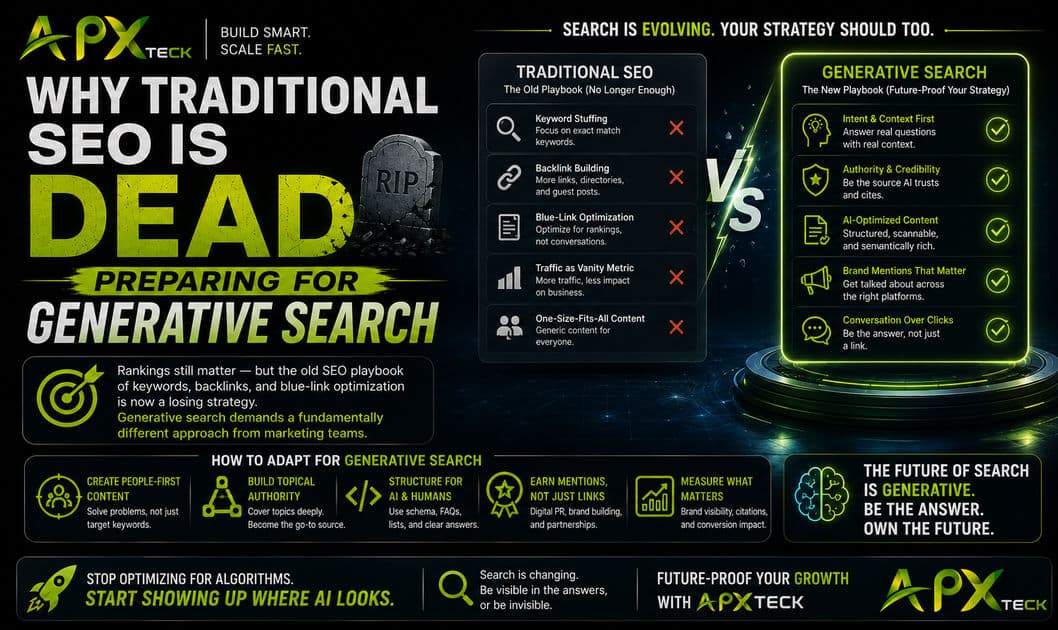
Why Traditional SEO Is Dead: Preparing for Generative Search
Here's the uncomfortable truth your SEO agency probably hasn't told you: your rankings are holding steady, but your organic pipeline is shrinking.
You're not imagining it. Nearly 65% of Google searches now end without a click. AI Overviews appear on roughly 48% of all tracked queries — up 58% year-over-year. And when a prospective buyer asks ChatGPT or Perplexity to recommend a vendor in your category, your brand either shows up in that synthesized answer or it doesn't exist. There's no position 4 to fall back on. There's no "above the fold." The AI gives an answer, and either you're in it, or you're invisible.
This isn't a technical SEO problem. It's a strategic one. And it demands a fundamentally different response from marketing leadership — not a tweak to your existing playbook, but a rethinking of how your brand earns visibility in an era of generative search.
What Generative Search Actually Changes
Generative search is the umbrella term for AI-powered search systems — Google AI Overviews, ChatGPT Search, Perplexity, Gemini, Claude, Copilot — that synthesize answers from multiple sources instead of returning a list of links. The user gets a direct, conversational response. Your website might be one of the 2-7 sources the AI cites. Or it might not be cited at all.
The Traffic Model Has Inverted
Traditional SEO assumed a simple funnel: rank well → earn clicks → capture leads. Generative search breaks this at the click stage. AI search engines produce zero-click rates between 60% and 93%. Google's AI Mode — its most aggressive generative format — hits 93% zero-click because it replaces organic results entirely with an AI conversation interface.
For informational queries — the exact queries that B2B content marketing has relied on for a decade — non-branded organic traffic has dropped 15-30% across content sites. And this decline is happening even for sites whose rankings haven't changed. The traffic isn't going to a competitor's page. It's being absorbed by an AI-generated answer that the user never clicks past.
The Competitive Frame Has Shifted
In traditional search, you competed against nine other results on page one. In generative search, you compete against every relevant source on the internet for a spot in a single synthesized answer. Citations cluster heavily: 40-55% of ChatGPT Search and Perplexity citations flow to fewer than 1,000 domains globally. Content without clear topical authority, structured data, and direct answers is systematically excluded — even when it ranks well in traditional Google results.
The implication for marketing leaders: your domain authority and backlink profile no longer guarantee visibility. The AI doesn't care about your DR score. It cares about whether your content is structured, authoritative, specific, and citable.
The Three Things That Died with Traditional SEO
Let me be precise about what's actually dead versus what's evolving.
Keyword-First Content Strategy Is Dead
The old model: find high-volume keywords, write content targeting those keywords, optimize title tags and meta descriptions, build backlinks, track rankings. This workflow produced an entire industry of "SEO content" that was optimized for crawlers but mediocre for humans.
Generative search engines don't rank pages by keyword relevance. They extract and synthesize information based on factual accuracy, source credibility, content structure, and specificity. Research from Princeton, Georgia Tech, and IIT Delhi found that adding verifiable statistics improved AI visibility by 41%, while promotional copy showed a negative 26% correlation with citation rates. The AI is actively trained to skip marketing fluff.
If your content team is still briefing writers with target keywords and word counts, you're optimizing for a system that's losing relevance.
Volume-Based Content Production Is Dead
Publishing 20 blog posts a month to "build topical authority" made sense when Google rewarded content velocity. In generative search, one deeply researched, well-structured, expert-backed article earns more AI citations than fifty thin posts. AI engines can detect redundant or repeated content and prefer sources that provide original insights, specific data, and unique frameworks.
Gartner's 2026 CMO Spend Survey shows marketing budgets compressed to 7.7% of revenue — the lowest in a decade. Spending that shrinking budget on content volume is a losing strategy. The ROI now comes from content depth.
Click-Based KPIs Are Dead
If your SEO dashboard still leads with organic sessions, page views, and click-through rate, you're measuring the exhaust of a dying engine. These metrics can't capture what happens when a buyer gets their answer inside ChatGPT and never visits your website — but trusts the brands named in that answer enough to put them on a shortlist.
The losses are invisible. You don't get a bounce-rate spike or a ranking drop when an AI engine recommends your competitor instead of you. The buyer simply never enters your funnel because they got their shortlist from a machine that didn't include your brand.
What Replaces Traditional SEO: The Generative Search Playbook
Here's what marketing teams need to build instead — and this isn't a list of tactical tips. It's a structural shift in how marketing organizations think about search visibility.
New KPIs: Share of Model and Citation Rate
The headline metric for generative search is Share of Model — the percentage of AI-generated answers in your category that mention or cite your brand. Think of it as market share of answers rather than keyword positions.
If you run a hundred representative prompts relevant to your business and your brand appears in thirty of the answers, your Share of Model is 30%. Tracked against competitors over time, this number tells you whether you're the brand the AI reaches for or the one it forgets. CMOs should track four metrics in a scorecard: Share of Model as the primary leading indicator, Citation Rate (what percentage of mentions include a clickable link to your content), AI-Referral Traffic (actual visits driven by AI platforms, tagged with UTM parameters), and Sentiment/Answer-Share (how your brand is characterized when mentioned).
Only 22% of US marketers have a fully integrated AI search and SEO strategy, according to Semrush research. The first-mover advantage here is real and measurable.
New Content Architecture: Answer-First, Citation-Ready
Generative search engines extract information in a specific pattern. They break a user's query into sub-queries, search for each one separately, evaluate multiple sources for factual consistency, and synthesize an answer that cites the most authoritative and clearly structured sources.
Your content needs to be built for this extraction process. That means every section should open with a direct, factual answer to the question implied by its heading — not two paragraphs of context-setting before getting to the point. Include verifiable statistics with sources. Use clear entity mentions — brand names, people, specific tools, defined terms. Structure content with clean heading hierarchies and FAQ sections that map to the way AI systems decompose queries.
Research from the University of Tokyo (March 2026) found that structural optimization alone — independent of content quality — produces a 17.3% improvement in AI citation rates across six generative engines. How you format matters as much as what you say.
New Budget Allocation: The 15% Shift
Forrester's Budget Planning Guide for 2026 B2B Marketing Executives recommends reallocating at least 15% of content or digital spend to AI search visibility — through modular content, schema markup, and expert profile optimization. Nearly 69% of B2B marketers surveyed call AI visibility a top CEO priority for 2026.
In practical terms, for a mid-market marketing team spending ₹5-15 lakh monthly on content and SEO, that 15% shift means ₹75,000-2.25 lakh redirected from low-value blog production and generic link building toward content restructuring for AI citation, schema markup implementation across key pages, AI visibility monitoring tools, and earned media strategies that build third-party citations.
This isn't new budget. It's a reallocation from activities with declining ROI to activities with compounding returns.
New Authority Signals: Earned Media Over Owned Content
Here's the finding that most marketing teams haven't absorbed yet: AI engines systematically favor earned third-party sources over brand-owned content. Analysis of AI citation patterns across over 1,000 publications found that earned media in publications like major tech outlets and industry journals generates citation rates that owned content — regardless of how well it's structured — cannot match.
Journalistic sources account for nearly 25% of all AI-generated citations. Your blog post is competing for citation against a news article about your company, an analyst report that mentions your product, or a third-party review that evaluates your solution. The companies winning at generative search are investing in digital PR, thought leadership placements, and expert profiles — not just their own content hub.
What This Means for Indian Marketing Teams
For Indian businesses operating in the B2B and SaaS space, the generative search shift creates a specific opportunity — and a specific risk.
The opportunity: most Indian companies haven't started optimizing for AI visibility. The competitive landscape for AI citations in Indian B2B categories is wide open compared to US or European markets. An Indian SaaS company or services firm that starts building citation authority now will face far less competition than one that waits for the market to mature.
The risk: Indian marketing teams are disproportionately reliant on traditional SEO and paid search. If your pipeline depends on ranking for "best CRM for Indian SMBs" and an AI Overview starts answering that query directly — citing three competitors and not you — your cost per lead jumps overnight, and you might not even notice why.
The practical first step is a visibility audit. Query ChatGPT, Perplexity, and Google AI Overviews with the same prompts your buyers would use. Note which brands appear. Note whether yours does. That 30-minute exercise will tell you more about your competitive position in 2026 than your ranking report does.
The Bottom Line for Marketing Leadership
Traditional SEO — the discipline of optimizing for ten blue links through keyword targeting, backlink acquisition, and technical crawl optimization — is dead as a standalone strategy. The mechanics still matter as a foundation, the way plumbing matters in a building. But no one markets a building by bragging about the plumbing.
Generative search is the new surface where buyers form opinions, compare vendors, and build shortlists. If your marketing strategy doesn't account for it, you're optimizing for a channel that delivers fewer results every quarter while ignoring the channel that's growing fastest.
The marketing leaders who act in 2026 will own the citation landscape in their category. The ones who wait will discover the problem in 2028, when their organic pipeline has eroded beyond easy repair and building citation authority from zero will take twice as long.
Start with the visibility audit. Implement the Share of Model scorecard. Reallocate 15% of your content spend. These are not speculative moves — they're evidence-based responses to a structural shift that's already measurable in every major industry.
Published by APXTECK — AI-powered SEO, web development, and automation for businesses ready for generative search. Schedule a visibility audit →
Article Comments
You must be signed in to post comments.
Sign In to Join the Discussion →No comments approved yet. Be the first to share your thoughts!
About the Author

Praveen Kumar
Co-Founder & DirectorFull-Stack Developer, APXTECK, chatgpt, google
Praveen Kumar is the Co-Founder and Full-Stack Developer at APXTECK, an AI-powered IT agency helping Indian SMBs grow through web development, automation, and AI integration. He builds production-grade systems using Node.js, Next.js, PostgreSQL, and modern AI APIs. When he is not shipping code, he is writing about practical technology that actually works for Indian businesses.
Related Insights

Next.js ISR: The Real Weapon for Better Search Rankings

How to Architect a Multi-Tenant SaaS That Actually Scales

Mobile App Development for B2B Enterprise Software

How AI Can Multiply Organic Traffic for Coaching Institutes

How Healthcare Clinics Are Using Custom Software Development to Double Operational Efficiency

What Is GEO and Why It's the Next Big Frontier Beyond SEO
Wearables, Data, and Dollars: The Business of Athlete Optimization