


How to Secure Funding with a High-Fidelity Prototype Built in Figma

Praveen Kumar
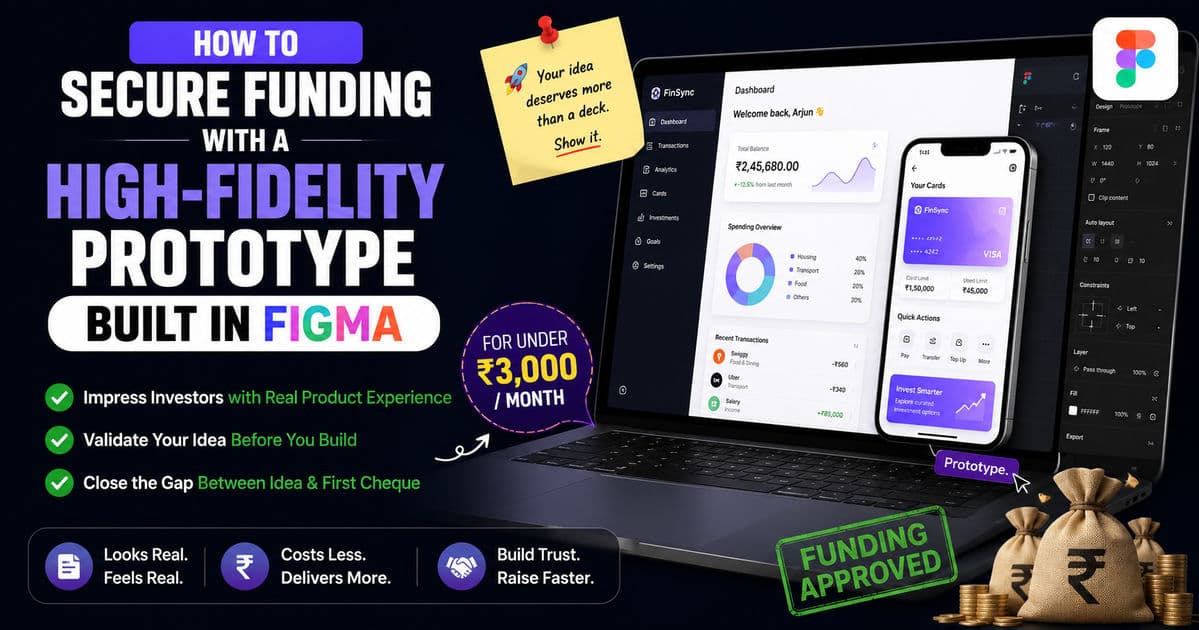
How to Secure Funding with a High-Fidelity Prototype Built in Figma
Indian investors funded fewer startups in 2026 than any year since 2022. Funding rounds dropped from over 480 to roughly 240 in just the first two months of the calendar year, even as total capital stayed relatively flat. The implication is brutal — investors are writing bigger cheques to fewer founders, and everyone else is getting ignored. If your pitch meeting consists of a slide deck and a verbal walkthrough, you are competing with one hand tied behind your back. A high-fidelity prototype built in Figma changes that equation entirely. It lets you show, not tell. And in a market where "just an idea" almost never lands a cheque anymore, showing is no longer optional.
Why the Pitch Deck Alone Is Dead for Indian Seed Rounds
Three years ago, a sharp 12-slide deck with a TAM chart and a founding team slide could open doors at angel networks in Bengaluru or Mumbai. That era is over. Indian seed-stage funding declined 15 percent year-over-year to approximately $1.3 billion in FY26, while early-stage funding (Series A and adjacent) surged 33 percent to $4.8 billion. What this means: investors are not running away from early-stage deals, they are just refusing to bet on fog. They want to see something tangible before writing even a ₹50 lakh cheque.
A static pitch deck cannot demonstrate user flow. It cannot show how your onboarding works, how a customer completes a transaction, or how your dashboard surfaces insights. Investors who receive 250-plus decks every quarter now openly prefer interactive demos over static slides. A clickable prototype built in Figma bridges that gap without forcing you to spend six months and ₹15-30 lakh on a coded MVP.
The Prototype Closes the Imagination Gap
When you walk an investor through a live Figma prototype, something psychological shifts. They stop evaluating your idea as a concept and start evaluating it as a product. They can tap through screens, see transitions, experience the user journey from signup to core value delivery. The perceived risk drops sharply because the investor is no longer imagining what the product might look like — they are experiencing it.
This works especially well for Indian B2B SaaS founders pitching to angel networks like Inflection Point Ventures, Venture Catalysts, or Rainmatter, where the decision-makers are often operators themselves. They want to feel the product, not just hear about it.
High-Fidelity Prototype vs. MVP — Know the Difference Before You Build
Founders consistently confuse these two, and the confusion costs time and money. A high-fidelity prototype is a polished, interactive design mockup — it looks and feels like a real product but has zero production code behind it. An MVP is a functional product that real users can interact with, generating real data on engagement, retention, and willingness to pay.
| Attribute | High-Fidelity Prototype | Minimum Viable Product |
|---|---|---|
| Purpose | Validate the vision, win investor trust | Validate the business model, prove demand |
| Tech Stack | Figma (no code) | Real code — Node.js, React, databases |
| Build Time | 2-4 weeks | 6-16 weeks |
| Cost (India) | ₹0-3,000/month (Figma plans) | ₹3-25 lakh (developer cost + infra) |
| What It Proves | "This is what we will build" | "People will pay for what we built" |
| Best For | Pre-seed, seed pitches | Series A readiness |
| User Data | None — it is a design artifact | Real analytics, retention, revenue signals |
The practical rule is straightforward: use a high-fidelity prototype to get into the room and win your seed round. Use an MVP to bridge from seed to Series A. Trying to build a coded MVP before you have seed capital is a common and expensive mistake for Indian founders, especially solo technical founders who burn three to six months building features nobody validated.
Why Figma Specifically — Not Sketch, Not Adobe XD, Not Canva
Figma is not just another design tool. It is the default prototyping platform across India's startup ecosystem, and for good reason.
Browser-Based, Zero Installation
Figma runs entirely in the browser. Your co-founder in Pune, your designer in Jaipur, and your investor in Mumbai can all open the same prototype link on any device — no downloads, no compatibility issues, no "can you install this app first" friction. For Indian founders pitching remotely (which is most pitches in 2026), this is a massive advantage.
The Free Tier Is Genuinely Usable
Figma's Starter plan costs nothing and includes up to three design files with unlimited collaborators. For a seed-stage founder building a single product prototype, three files is often enough to cover your core user flows, your pitch presentation, and a design exploration file. You can prototype an entire investor-ready product experience without spending a rupee.
When you need to scale, the Professional plan runs approximately ₹1,000-1,300 per editor per month (billed annually at $12/editor/month). A three-person founding team with one designer, one PM, and five engineer viewers can operate on Figma Professional for roughly ₹3,000/month total, because viewers and commenters are always free.
Interactive Prototyping Without Code
Figma lets you link screens with hover, tap, drag, and scroll interactions to create clickable prototypes that behave like real apps. You can add transitions, overlays, smart animate effects, and even conditional logic through component variants. An investor clicking through your prototype should not be able to tell, at a glance, that it is not a working product. That is the standard you are aiming for.
AI Features That Accelerate the Build
Figma's 2026 AI capabilities — including First Draft wireframe generation, AI-powered content writing for UX copy, and automated layer naming — can compress the prototype creation timeline from weeks to days. For resource-strapped Indian founders, this matters.
How to Build a Figma Prototype That Wins Investor Meetings
Building a high-fidelity prototype is not the same as designing a pretty interface. Investor-ready prototypes follow a specific structure that maps directly to what VCs and angels evaluate.
Start with Problem Framing, Not Screens
Before you open Figma, spend one to two days defining the exact user pain you are solving. Write a one-paragraph problem statement. Identify the user persona. Map the "before" state (how users solve this problem today) and the "after" state (how your product changes their life). This framing becomes the narrative spine of your prototype, and investors will test whether your prototype actually demonstrates the transformation you claim.
Map Three to Five Core User Flows
Do not try to prototype your entire product vision. Pick the three to five flows that demonstrate your core value proposition and build only those. For a fintech app, that might be: onboarding → KYC verification → first transaction → dashboard view. For an EdTech platform, it might be: course discovery → enrolment → lesson experience → progress tracking.
Each flow should be clickable end-to-end, with no dead-end screens. Every interaction should feel intentional. If an investor taps a button and nothing happens, you have lost credibility.
Design at Production Fidelity
This is where "high-fidelity" earns its name. Your prototype should use real brand colours, actual typography, realistic content (not "Lorem ipsum"), and properly sized assets. If you are building a B2B dashboard, populate it with realistic data — Indian company names, INR figures, plausible metrics. If it is a consumer app, use real Indian city names, real UPI references, realistic notification copy.
Investors notice the difference between a prototype that looks like a design exercise and one that looks like a product screenshot. Aim for the latter.
Add Micro-Interactions and Transitions
Smart Animate in Figma lets you create smooth transitions between states. Use it for loading indicators, button hover effects, card expansions, and navigation transitions. These small details signal that you have thought about the user experience at a level that most seed-stage founders have not. It is a credibility multiplier.
Build the Investor Walkthrough as a Separate Flow
Create a dedicated prototype flow specifically for investor demos. This flow should start with your problem statement screen, walk through the core user journey, highlight your differentiation at key moments, and end on a traction or roadmap screen. Think of it as a guided tour, not a free-exploration sandbox.
This investor-specific flow can include annotation overlays — small callout boxes that explain business logic, market size relevance, or technical architecture decisions at specific screens. Figma's component overlay feature handles this cleanly.
What Your Prototype Must Demonstrate to Investors
Indian angel investors and seed-stage VCs are evaluating five things when they see your prototype. Miss any of these, and the prototype works against you instead of for you.
Product-Market Fit Signal
Your prototype must make it obvious that you understand your user's problem deeply. The screens, copy, and flow should reflect real user language, real pain points, and a solution that feels inevitable rather than forced. If your prototype could serve any market by swapping the logo, it is not specific enough.
Design Maturity
Investors use your prototype's polish as a proxy for your team's execution capability. Sloppy alignment, inconsistent spacing, generic stock icons, and Lorem Ipsum text all signal that you are not ready to build a production product. In India's increasingly competitive seed market, where investor participation dropped 53 percent year-over-year in 2025, you cannot afford to look amateur.
Technical Feasibility
Your prototype should not promise features that are architecturally unrealistic for your stage. If you show a real-time AI recommendation engine in your prototype but your team is two people with no ML experience, sophisticated investors will see through it. Build your prototype around what your team can actually ship in the first six to twelve months.
Scalability Narrative
Include screens that hint at your platform's expansion potential — a settings page with integrations, a dashboard that could serve multiple user types, or an analytics view that suggests data network effects. These are visual cues that tell investors your thinking extends beyond the initial product.
Revenue Model Visibility
Show the money. If your product has a subscription model, include a pricing screen. If it is transaction-based, show the payment flow with Razorpay or UPI integration. Investors want to see that you have thought about monetisation, not just features.
Common Mistakes That Kill Investor Interest in Your Prototype
Prototyping Everything Instead of the Core Loop
Founders who try to show 40 screens covering every edge case end up with a prototype that feels like a product tour, not a product experience. Three to five flows, built deeply, beat 15 flows built shallowly.
Using Placeholder Content
"Lorem ipsum dolor sit amet" in an investor prototype is an instant credibility killer. Every headline, every data point, every notification should use realistic, India-relevant content. If your prototype shows a payment of "$99.00" instead of "₹4,999", you are signalling that you have not localised your thinking for the Indian market.
Ignoring Mobile Responsiveness
Over 70 percent of India's internet users access services on mobile. If your prototype only shows a desktop view and your product is consumer-facing, investors will question whether you understand your own user base. Build mobile-first prototype frames, and have the desktop version as a secondary flow.
No Clear Starting Point
When you share your Figma prototype link, the investor should land on a clear starting screen with an obvious entry point — not a cluttered Figma canvas with 50 frames visible. Use Figma's prototype presentation mode and set a specific starting frame.
The Cost Math for Indian Founders
Here is what a high-fidelity Figma prototype actually costs for a typical Indian seed-stage startup:
| Expense | Monthly Cost (INR) | Notes |
|---|---|---|
| Figma Starter Plan | ₹0 | 3 files, unlimited viewers |
| Figma Professional (1 editor) | ~₹1,000-1,300 | Unlimited files, component libraries |
| Freelance UI designer (India) | ₹15,000-40,000 | 2-4 week engagement |
| Stock illustrations/icons | ₹0-2,000 | Many free options (Heroicons, Unsplash) |
| User research (informal) | ₹0 | WhatsApp surveys, founder-led interviews |
| Total one-time prototype cost | ₹15,000-43,000 | Compare this to ₹3-25 lakh for an MVP |
For under ₹50,000, you can have an investor-ready prototype that communicates your product vision more effectively than a coded MVP that took three months and several lakhs to build. That is not a compromise — it is strategic capital allocation.
From Prototype to Funded — The Timeline
A focused team can deliver a high-fidelity, investor-ready prototype in two to four weeks. A structured design sprint can compress the core flows into five days. The typical seed-stage timeline looks like this: Week 1 for problem framing and user flow mapping. Week 2 for high-fidelity screen design in Figma. Week 3 for interaction design, transitions, and prototype linking. Week 4 for investor walkthrough flow, testing, and iteration based on feedback from two or three friendly advisors.
Once your prototype is ready, share the Figma link (set to view-only) alongside your pitch deck. Better yet, lead your investor meeting with the prototype walkthrough and use the deck as a supporting document, not the main event.
In a funding market where Indian startups raised $5.2 billion across 501 deals in H1 2026 — with seed-stage funding growing 18 percent year-over-year — the founders who secure capital are the ones who reduce investor risk at every touchpoint. A high-fidelity Figma prototype is the single most cost-effective way to do that before you write a line of production code.
Stop pitching ideas. Start demonstrating products.
Published by APXTECK — helping Indian startups and SMBs turn product ideas into funded, production-ready software. Talk to us →
Article Comments
You must be signed in to post comments.
Sign In to Join the Discussion →No comments approved yet. Be the first to share your thoughts!
About the Author

Praveen Kumar
Co-Founder & DirectorFull-Stack Developer, APXTECK, chatgpt, google
Praveen Kumar is the Co-Founder and Full-Stack Developer at APXTECK, an AI-powered IT agency helping Indian SMBs grow through web development, automation, and AI integration. He builds production-grade systems using Node.js, Next.js, PostgreSQL, and modern AI APIs. When he is not shipping code, he is writing about practical technology that actually works for Indian businesses.
Related Insights

UPI MDR Is Back — Ashneer Grover Is Half Right | APXTECK

Amodei Wants to Slow AI. Indian SMBs, Read This First | APXTECK

How Blinkit's Free Ambulance Became Its Best Marketing Move

GPT-6 Astra: OpenAI’s New AI Model Could Change Software Development and Business Work

AI-Powered Cyberattacks Are Rising: Why Every Business Needs Stronger Cybersecurity Now

How Next.js and Generative Search Help Builders Win Leads

Build Your Own Food Delivery App: Stop Giving Your Profits to Swiggy & Zomato