


Maximize Digital Marketing ROI With Custom Software

Praveen Kumar
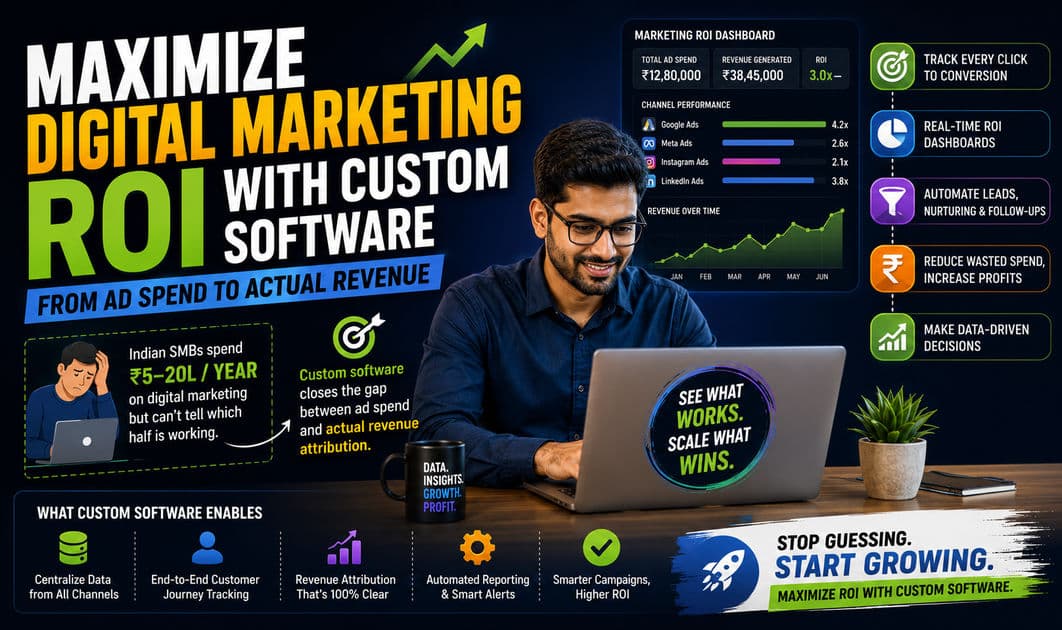
You're Not Bad at Marketing. You're Blind at Measurement.
Here's the conversation I have at least twice a month with Indian SMB founders. They're spending ₹50,000 to ₹2,00,000 per month on Google Ads, Meta campaigns, SEO content, and maybe some influencer collaborations. Revenue is growing — or at least not shrinking. But when I ask, "Which campaign generated the most profit last quarter?" the answer is always some version of a shrug.
Not because they don't care. Because they literally cannot answer the question.
Their Google Ads dashboard shows clicks and conversions. Their Meta dashboard shows reach and leads. Their CRM — if they have one — shows deals closed. But nothing connects the ₹12,000 they spent on a specific Google Ads campaign in March to the ₹2.4L worth of orders that came from leads who clicked that ad, enquired on WhatsApp, were followed up by the sales team, and converted over six weeks.
The gap between "marketing spend" and "revenue attributable to that spend" is where Indian SMBs are haemorrhaging money. And that gap doesn't exist because of bad marketing. It exists because of disconnected technology — and no off-the-shelf marketing tool is designed to close it for the way Indian SMBs actually sell.
Custom software is how you close that gap. Not with another SaaS subscription. With a system built around your specific sales process, your specific channels, and your specific definition of ROI.
Why the Standard Marketing Tech Stack Fails Indian SMBs
The marketing technology industry has a dirty secret: most tools are built for a sales process that Indian SMBs don't follow.
The standard SaaS marketing stack — Google Analytics, a CRM like HubSpot, an email platform like Mailchimp, maybe a social scheduling tool — assumes a linear, primarily digital customer journey. Visitor lands on website, fills a form, enters a nurture sequence, gets scored, gets handed to sales, closes online. Clean. Trackable. Beautiful on paper.
Indian SMBs don't sell like this.
The Real Indian SMB Sales Process
A typical Indian SMB customer journey looks more like this: a potential buyer sees a Google Ad. They don't click the CTA — they screenshot the phone number and call directly. Or they find the business through Google but enquire via WhatsApp because that's what feels natural. The sales conversation happens over WhatsApp messages and phone calls over two weeks. The order is finalized verbally. Payment happens via UPI or bank transfer. The "conversion" never touches the digital tracking layer.
From Google Analytics' perspective, that ad click was a bounce. From Meta's perspective, the impression generated no measurable action. From HubSpot's perspective, this customer doesn't exist. But from the business's perspective, that customer just placed a ₹1.5L order.
Now multiply this pattern across 70–80% of your customers — which is the reality for most Indian SMBs selling high-value products or services — and you understand why your marketing dashboards and your revenue numbers tell completely different stories.
The Multi-Tool Data Fragmentation Problem
Even when leads do follow a trackable digital path, most Indian SMBs run their marketing through four to seven disconnected tools. Google Ads has its data. Meta Ads Manager has its data. WhatsApp Business has its data. The CRM — if it exists — has partial data. The billing system has revenue data. Google Sheets has whatever someone manually compiled last Friday.
No single tool sees the full picture. And the "integrations" that connect these tools are shallow — they pass basic data like name and email between systems, but they don't carry the contextual information that actually matters for attribution. Which ad did this person see? Which keyword triggered their search? How many WhatsApp messages did the sales rep send before closing? What was the time from first touch to final payment?
That contextual thread is where ROI lives. And it breaks the moment your data crosses from one SaaS tool to another.
What Custom Software Actually Solves in the Marketing-to-Revenue Pipeline
Custom software for marketing ROI isn't about replacing Google Ads or building your own analytics platform. That would be absurd. It's about building the connective layer that sits between your marketing channels, your sales process, and your revenue data — the layer that no off-the-shelf tool provides because no off-the-shelf tool knows how your specific business converts customers.
Solving Attribution: From Ad Click to Revenue, in One System
The single most valuable thing custom software does for marketing ROI is close the attribution loop.
Here's what a custom attribution system looks like for an Indian SMB. Every marketing channel — Google Ads, Meta, organic search, referral links, WhatsApp click-to-chat — generates leads that land in one unified pipeline. Each lead carries a source tag that tracks exactly where they originated. As the lead moves through your sales process — first WhatsApp response, follow-up call, quotation sent, order confirmed, payment received — every stage is timestamped and attributed back to the original source.
When the CEO asks, "What's our best-performing channel this quarter?" the answer isn't based on clicks or impressions. It's based on actual revenue collected, broken down by the channel that started the conversation.
This is trivially easy to build with a Node.js backend, PostgreSQL database, and webhook integrations with your ad platforms. It's nearly impossible to achieve by stitching together five different SaaS tools with Zapier.
Solving the WhatsApp Black Hole
For Indian SMBs, WhatsApp is the most important sales channel and the most poorly tracked one. Conversations happen in a black hole — unless someone manually logs them in a spreadsheet, there's no record of which leads are being followed up, how many messages it takes to convert, or which sales rep is most effective.
A custom system integrating with the WhatsApp Cloud API changes this completely. Every incoming WhatsApp message from a tracked source automatically creates or updates a lead record. Response times are logged. Conversation outcomes are tagged. When a WhatsApp lead converts into a paying customer, the system traces it back to the specific campaign, ad set, or keyword that generated the enquiry.
The result: WhatsApp stops being an unmeasured channel and starts being your highest-ROI conversion engine — because you can finally see the numbers that prove it.
Solving Lead Response Speed
Marketing ROI isn't just about which channels bring leads. It's about how fast you act on them.
Data across industries consistently shows that leads contacted within five minutes of enquiring are dramatically more likely to convert than leads contacted an hour later. In the Indian SMB context, where WhatsApp and phone calls are the primary response channels, the difference between a 2-minute response and a 30-minute response can be the difference between winning and losing the deal to a competitor who replied faster.
Custom software enables instant, automated first responses. A lead fills out a form or sends a WhatsApp message, and within seconds they receive a contextual acknowledgment — not a generic "Thanks for reaching out" but a message that references what they enquired about, confirms availability or pricing if applicable, and tells them exactly when a human will follow up. Simultaneously, the assigned sales rep gets an alert with the lead's full context: source, product interest, location, and any previous interactions.
No SaaS CRM does this out of the box for WhatsApp-first sales processes. Custom software does it by design.
The Custom Marketing Tech Stack: What to Build and What to Buy
Not everything needs to be custom-built. The smart approach is buying where commoditized tools excel and building where your business needs something specific.
| Function | Buy (SaaS) | Build (Custom) | Why |
|---|---|---|---|
| Ad management | Google Ads, Meta Ads Manager | — | These platforms are irreplaceable for ad buying |
| Website analytics | Google Analytics 4, Clarity | — | Free, mature, and sufficient for traffic analysis |
| Landing pages | — | Custom Next.js pages | Full control over tracking pixels, UTM handling, and conversion events |
| Lead capture and routing | — | Custom webhook + pipeline system | Standard CRMs can't handle WhatsApp-first, phone-first Indian sales flows |
| Attribution tracking | — | Custom attribution engine | No off-the-shelf tool tracks the full Indian SMB journey from ad to UPI payment |
| Email campaigns | Resend, Postmark, or Amazon SES | Custom trigger logic | Use commodity email delivery but custom rules for when and what to send |
| WhatsApp automation | — | Custom WhatsApp Cloud API integration | Template messages, auto-responses, conversation logging, and attribution tagging |
| Reporting and ROI dashboard | — | Custom dashboard | Pulls data from every source into one view showing actual revenue per channel |
| Social scheduling | Buffer or native platform tools | — | Commodity function; no ROI benefit from building custom |
The custom pieces — lead capture, attribution, WhatsApp integration, and the reporting dashboard — are the high-leverage investments. They're what transform marketing from a cost centre that reports vanity metrics into a revenue engine that reports profit per channel.
Building the Attribution Engine: How It Works in Practice
Let me walk through the mechanics, because this is where the ROI lives.
Step 1: Unified Source Tagging
Every marketing touchpoint gets a unique identifier. Google Ads campaigns pass UTM parameters to your landing pages. Meta campaigns do the same. WhatsApp click-to-chat links embed a source tag in the pre-filled message. QR codes on offline materials — business cards, packaging, event banners — carry unique URL parameters that identify the specific material.
When any of these leads hit your custom system — via form submission, WhatsApp message, or phone call through a tracked number — the source tag is captured and permanently attached to that lead record.
Step 2: Full-Funnel Event Tracking
As the lead progresses, every meaningful event is logged against their record: first response sent (with timestamp), quotation shared, follow-up calls made, objections raised, order confirmed, invoice generated, payment received. Each event is timestamped, and the system calculates the time between each stage.
This isn't manual data entry. The system captures events from your existing tools via webhooks and API integrations. When a Razorpay payment succeeds, a webhook fires and the system automatically marks the lead as "converted" and records the revenue amount. When a WhatsApp message is sent through the API, the system logs it as a touchpoint.
Step 3: Revenue Attribution Reporting
Now the CEO's dashboard shows something genuinely useful:
| Channel | Leads Generated | Leads Converted | Revenue | Ad Spend | Actual ROI |
|---|---|---|---|---|---|
| Google Ads — Brand keywords | 85 | 22 | ₹6.8L | ₹45,000 | 15.1x |
| Google Ads — Generic keywords | 210 | 18 | ₹4.2L | ₹1,20,000 | 3.5x |
| Meta — Retargeting | 45 | 12 | ₹3.1L | ₹28,000 | 11.1x |
| Meta — Cold audience | 320 | 9 | ₹1.8L | ₹95,000 | 1.9x |
| Organic + SEO | 150 | 30 | ₹8.5L | ₹35,000 (content) | 24.3x |
| WhatsApp referrals | 60 | 25 | ₹7.2L | ₹0 | ∞ |
Now the marketing decisions become obvious. The ₹95,000/month on cold Meta audiences is barely breaking even — scale it down or restructure the targeting. Brand keywords are printing money — increase the budget. Organic SEO has the highest ROI — invest more in content. WhatsApp referrals are pure profit — build a referral program.
Without custom attribution, all six channels looked roughly the same in their respective dashboards. With it, the allocation decisions become crystal clear — and every reallocation directly improves overall ROI.
Automating the Marketing Feedback Loop
Attribution tells you what happened. Automation ensures the right things happen faster.
Automated Lead Scoring Based on Real Behaviour
Instead of scoring leads by guesswork or generic rules, a custom system scores based on actions that actually predict conversion in your business. A lead who opened the quotation PDF twice, responded to a WhatsApp follow-up within an hour, and visited the pricing page three times gets a higher score than a lead who filled a form and went silent.
The scoring model is built on your historical data — your conversion patterns, not a SaaS vendor's generic model. Over time, as more data accumulates, the system gets better at predicting which leads deserve immediate attention and which can wait.
Budget Alerts and Auto-Pause Rules
Custom software can monitor your ad spend against performance thresholds in real-time. If a campaign's cost-per-qualified-lead crosses a threshold you define — say, ₹1,200 per lead when your profitable ceiling is ₹800 — the system alerts you immediately and can auto-pause the campaign via the Google Ads API until you review and adjust.
Most SMBs discover budget waste days or weeks after it happens, during the monthly review. Real-time monitoring catches it in hours, preventing the slow bleed that turns a ₹80,000/month ad budget into ₹1,20,000 of spend with ₹40,000 of waste.
Personalised Re-engagement at Scale
When a lead goes cold — no response in seven days — the system doesn't wait for the sales rep to remember. It triggers a contextual re-engagement message via WhatsApp or email, referencing the specific product or service the lead enquired about, with updated pricing or a relevant case study. If the lead re-engages, the sales rep is notified instantly with the full conversation history.
This single automation recovers 10–15% of leads that would otherwise die silently — leads that already cost money to acquire and are being wasted through manual follow-up inconsistency.
The ROI of Building the ROI System
Here's the cost-benefit analysis that matters:
| Investment | Cost |
|---|---|
| Custom attribution + lead pipeline system | ₹3L – ₹6L (one-time development) |
| WhatsApp Cloud API integration | ₹50K – ₹1.5L (one-time) |
| Custom reporting dashboard | ₹1L – ₹2L (one-time) |
| Monthly hosting + API costs | ₹5,000 – ₹12,000/month |
| Total Year 1 | ₹5L – ₹11L |
Now the returns:
| Benefit | Conservative Annual Impact |
|---|---|
| Marketing spend reallocation (cutting waste, doubling down on winners) | 20–30% improvement in overall ROI → ₹2L – ₹6L saved or redirected |
| Faster lead response improving conversion rate | 10–15% lift in close rate → ₹3L – ₹8L additional revenue |
| Automated re-engagement recovering dead leads | 10–15% lead recovery → ₹1.5L – ₹4L additional revenue |
| Time saved on manual reporting and data compilation | 8–12 hours/month → ₹50K – ₹1L annually in productive time reclaimed |
| Total Year 1 Impact | ₹7L – ₹19L |
Payback period: three to eight months, depending on current marketing spend and sales volume. For an SMB spending ₹1L+/month on digital marketing, this system pays for itself before the end of the first year and then keeps compounding — because every insight it generates makes the next month's spend more efficient than the last.
The Sequence: Build This in the Right Order
Don't build everything at once. The correct sequence prioritises the components that generate measurable ROI fastest.
Month 1: Build the lead capture and source tagging system. Every lead from every channel flows into one pipeline with attribution data attached. This immediately gives you visibility you've never had — even before any automation is in place.
Month 2: Integrate WhatsApp Cloud API for automated first responses and conversation logging. This closes the WhatsApp black hole and improves lead response times from hours to seconds.
Month 3: Build the attribution dashboard connecting ad spend to actual revenue. This is the moment your marketing decisions shift from intuition-based to data-based.
Month 4: Add lead scoring, budget alerts, and automated re-engagement workflows. These compound the ROI by improving conversion rates and reducing waste on autopilot.
Each phase delivers standalone value. If you stop after month two, you still have a significantly better marketing operation than you started with. But the full system — built over four months — transforms marketing from your biggest question mark into your most measurable, optimizable growth lever.
Stop Guessing. Start Measuring What Matters.
Indian SMBs don't have a marketing problem. They have a measurement problem wrapped in a technology gap disguised as a marketing problem.
The ₹10L you're spending annually on digital marketing might be generating ₹50L in revenue — or it might be generating ₹15L while the rest leaks through channels you can't track, leads you respond to too slowly, and follow-ups that nobody remembers to send. You don't know. And as long as you don't know, every rupee of ad spend is partially a gamble.
Custom software eliminates the gamble. It connects every marketing rupee to a trackable customer journey, automates the actions that convert leads faster, and gives you a dashboard that shows real profit per channel — not clicks, not impressions, not vanity metrics.
Build the connective layer your marketing stack is missing. Measure what your SaaS tools can't. And make every campaign decision based on revenue data, not dashboard theatre.
Published by APXTECK — we build custom marketing attribution and automation systems for Indian SMBs who are done guessing where their ad budget goes. Get your marketing stack audited → apxteck.com/contact
Article Comments
You must be signed in to post comments.
Sign In to Join the Discussion →No comments approved yet. Be the first to share your thoughts!
About the Author

Praveen Kumar
Co-Founder & DirectorFull-Stack Developer, APXTECK, chatgpt, google
Praveen Kumar is the Co-Founder and Full-Stack Developer at APXTECK, an AI-powered IT agency helping Indian SMBs grow through web development, automation, and AI integration. He builds production-grade systems using Node.js, Next.js, PostgreSQL, and modern AI APIs. When he is not shipping code, he is writing about practical technology that actually works for Indian businesses.
Related Insights

How Micro-Animations in Custom Designs Turn Visitors into Buyers

Secret Psychology Behind High-Converting Coaching Interfaces

How Node.js Development Empowers SMBs in Maharashtra

The SMB Guide to Scaling Down Enterprise Tech on a Budget

How Business Automation Saves 20+ Hours of Manual Work Weekly

Why Traditional SEO Is Dead: Preparing for Generative Search

Next.js ISR: The Real Weapon for Better Search Rankings